
Based on empirical findings from a qualitative-reconstructive study, this article examines the professional self-conception of instrumental teachers who also identify with the field of music mediation. It analyses how music mediation practices influence professional self-perception, pedagogical orientation, and institutional action. Starting from the observation of increasing institutional ‘schoolification’ of music schools, music mediation is understood as a source of impulses for reflection, creativity, and participatory teaching practices.
The research design is based on group discussions, which were analysed using the documentary method. The focus lies on reconstructing collective orientations that provide insights into implicit professional knowledge and the processes of professional transformation. The analysis reveals that music mediation is often perceived as a counterbalance to institutional constraints: it opens up spaces for artistic freedom and supports (re-)alignment with key pedagogical principles such as aesthetic experience, participation, and self-determination.
Based on the reconstructed orientations, a typology of professional self-conception was developed, highlighting different ways of understanding musical experience and pedagogical objectives. Two interrelated perspectives emerge: one with a stronger artistic-aesthetic orientation, the other emphasizing social and participatory aspects. Both share a focus on musical experience as a central professional value, which is pedagogically operationalised in different ways.
The findings indicate that music mediation not only stimulates individual reflection, but also contributes to institutional development. It offers perspectives for balancing artistic autonomy, social responsibility, and institutional openness.
Cet article présente les résultats d’une enquête qualitative sur la perception professionnelle d’enseignant.es en musique pratiquant également la médiation de la musique.
L’étude empirique, menée dans le cadre d’une thèse de doctorat, est basée sur l’analyse d’entretiens de groups réalisés avec 16 enseigant.es en musique autrichien.nes et allemand.es. Dans cette recherche il s’agit d’analyser l’influence de la pratique de la médiation de la musique sur les méthodes pédagogiques des enseignant.es (attitudes et actions).
Les résultats montrent que les conditions structurelles dans les écoles de musique – telles que la scolarisation des savoirs et la course à la performance – s’opposent souvent aux valeurs éducationnelles fondamentales portées par les enseignant.es. La médiation de la musique agit alors comme un catalyseur et permet à ces enseignant.es de se (re)
centrer sur leurs objectifs, tels que l’accès à l’expérience sensible, la participation et la construction d’une relation par la pratique musicale. La recherche identifie deux types: l’un envisage l’expérience musicale pour sa valeur intrinsèque – et l’autre la considère comme un levier de participation – comme un droit pour tous. L’article se conclut par une réflexion sur l’Artistic citizenship comme un concept sous-jacent à la refondation des institutions et s’interroge sur les façons dont la médiation de la musique peut inspirer les développements institutionnels afin de positionner les écoles de musique comme des espaces culturels ou la réflexivité et l’inclusion s’exercent.
Der Beitrag untersucht auf Grundlage empirischer Befunde einer qualitativ-rekonstruktiven Studie das professionelle Selbstverständnis von Instrumentalpädagog_innen, die sich zugleich in der Musikvermittlung verorten. Analysiert wird, inwiefern musikvermittelnde Praxis berufliche Selbstwahrnehmung, pädagogische Orientierung und institutionelle Handlungspraxis beeinflusst. Ausgehend von der Beobachtung einer zunehmenden institutionellen ,Verschulung‘ von Musikschulen wird Musikvermittlung als Impulsgeberin für Reflexion, Kreativität und partizipative Unterrichtsformen betrachtet.
Das Forschungsdesign basiert auf Gruppendiskussionen, die mittels dokumentarischer Methode ausgewertet wurden. Im Mittelpunkt steht die Rekonstruktion kollektiver Orientierungen, die Einblick in implizites Professionswissen und Prozesse beruflicher Transformation geben. Die Analyse zeigt, dass Musikvermittlung häufig als Gegenpol zu institutionellen Restriktionen wahrgenommen wird: Sie ermöglicht Erfahrungsräume künstlerischer Freiheit und unterstützt die (Wieder-)Ausrichtung auf zentrale pädagogische Leitideen wie ästhetische Erfahrung, Teilhabe und Selbstbestimmung.
Auf Basis der rekonstruierten Orientierungen wurde eine Typologie professioneller Selbstverständnisse entwickelt, die unterschiedliche Auffassungen von musikalischer Erfahrung und pädagogischer Zielsetzung sichtbar macht. Dabei treten zwei miteinander verbundene Bezugsperspektiven hervor: eine stärker künstlerisch-ästhetisch ausgerichtete und eine sozial-partizipativ geprägte. Gemeinsam ist beiden die Orientierung an der musikalischen Erfahrung als zentralem professionellen Wert, die jedoch in jeweils unterschiedlicher Weise pädagogisch konkretisiert wird.
Die Ergebnisse verdeutlichen, dass musikvermittelnde Praxis nicht nur individuelle Reflexionsprozesse anregt, sondern auch institutionelle Entwicklungsimpulse setzt. Sie eröffnet Perspektiven für eine Balance zwischen künstlerischer Autonomie, sozialer Verantwortung und institutioneller Offenheit.
music mediation, instrumental pedagogy, professional self-understanding, artistic citizenship, institutional transformation
This article draws on selected empirical findings from my doctoral research, which investigated the role of music mediation in instrumental pedagogy and its impact on teachers’ professional self-understanding, pedagogical orientation, and institutional practice. While the data originate from the broader context of my dissertation, this article focuses on aspects particularly relevant to teachers’ professional perspectives, instructional approaches and institutional interactions, providing a concise and targeted overview.
It first summarises the practical and conceptual observations that motivated the research, followed by an overview of the methodological approach. Central empirical insights are then synthesised, illustrating how engagement with music mediation encourages reflective and participatory approaches to teaching, shapes professional orientation, and interacts with institutional structures.
The article further highlights a reconstructed typology of professional orientation, discusses the implications of Artistic Citizenship for pedagogical practice, and explores how engagement with music mediation can catalyse institutional reflection and transformation. By emphasizing the intersections between instrumental pedagogy and music mediation, it contributes to the professional discourse on expanding pedagogical horizons within music schools.
Although the study primarily focuses on Austrian music schools, a smaller number of participants from Germany provide comparative insights, showing that, despite minor differences in employment conditions, shared orientation and experiences emerge.
Against this backdrop, the article explores key questions arising from my doctoral research: in what ways engagement with music mediation shapes instrumental teachers’ professional self-understanding, guides their pedagogical orientation and decisions in daily practice, and explains the increasing interest in music mediation within the profession.
Within the context of my own instrument teaching practice, I first engaged intensively with music mediation. Over time, I developed and implemented music mediation projects at music schools, broadening access to classical music and fostering interdisciplinary collaboration. I observed that ensemble-based projects and participatory initiatives not only encouraged collaboration but also promoted students’ active and immersive involvement (McGregor 2024a, 250-52). These experiences revealed recurring patterns of student engagement, teacher agency, and interactions with institutional contexts, providing empirical grounding for understanding how music mediation influences professional perspectives and pedagogical approaches.
Building on these initial practical experiences, I was motivated to deepen my understanding through formal study. Enrolling in the programme Musikvermittlung - Musik im Kontext at the Anton Bruckner Private University Linz (ABPU) offered a structured framework for reflection, enabling me to analyse and contextualise my pedagogical observations and systematically explore innovative approaches.
Beyond these personal experiences, broader developments also point to the growing significance of music mediation. Over the past decade, it has become increasingly visible not only in the professional concert and orchestra sector but also across educational and institutional contexts, gradually establishing itself as a relevant component of instrumental and music pedagogical discourse and practice. This development is reflected in a few illustrative examples of institutional and educational initiatives that highlight the growing relevance of music mediation within the broader context of instrumental pedagogical practice:1
Since its establishment in 2009, the programme Musikvermittlung - Musik im Kontext at the ABPU has attracted strong interest among instrument teachers, with roughly half of its students coming from this professional background.
Content related to music mediation has become more firmly embedded in university curricula for instrumental pedagogy, both as mandatory components and as elective modules.2
Professional development programmes offered by music schools and associations now include seminars on creativity enhancement, concert design, community music, and concert moderation.
Competition formats, such as the Ensemble kreativ category introduced in the prima la musica youth music competition in 2021, further promote artistic initiative and interdisciplinary collaboration (Musik der Jugend 2023, 14).
It is also increasingly evident that instrument teachers today operate in a wide range of artistic and educational contexts, and the growing permeability between these professional domains – within which music mediation is establishing itself as a distinct field – encourages a broader, more differentiated professional self-understanding.3
These practical observations, together with broader institutional developments, provide the empirical and conceptual basis for the research approach presented in the following section, which focuses on reconstructing professional self-understanding and pedagogical orientations.
This study focused on instrument teachers who identify with both instrumental pedagogy and music mediation. The aim was to examine their professional self-understanding and the extent to which engagement with music mediation informs their pedagogical practice, underlying attitudes, and perceptions of the music school’s role. At the same time, the study acknowledges that the relationship between instrumental pedagogy and music mediation is not unidirectional. Music mediation can also be understood as an integral dimension of instrument teaching itself, particularly where artistic, creative, and participatory processes form part of pedagogical practice.
Additionally, the study sought to identify factors contributing to the increasing interest in music mediation among instrumental teachers. Given the institutional and cultural contexts of the research, the focus lay primarily on practices related to the field of Western classical music. This focus does not imply exclusivity but reflects the environment in which the participating teachers primarily operate.
To address these aims and research questions regarding the professional self-understanding of instrumental teachers and the role of music mediation in their pedagogical practice, the first part of the dissertation explored the significance of music mediation and examined whether overarching goals could be identified across its diverse practices. To this end, a range of mediation settings was analysed, revealing common concerns and intentions (McGregor 2024b, 34-47). The selection of these settings was guided by the “reference spaces” defined by Constanze Wimmer, which include music mediation practices “in the cultural sector”, “in and with educational institutions,” and “in and with social institutions” (Wimmer 2023, 211).
To concretely examine these reference spaces, five examples of music mediation projects were selected – each representing a distinct field of practice. The examples were chosen to illustrate the diversity of mediation contexts, while maintaining methodological coherence with the study’s conceptual framework. Although numerous other initiatives could have been included, focusing on five representative cases ensured analytical depth and contextual clarity.
2 x hören [Listen Twice], developed by the Körber Foundation in Hamburg, is a music mediation format centered around a chamber music work. Through a moderated dialogue between musicians and a music mediator – focusing on the work’s context, stylistic features, and personal interpretative approaches – audiences engage in a reflective listening process that culminates in a second performance.4
WAGner DICH!, a participatory initiative by the Austrian radio station Ö1 in 2013, encouraged listeners to reinterpret the famous Ride of the Valkyries by Richard Wagner without any stylistic constraints. The roughly seventy submissions -– from jazz to children's radio plays -– highlight the potential of creative engagement and playful experimentation as forms of music mediation.5
As part of a multi-week music mediation project, students from a Viennese secondary school collaboratively developed their own artistic response to Richard Strauss’s Don Quixote, despite having no prior experience with classical music. With guidance from mediators and members of the Vienna Symphony Orchestra, they reimagined the narrative as a computer game, created original music and staging, and presented a final performance -– illustrating a cross-institutional and participatory response project.6
The Hörminute [Listening Minute] is an innovative digital tool for music mediation in primary education, developed to promote conscious and communal listening among young pupils. Created by mica austria in cooperation with the Platform for Music Mediation Austria (PMÖ), it offers short listening experiences embedded in ritualised and atmospheric classroom settings, aiming to stimulate reflection, imagination, and cross-curricular creativity through collective auditory engagement.7
As part of a music mediation project connected to the youth opera Tschick by Ludger Vollmer, based on the novel by Wolfgang Herrndorf, students and lecturers from the University of Music and Performing Arts Vienna collaborated with juvenile inmates of the Gerasdorf prison. In a series of workshops, participants engaged with the opera’s themes, explored the concept of heroism, and developed their own artistic responses, culminating in a final performance within the correctional facility.8
From these examples, a set of target dimensions – referred to here as topoi of music mediation (McGregor 2024b, 48-103) – was derived and subsequently compared with major themes in the instrumental pedagogy discourse of the past two decades in German-speaking contexts (e.g. Doerne 2010; Lessing 2016; Mahlert 2016; Röbke 2016, 2018; Dartsch 2019). This comparison revealed substantial thematic overlaps: both fields aim to enable aesthetic experiences, foster meaningful musical engagement, and promote broad participation in music.
Precisely because of these shared aims, the growing interest of instrument teachers in music mediation raises important questions. If the goals are largely congruent, what motivates professionals to seek out this newer field? Is it merely a matter of creative input or new concert formats, or does something more fundamental drive their engagement?
To explore the motivation behind these observed overlaps, the following section introduces a conceptual framework that integrates theoretical perspectives on pedagogy with the practical dimensions of professional action, linking empirical observations with broader reflections on instrument teaching and music mediation.
Building on the theoretical analysis of instrumental pedagogy and music mediation, the study draws on Neuweg’s concept of teacher knowledge as a heuristic framework for linking formal academic knowledge with practical, practice-based expertise (Neuweg 2014). Neuweg distinguishes three forms of knowledge:
Knowledge 1: codified, systematic professional knowledge acquired through formal training,
Knowledge 2: subjective mental structures shaped by individual learning experiences, and
Knowledge 3: practical know-how manifested in everyday professional action.
Transformations within professional practice occur particularly at the intersections of these levels, where formal knowledge, individual understanding, and situated action interact.
This dynamic captures what Neuweg describes as the “theory-practice problem” (Neuweg 2014, 586), illustrating the ongoing negotiation between codified expertise and experiential understanding within professional contexts.
In the present study, Neuweg’s framework functions as a conceptual bridge between theoretical reflection and empirical reconstruction, directing the analytical focus toward the teachers’ knowledge 3, which is embedded in situated practice and can be accessed through empirical analysis. Attention to this level allows for the reconstruction of implicit, practice-based knowledge and the identification of how engagement with music mediation shapes both pedagogical practice and professional self-understanding.
Building on this framework, the empirical part of the study examines how everyday professional knowledge shapes pedagogical action and professional self-understanding, particularly in the context of music mediation.
The study was conducted within the practical field in order to reconstruct practitioners’ implicit knowledge, with the aim of illuminating practice-based professional self-understanding and identifying factors that explain the observed engagement with music mediation.
The second part of the dissertation focused on instrumental teachers who position themselves within both fields. Everyday professional knowledge, understood as a reflection of professional self-understanding, was expected to provide insight into how engagement with music mediation shapes pedagogical practice and informs professional orientations.
Drawing on Andreas Doerne’s perspective, pedagogical self-understanding is anchored in overarching educational aims, which occupy the highest position in the hierarchy of goals and fundamentally guide professional action. It encompasses “the answer to the fundamental question concerning the meaning of one’s own actions” and constitutes “the center of gravity of pedagogical endeavour” (Doerne 2010, 115). Professional self-understanding thus forms the foundation of pedagogical practice and the attitudes that underpin it.
These conceptual considerations informed the empirical design and guided the formulation of the following research questions:
What collective orientations for action can be reconstructed?
What underlying attitudes can be identified, and what factors shape them?
Which factors influence instrumental teachers’ engagement with music mediation?
To operationalise professional self-understanding, the study drew on the concept of teacher beliefs from educational science. Teacher beliefs were defined as teachers’ ideas and assumptions about school- and teaching-related phenomena, with an evaluative component (Kunter & Pohlmann 2015, 267). The analysis differentiated between four reference systems: self, teaching/learning context, education system, and society, allowing for structured exploration of professional identity, pedagogical concepts, institutional conditions, and cultural or societal values.
A sample of 16 instrumental teachers from Austria and Germany, aged 26-62, was selected through theoretical sampling. Participants had a background in instrumental pedagogy and either formal qualifications in music mediation or substantial practical experience. All were employed in music schools, with variation in institutional size, location, and instrument specializations to reflect the diversity of current practice.
As the study focused on collective orientation rather than individual beliefs, a qualitative design based on group discussions was employed (Loos & Schäffer 2001). This approach enabled the reconstruction of shared logics of action within the professional group. The data was analysed using the documentary method (Przyborski 2004; Przyborski & Wohlrab-Sahr 2014).
What emerged in the group discussions was particularly revealing. Interestingly, depth and intensity did not primarily arise when participants spoke about specific music mediation projects in music schools, but rather in connection with recurring broader themes:
The participants’ perception of increasing ‘schoolification’, a term used here to denote the growing formalization and institutional framing of music schools, including performance pressure (e.g. handling of examinations in the Austrian context), more formalised institutional structures, and a stronger orientation toward prescribed guidelines.
The perceived relevance of music mediation: These passages repeatedly highlighted how engagement with music mediation resonates with their professional practice and sense of purpose.
To illustrate these aspects, two brief excerpts have been selected that capture in a particularly succinct way what was shared by the participants. Analysis of these excerpts shows how two interconnected themes emerged in the group discussions, which in turn contributed to identifying the tertium comparationis – a cross-case framework for reconstructing homologous structures of meaning.
The first excerpt reads:
“We all know what the development has meant: more and more school, more and more reports, more and more exams, more and more pressure.”9
In this passage, a clear collective reference is established: the opening phrase “We all know” signals a shared experience and conveys a sense of general, supra-individual certainty. This linguistic choice constructs an implicit community, reinforced by the term “all”. The speaker thus expresses not an individual interpretation but rather a collectively assumed understanding.
The development of the institutional context is presented as a cumulative escalation: “more and more school, more and more reports, more and more exams, more and more pressure”. The repeated structure signals an ongoing, almost inevitable dynamic. The phrase “more and more” rhythmically emphasises this escalation, implicitly framing schooling as increasingly dominated by formal, quantitative requirements.
Implicitly, the passage documents a collective orientation in which school is not seen as a space for content or pedagogical development, but as an institutional setting defined by selection and performance metrics. This experiential logic foregrounds a linear, unidirectional perception of educational change, leaving little room for alternative perspectives. The phrase “We all know” further suggests that such interpretations are taken for granted within the group, indicating a collectively shared everyday understanding of school.
The second excerpt illustrates the other recurrent theme:
“This [music mediation] gave me a sense of the diversity, the possibility of diversity, in music school again. It brought back a bit of freedom, freedom in action.”
Here, the speaker frames music mediation as a means of restoring or regaining something previously diminished. The phrase “gave me… back” implies a prior deficit, while the term “diversity” metaphorically signals multiplicity, liveliness, and openness. This orientation envisions music school as ideally a space of variety and creativity – a collectively held ideal reflected in the individual utterance.
The addition of “freedom in action” further specifies the notion of agency: the speaker refers not to abstract freedom but to the practical leeway in professional pedagogical practice. This implicit action logic constructs a framework in which institutionalised educational contexts inherently limit opportunities, whereas music mediation functions as a counterbalance, enabling the recovery of diversity and practical freedom.
From these excerpts, several hypotheses about the collective orientation of the participants can be drawn:
There is a shared orientation toward understanding music school as a diverse, freedom-supporting space, not solely governed by standardised procedures and expectations.
The passages reveal an underlying tension: institutionalisation tends to constrain action, while music mediation provides opportunities to reclaim diversity and freedom in professional practice.
These utterances reflect not merely individual experiences but a collectively shared orientation among educators, oscillating between standardisation and creative agency.
While there was a slight difference between the employment conditions of participants from Austria and Germany, the findings indicate a fundamentally shared perception of institutional constraints, with music mediation emerging as a key resource for navigating these constraints in professional practice.
The analysis of the empirical material revealed that two themes were closely interconnected: the participants’ critique of institutional structures and their perception of the relevance of music mediation. This interconnection provided the basis for reconstructing an analogy of processes that served as a comparative reference framework within and across cases, through which homologous meaning structures became discernible.
Across all group discussions, a pronounced desire for change emerged, often triggered by a perceived stagnation of pedagogical practice under restrictive institutional conditions. The encounter with music mediation acted as a stimulus and affective impulse, redirecting attention toward core aims of instrumental pedagogy, such as musical experience, participation, and educational aspiration. At the same time, it encouraged critical reflection on one’s own professional practice, as well as on the broader institutional and societal responsibilities of music schools.
Building on these reconstructed meaning structures and their interconnection, the next analytical step focused on identifying systematic patterns across all group discussions. These patterns revealed comparable sequences of perception, affective response, and volitional action, thus providing the theoretical foundation for developing a typology.
The following section synthesises these reconstructed dynamics into a theoretical model, enabling the identification of homologous orientations and processes of professional transformation.
The analytical synthesis of the reconstructed structures of meaning revealed recurring processual patterns that connected the critique of the growing schoolification of music schools with the value attributed to the approaches of music mediation. These cross-case regularities indicated a coherent interpretative framework that served as a tertium comparationis for typological reconstruction. On this basis, a theoretical model was developed to visualise these dynamics. The model illustrates how three interrelated categories – (1) willingness to change, (2) affective impact/music mediation as a gamechanger, and (3) volition/willpower – interact with one another and converge in a fourth category: (4) transformation of the orientation towards action.
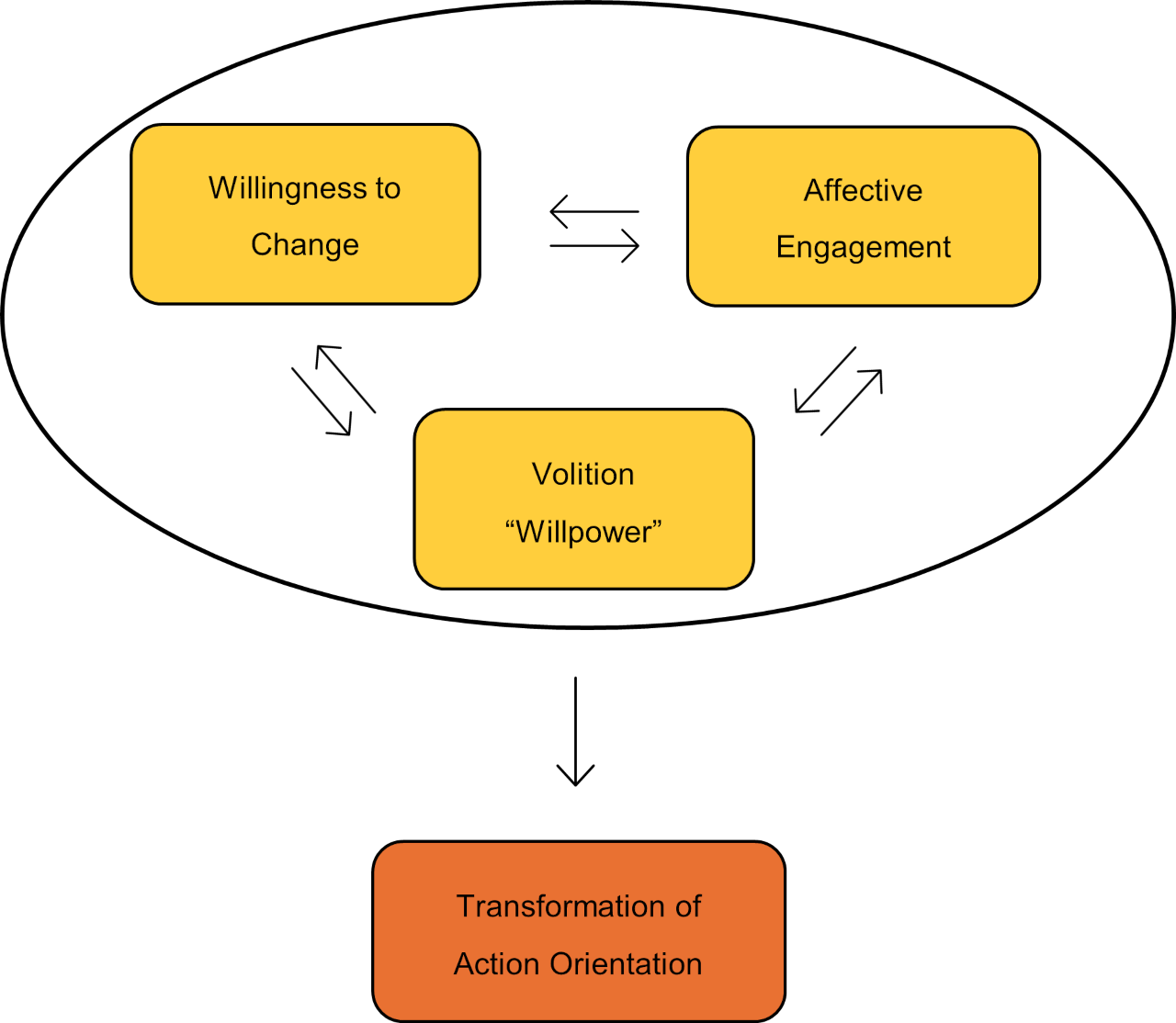
The category of Willingness to Change refers to an emerging awareness of dissatisfaction with established professional routines and institutional conditions. This awareness generates a drive to explore new impulses and perspectives and thus marks the beginning of a reflective engagement with one’s own pedagogical orientation.
The encounter with music mediation functions as an affective and cognitive turning point. It evokes emotional resonance and opens alternative frames of reference, inspiring unconventional thinking and reframing pedagogical goals. In this sense, music mediation operates as a gamechanger that reactivates central aims of instrumental pedagogy – musical experience, participation, and artistic expressivity.
Volition denotes the subsequent phase, in which reflection is transformed into intentional, goal-directed action. It involves the conscious pursuit and implementation of newly articulated values and aims, even under institutional constraints. The perceived meaningfulness of these goals provides motivational coherence and stabilises professional orientation.
Taken together, these three dimensions – Willingness to Change, Affective Engagement, and Volition – describe an interrelated process of transformation that results in new forms of professional agency. The Transformation of the Orientation to Action is therefore not conceived as a singular event but as a dynamic, iterative process shaped by emotional, reflective, and contextual factors.
The process model outlined above provides the conceptual foundation for identifying structural patterns of professional orientation. Based on the reconstructed dynamics, a typology was developed that situates musical experience as the central reference point of professional self-conception – both as an individual artistic practice and as a collectively shared pedagogical value. Within this typology, two distinct yet interrelated interpretative patterns emerge, each reflecting a specific orientation toward the meaning and function of musical experience in music school contexts.
Type I: Musical Experience as Artistic-Aesthetic Practice
This type is characterised by an orientation that values musical experience primarily for its intrinsic artistic and aesthetic qualities. The immediate, subjective encounter with music is understood as an autonomous sphere of artistic expression and personal growth. Pedagogical action is guided by the aspiration to foster aesthetic sensitivity, depth of interpretation, and individual artistic agency. Within this orientation, the teacher’s role is conceptualised as that of an artistic-pedagogical facilitator – one who enables and reflects aesthetic experience while maintaining a strong commitment to artistic integrity.
From a documentary perspective, this type reflects a professional habitus in which the artistic dimension of pedagogy constitutes the primary frame of reference for meaning-making and legitimation.
Type II: Musical Experience as Social and Cultural Participation
In contrast, this type interprets musical experience as a means of cultural and social participation. Here, the value of music extends beyond its aesthetic dimension and is framed as a fundamental right and collective responsibility. The pedagogical focus lies in fostering accessibility, inclusion, and empowerment through music, emphasizing the societal function of artistic practice. The teacher’s role expands beyond artistic mediation to encompass socio-cultural facilitation – enabling participation, reducing barriers, and promoting agency through collective music-making.
From the perspective of the documentary method, this type reveals an orientation toward music as a social practice and thus articulates a different horizon of professional meaning.
These two types are not to be understood as mutually exclusive categories, but as ideal-typical orientations that represent distinct interpretative logics. The tertium comparationis underlying both types lies in the shared understanding of musical experience as a central professional value – albeit realised through different emphases: one highlighting artistic autonomy, the other social participation.
This typology thereby exemplifies how individual constructions of meaning are anchored in collective frameworks of interpretation, rendering visible the diversity and dynamics of professional self-conceptions within the field of instrumental pedagogy.
Throughout this research, a close thematic connection between music mediation and instrumental pedagogy became apparent, as both fields share overlapping objectives and concerns. Reconstructing participants’ professional self-understanding revealed that, at its core, it aligns with a conception of instrumental pedagogy oriented toward meaningful and fulfilling musical practice. While this orientation is also reflected in recent pedagogical discourse, engagement with music mediation often prompted participants to reflect explicitly on these ideas and, in some cases, to revise or refine their professional convictions.
Empirical findings highlight a recurring tension between participants’ professional ideals and their enacted practices. Kunter and Pohlmann describe this as a “practice shock” (2015, 268), which arises when pedagogical aspirations contrast sharply with the realities of daily teaching. Similarly, Doerne (2010, 115-16) notes that overarching educational goals may be lost as lessons devolve into routine repertoire drills, while questions about purpose and direction are overshadowed by the pressures of everyday work.
Following Neuweg (2014), these observations can be interpreted as indicative of a broader theory-practice problem. Knowledge acquired during training, though firmly embedded in professional education, often fails to shape the cognitive structures guiding daily pedagogical action – a phenomenon he terms “inert knowledge” (Neuweg 2014, 596-97). Engagement with music mediation, however, frequently acted as a catalyst for reorienting professional practice. By providing a concrete experiential context, it enabled participants to reconnect with foundational pedagogical ideals and reflect on the purpose and ultimate aims of their teaching.
This reflective reorientation is central to understanding the emergence of the typological patterns presented above. The typology captures how participants differently integrate musical experience into their professional self-conception: some emphasise artistic-aesthetic autonomy (Type I), while others foreground social and cultural participation (Type II). In both cases, music mediation functions as a trigger that activates reflective engagement with professional values, illustrating how structural gaps between ideals and practice can shape distinct orientations toward musical experience.
While this article does not allow for a full step-by-step reconstruction of implicit orientations, these observations demonstrate how empirical insights and theoretical concepts converge to inform the typology, linking the process model to observable patterns of professional self-conception.
Instrumental pedagogical practice is guided by overarching educational goals, which, according to Doerne, constitute the “gravitational center” (Doerne 2016, 23) of teachers’ professional efforts and the foundation of their pedagogical self-understanding. These central objectives shape day-to-day teaching and define the essence of professional action. Music schools, as voluntary spaces open to people of all ages and skill levels, embody this intrinsic value – their very own worth. Doerne emphasises that this value is an invaluable asset: music schools should never relinquish it and should actively cultivate and further develop it, seeking ways to strengthen and expand the opportunities it provides for voluntary, meaningful musical engagement.
The study’s findings indicate that existing institutional frameworks often conflict with these pedagogical convictions. Addressing this tension requires reflection on the self-conception of music schools and openness to new, potentially unconventional approaches. This reflection encompasses not only the practices of individual teachers but also the broader organizational and administrative context of music schools.
Questions emerge: How much formal schooling is necessary? How can music schools simultaneously enable aesthetic experience, social participation, and personal growth? How can structures be designed to enable rather than constrain?
In the reconstructed typology – particularly in Type II – a pedagogical self-understanding emerged that resonates with Artistic Citizenship, which frames musicians as socially engaged practitioners whose creative work fosters community, participation and the common good (Elliott et al. 2016).
A central question arises: how can Artistic Citizenship inform the future development of music schools, particularly in balancing institutional structures and pedagogical autonomy? Wolfgang Lessing (2023) illustrates this with a case study in which an instrumental teacher deliberately crosses institutional boundaries, disrupts established routines, and creates new spaces for artistic agency and social inclusion. Such practices shift the focus from what is taught to who participates and highlight the political and participatory dimension of pedagogy. Lessing emphasises that Artistic Citizenship is collective, aiming to involve students and teachers alike in shaping educational processes, thus enabling all participants to become Artistic Citizens in their own right (Lessing 2023, 47).
This perspective calls for new forms of institutional collaboration that support both artistic expression and social participation. It also underscores the need to critically reassess existing structures, pedagogical content, and self-understanding within music schools. New, potentially unconventional approaches, alongside adaptive institutional frameworks, are required to mediate tensions between formal schooling and creative autonomy.
Within this context, a dialectical tension emerges between standardisation and pedagogical flexibility. Music schools should treat this tension not as a problem to resolve but as an opportunity to shape reflective, process-oriented, and artistically driven educational spaces. As Doerne notes, such spaces are “voluntary and therefore necessarily self-determined” (2016, 23), providing opportunities for self-directed musical engagement while upholding pedagogical quality standards.
Music schools, therefore, not only fulfil formal educational mandates – developing young talent, promoting amateur music-making, providing broad access, and preserving musical traditions – but also serve as spaces for openness, innovation, and the exploration of new musical and social possibilities.
While these reflections illustrate key pedagogical dynamics, the study’s scope is limited to a specific group of instrument teachers and institutional contexts. Although most participants were employed in Austrian music schools, with a smaller number from Germany, the findings suggest shared orientations and experiences that may inform comparative studies in other national contexts. Future research could examine these processes more broadly, including perspectives from different countries, institutional roles, and pedagogical traditions.
Music mediation emerges as a key catalyst for both individual and institutional transformation. Voit (2023, 42) emphasises that mediation can transform self-understanding both outwardly, toward society, and inwardly, within the institution itself. Although his analysis focuses on concert halls, the principle extends to music schools, which must continuously reflect on and develop their self-conception to safeguard their intrinsic value as spaces that enable aesthetic experience, social participation, and lifelong musical engagement.
Engagement with music mediation reinforces pedagogical reflection, reconnecting teachers with foundational ideals and shaping institutional practices. In doing so, music schools are positioned not only as formal educational institutions, but also as dynamic spaces for experimentation, transformation, and the cultivation of new musical and social possibilities.
My observations relate primarily to the Austrian field of practice.↩︎
The reference here is to the curricula of music universities in Austria.↩︎
This observation resonates with Berg’s argument concerning “tendencies towards the dissolution of a uniform professional profile” as well as Smilde’s research on “portfolio careers” (Smilde 2009, 2017). German quotations in this article have been translated by the author.↩︎
Initially, the programme featured exclusively contemporary chamber music. Over time, however, the format has evolved to incorporate works from other historical periods, alongside ensembles representing a range of musical genres. The concept has since been adopted by other concert organisers. koerber-stiftung.de/projekte/2-hoeren/ (accessed May 9, 2025).↩︎
oe1.orf.at/artikel/329233/WAGner-DICH (accessed May 25, 2025).↩︎
youtube.com/watch?v=KvmBVeq0hH0 (accessed May 23, 2025).↩︎
hoerminute.at/ (accessed May 6, 2025).↩︎
musikzumanfassen.at/musikvermittlung/sonderprojekte/tschick-strafgefangene-2022/ (accessed May 6, 2025).↩︎
The following quotations from the empirical study were translated into English by the author and linguistically adjusted for improved clarity.↩︎
Berg, Ivo Ignaz. 2018. “Üben, Musizieren und Kooperieren: Zum Berufsbild und Selbstverständnis von Lehrenden der Instrumentalpädagogik.” In Instrumentalpädagogik – wie und wozu? Entwicklungsstand und Perspektiven. Üben & Musizieren, edited by Wolfgang Rüdiger, 51-67. Mainz: Schott Music GmbH & Co. KG.
Dartsch, Michael. 2019. Didaktik künstlerischen Musizierens: Für Instrumentalunterricht und elementare Musikpraxis. Wiesbaden: Breitkopf & Härtel.
Doerne, Andreas. 2010. Umfassend musizieren: Grundlagen einer integralen Instrumentalpädagogik. Wiesbaden, Leipzig: Breitkopf & Härtel.
Doerne, Andreas, Reinhart von Gutzeit, and Ulrich Rademacher. 2016. “Leistung ohne Druck? Leistungsüberprüfung – ein allgegenwärtiges Phänomen mit Risiken und Nebenwirkungen.” Üben & Musizieren 2, 18-23.
Elliott, David, Marissa Silverman, and Wayne Bowman, (eds.). 2016. Artistic citizenship: Artistry, social responsibility, and ethical praxis. New York, NY: Oxford University Press.
Kunter, Mareike, and Britta Pohlmann. 2015. “Lehrer.” In Pädagogische Psychologie (2nd, fully revised and updated ed.). Springer-Lehrbuch, edited by Elke Wild and Jens Möller, 261-281. Berlin, Heidelberg: Springer.
Lessing, Wolfgang. 2016. “Paradoxie als Regel: (Musik-)Pädagogische Antinomien im instrumentalen Gruppenunterricht.” In Herzstück Musizieren: Instrumentaler Gruppenunterricht zwischen Planung und Wagnis. Üben & Musizieren – Texte zur Instrumentalpädagogik, edited by Natalia Ardila-Mantilla, Peter Röbke, Christine Stöger, and Bianka Wüstehube, 77-88. Mainz: Schott Music GmbH & Co. KG.
Lessing, Wolfgang. 2023. “Artistic citizenship: Überlegungen zur Grundlegung eines musikpädagogischen Orientierungsbegriffs.” üben & musizieren.research, Special Edition Artistic citizenship, 16-53. Accessed October 25, 2025. uebenundmusizieren.de/artikel/research_artistic-citizenship_lessing/.
Loos, Peter, and Burkhard Schäffer. 2001. Das Gruppendiskussionsverfahren: Theoretische Grundlagen und empirische Anwendung. Opladen: Leske + Budrich.
Mahlert, Ulrich. 2016. “Glück im Musizieren: Erscheinungsformen, Bedingungen, Ermöglichungen.” In Herzstück Musizieren: Instrumentaler Gruppenunterricht zwischen Planung und Wagnis. Üben & Musizieren – Texte zur Instrumentalpädagogik, edited by Natalia Ardila-Mantilla, Peter Röbke, Christine Stöger, and Bianka Wüstehube, 65-76. Mainz: Schott Music GmbH & Co. KG.
McGregor, Judith. 2024a. “Ästhetische Erfahrungen und resonante Beziehungen zu Musik. Wie musikvermittlerische Praxis die innere Landkarte von Instrumentalpädagog*innen prägt.” In Instrumentaldidaktik künstlerisch gedacht: Aspekte, Handlungsweisen, Perspektiven, edited by Hannah Lindmaier and Peter Röbke, 249-262. Münster: Waxmann.
McGregor, Judith. 2024b. Musikvermittlung im instrumentalpädagogischen Kontext: Zur Rekonstruktion eines kollektiven professionellen Selbstverständnisses [Doctoral dissertation]. University of Music and Performing Arts Vienna: Institut für musikpädagogische Forschung und Praxis.
Musik der Jugend (ed.). 2023. “prima la musica 2023: Ausschreibung.” Accessed October 25, 2025. musikderjugend.at/fileadmin/daten/prima_la_musica/2023/Ausschreibung_prima_la_musica_2023_Website.pdf.
Neuweg, Georg Hans. 2014. “Das Wissen der Wissensvermittler: Problemstellungen, Befunde und Perspektiven der Forschung zum Lehrerwissen.” In Handbuch der Forschung zum Lehrerberuf (2nd, revised and expanded ed.), edited by Ewald Terhart, Hedda Bennewitz, and Martin Rothland, 583-614. Münster/New York: Waxmann.
Przyborski, Aglaja. 2004. Gesprächsanalyse und dokumentarische Methode: Qualitative Auswertung von Gesprächen, Gruppendiskussionen und anderen Diskursen. (1st ed.). Wiesbaden: Springer Fachmedien Wiesbaden GmbH.
Przyborski, Aglaja, and Monika Wohlrab-Sahr. 2014. Qualitative Sozialforschung: Ein Arbeitsbuch. (4th ed.). Lehr- und Handbücher der Soziologie Series. Berlin/Munich/Boston: Walter de Gruyter GmbH. ebookcentral.proquest.com/lib/kxp/detail.action?docID=1586358.
Röbke, Peter. 2016. “Von der Unverfügbarkeit des Musiziermoments: Eine Spurensuche in der Instrumentalpädagogik.” In Herzstück Musizieren: Instrumentaler Gruppenunterricht zwischen Planung und Wagnis, edited by Natalia Ardila-Mantilla, Peter Röbke, Christine Stöger, and Bianka Wüstehube, 45-64. Mainz: Schott Music GmbH & Co. KG.
Röbke, Peter. 2018. “Didaktik Plus: Ein Versuch über musikalische Vollzüge sowie Antriebe und soziale Kontexte des instrumentalen Lernens.” In Instrumentalpädagogik – wie und wozu? Entwicklungsstand und Perspektiven. Üben & Musizieren, edited by Wolfgang Rüdiger, 85-97. Mainz: Schott Music GmbH & Co. KG.
Smilde, Rineke. 2009. Musicians as lifelong learners. Delft: Eburon Academic Publishers.
Smilde, Rineke. 2017. “Wie ein Chamäleon! Musikerinnen und Musiker müssen sich heute flexibel den unterschiedlichsten Herausforderungen stellen.” Üben & Musizieren 2, 6-10.
Voit, Johannes. 2023. “Begründungsfiguren und -diskurse der Musikvermittlung.” In Handbuch Musikvermittlung – Studium, Lehre, Berufspraxis, edited by Axel Petri-Preis and Johannes Voit, 37-42. Bielefeld: transcript.
Wimmer, Constanze.2023. “Musikvermittlung zwischen künstlerischer und pädagogischer Orientierung.” In Handbuch Musikvermittlung – Studium, Lehre, Berufspraxis, edited by Axel Petri-Preis and Johannes Voit, 211-217. Bielefeld: transcript.
Judith McGregor studied instrumental pedagogy at the mdw – University of Music and Performing Arts Vienna and completed the master’s programme Musikvermittlung – Musik im Kontext at the Anton Bruckner Private University Linz. She currently works as a university assistant in the field of instrumental pedagogy at the mdw and earned her doctorate with a dissertation on music mediation in the context of instrumental pedagogy. Her research focuses on the pedagogical attitudes and action orientations of instrument teachers who are active in both instrument teaching and music mediation. In addition, she teaches at a music school and works as a freelance violist.
ISSN 2943-6109 – Volume 2/2 (2025) – DOI: 10.71228/ijmm.2025.29
This paper is published under a Creative Commons Attribution 4.0 International License. Parts of an article may be published under a different license. If this is the case, these parts are clearly marked as such.
