
Department of Music Education, University of Münster, Münster, Germany
Correspondence: i.siedenburg@uni-muenster.de
Based on the German term Musikvermittlung, this article highlights the problems of conceptual approaches to music mediation in order to develop suggestions for future directions in jazz. To this end, the article first draws on the specialist discourse concerning the terminological implications of Musikvermittlung, which primarily relates to the field of classical music. Particular attention is paid to the problem that a one-dimensional understanding of “Vermittlung” or “mediation” implies that learning is seen as a passive process, in which cultural hierarchies are reinforced.
In the following pages, these findings are reflected upon in relation to jazz and its socio-cultural contexts. Points of orientation are developed for the further conceptual development of “jazz encounters”. Key aspects include a processual understanding of jazz and a power-critical orientation arrived at through encounters in “third spaces”. Finally, suggestions for study programmes and further training of jazz musicians are developed, which aim, among other things, to prompt reflection on one’s own professional self-image.
Partant du terme allemand « Musikvermittlung », l'article présente les problèmes soulevés des approches théoriques de la médiation de la musique, afin de développer des suggestions pour les orientations futures du jazz. Pour ce faire, l’auteur se réfère aux discours spécialisés concernant les implications terminologiques de « Musikvermittlung » qui montrent que ce terme renvoie principalement au domaine de la musique classique. Une attention particulière est accordée au problème que pose une compréhension unidimensionnelle des termes « Vermittlung » ou « médiation », qui fait de l'apprentissage un processus de transmission passif et ainsi renforce les hiérarchies culturelles.
Par la suite, ces réflexions sont développées dans le cadre spécifique du jazz et à ses contextes socioculturels. Des orientations sont enfin proposées pour le développement conceptuel des « rencontres de jazz ». Les aspects essentiels en sont une compréhension processuelle du jazz ainsi qu'une orientation critique du pouvoir à travers des rencontres musicales dans de « troisièmes espaces ». Enfin, des propositions pour la formation des musiciens et musiciennes de jazz sont développées, visant entre autres à permettre des expériences communes avec différents groupes de dialogue et à réfléchir à sa propre image professionnelle.
Ausgehend vom deutschen Begriff Musikvermittlung zeigt der Beitrag Problematiken konzeptioneller Ansätze auf, um daran anknüpfend Anregungen für künftige Weichenstellungen im Jazz zu entwickeln. Dafür wird zunächst der Fachdiskurs zu terminologischen Implikationen von Musikvermittlung herangezogen, der sich vornehmlich auf den Bereich der klassischen Musik bezieht. Besonderes Augenmerk richtet sich dabei auf das Problem, dass durch ein eindimensionales Verständnis von „Vermittlung“ Lernen als passiver Prozess gedacht und kulturelle Hierarchien verstärkt werden.
Nachfolgend werden diese Erkenntnisse in Bezug auf den Jazz und seine soziokulturellen Kontexte reflektiert und Orientierungspunkte für die konzeptionelle Weiterentwicklung von „Jazz-Begegnungen“ entwickelt. Wesentliche Aspekte sind dabei ein prozessuales Verständnis von Jazz sowie eine machtkritische Ausrichtung durch Begegnungen in „dritten Räumen“. Abschließend werden Vorschläge für die Aus- und Weiterbildung von Jazzmusiker_innen entwickelt, die unter anderem auf die Ermöglichung von gemeinsamen Erfahrungen mit verschiedenen Dialoggruppen und die Reflexion des eigenen beruflichen Selbstverständnisses abzielen.
jazz encounters, jazz mediation, terminology, diversity, study and training programmes
Music mediation is also becoming increasingly important in jazz, as this issue of the journal attests. Just as it occurred within Western classical music before – especially since the 1980s (Voit 2023b, 70) – jazz-related concepts initially emerged from practical experience, with concerts being organised for special target groups at festivals, in clubs or in schools, or other projects being launched. In addition to this increasingly lively field of practice, a discourse is currently unfolding in which prerequisites, principles and objectives are being reflected upon.
While this development is still relatively new in jazz, Musikvermittlung – I continue to use the German term for specific reasons, see below – has already become firmly established in classical music over the past few decades in German-speaking countries. Originating from concert education initiatives, the programme has now expanded to encompass a broad range of target groups. An entire professional field has emerged from the practical domain of Musikvermittlung, with study programmes and a field of research (Petri-Preis and Voit 2023, 25-27). The jazz sector can leverage this advantage in experience. Although the situations of both cultural domains differ in many respects, it is essential to build upon research findings, practical experience, and controversies from the classically orientated Musikvermittlung, so that the acquired knowledge can be integrated into the further development of jazz-related discourse. However, this opportunity has thus far been utilised only to a limited extent.
In this article, I aim to highlight the problems associated with the term Musikvermittlung and the approaches developed under this term, in order to draw conclusions for the orientation of concepts in jazz. I will therefore commence by focussing on approaches and research that have been developed primarily in the field of Western classical music and discussed in music education contexts. Subsequently, I will reflect on the relevance of these findings for jazz, considering style-specific, sociopolitical, and pedagogical challenges.
As some central aspects of Musikvermittlung will be criticised, I would like to emphasise in advance that there are, of course, projects that take into account the problems presented here and already meet many of the demands formulated in this text. Nevertheless, I believe it is important to critically reflect on existing terminologies and the approaches related to them. The term Musikvermittlung has become so firmly established that its implications continue to have an impact – particularly in the non-academic field and in the development of concepts and programmes for practical application, but also as a title of degree programmes. The following conceptual reflection aims to help adopt a more conscious approach to charting the course in jazz, taking into account available experiences and current discourses, and perhaps finding alternatives that might be more suitable for conveying what we want to achieve.
From my perspective as a music educator and researcher in music education, as well as a jazz musician myself, I still see room for improvement when it comes to linking Musikvermittlung with current music education approaches, while focusing on the special potential of jazz.
After having been used rather sporadically and unsystematically until the turn of the millennium (Petri-Preis 2023, 34), the German term Musikvermittlung has now largely become established. Nevertheless, it is still used inconsistently – on the one hand due to the expansion of target groups, objectives, and concepts, and on the other hand due to the different contexts of use and theoretical frameworks (Petri-Preis and Voit 2023, 27-29). Among the various attempts at definition, a proposal by Mautner-Obst particularly reflects this broad spectrum of meaning:
At present, Musikvermittlung is proving to be an artistic, pedagogical and communicative practice that aims to open up access to music for heterogeneous audiences in various formats ranging from artistic-creative to cognitive-reflective, thereby enabling and deepening aesthetic experiences and testing and expanding creative means of expression. This can also support the concerns of cultural policy or cultural management1 (Mautner-Obst 2018, 339, cited by Voit and Petri-Preis 2024, 4).
The definition reveals the diversity of manifestations and orientations. Additionally, it refers to a specific feature: Musikvermittlung brings music education and artistic interests together with cultural policy and cultural management concerns.
Chaker and Petri-Preis (2022) introduce the term Musikvermittlung into the English-speaking music education discourse as a loanword. They identify issues of different English terms such as “music education”, “children's concerts” or “community engagement”, which tend to be applied mostly within certain contexts or merely allude to aspects of the Musikvermittlung field. In addition, the direct translation “music mediation” risks being misleading because of its application in other areas; for instance via the broad sociological understanding of the term by Antoine Hennion (2015) or Georgina Born (2005). Chaker and Petri-Preis thus recommend utilising Musikvermittlung also in the English language:
So the term “mediation” is already strongly associated with other theoretical approaches, connotations, meanings and concepts. From this, it becomes clear that the literal translation of Musikvermittlung, music mediation, may lead to misunderstandings and irritations in a global scientific community rather than bring clarity, as it entails a whole new discourse space. (Chaker and Petri-Preis 2022, 16)
This criticism is understandable, but there is a similar problem in both the German and the French language. In German, “mediation” is also often used in connection with conflict resolution strategies and therefore does not fit this specific context. The French equivalent “médiation musicale” poses similar difficulties, as the widespread use of “médiation” in legal or political contexts can evoke other associations. A decision between the German, English or French version can therefore only contribute to a limited degree of precision.
Since Musikvermittlung has become widely accepted in German discourse and I am concerned with the implications of the term, I will primarily use Musikvermittlung in the following and indicate the terminological problems by using italics. However, the difficulties outlined in this article can also be applied to “music mediation” or “médiation musicale” in many respects. Therefore, my argument should be coherent if the terms are understood synonymously.
Rebekka Hüttmann (2009) identifies two different uses of Musikvermittlung: “Vermittlung von” – in English “mediation of” (here: knowledge and ability) – and “Vermittlung zwischen” – in English “mediation between” (here: people and music; see also Petri-Preis 2023, 34). She thus differentiates between a more object-oriented and a more subject-oriented perspective, but emphasizes that these should not be understood as a pair of opposites; rather, they ought to complement each other (Hüttmann 2009, 59; see also Schippling and Voit 2023, 221). However, whether this is actually practised in the discourse on Musikvermittlung remains to be discussed, and the former perspective (“mediation of”) is viewed critically by some authors.
Dorothee Barth (2015) criticises the fact that the phrase “Vermittlung von” refers to a one-dimensional process in which an object is mediated to a person or group. She aptly states that this idea is no longer in line with the times:
‘Vermittlung von’ [...] ignores the perceptual-theoretical realisation that it requires the subject to construct an object in order to appropriate it in a specific form. Each subject carries out this appropriation in a different way, depending, among other things, on the experiences it has had so far and to which it connects [...] (Barth 2015, 74-75).
Barth thus establishes a connection with constructivist perspectives on music education (i.e. Krause 2007, 62) by referring to the attribution process through which individuals assign meanings to particular types of music.
Sachsse (2023) also emphasises the relevance of these ascriptions of meaning, which he regards as the result of interactive engagement based on individual needs. For him, a subject-oriented approach is an essential prerequisite for successful Musikvermittlung from an educational perspective:
It is only through such a focus on the needs, demands, and the reception and learning conditions of the recipients of mediation activities that goal perspectives for musical education even begin to emerge – perspectives that Musikvermittlung must repeatedly assert in the face of commercial advertising and marketing interests (see Mautner 2007). (Sachsse 2023, 284)
Like all learning, engaging with cultures or music is an active process. People connect new experiences to previous ones, attribute subjective meanings to objects, activities and encounters, actively acquire knowledge and skills, and even co-create or modify the music or culture in question. In contrast, the notion of “Vermittlung von” suggests a more passive concept of learning, in which content is simply “poured into” people's minds – an idea that is also criticised in German-speaking contexts through the metaphor of the “Nuremberg funnel”, where music is perceived as a static object. If, instead, we align with the praxial understanding developed by Small (1998) and Elliott (1995), music is a “practice”. In other words: “Music is what people do” (Buchborn et al. 2022). For the field of Musikvermittlung, this implies that the musical practice of Jazz should be placed at the centre, making its specific doings (such as improvisation) tangible, thus enabling participants to contribute their individual musical backgrounds. Jazz, understood as a practice, can be adapted and developed further through this collective process.
Another problem with the term Musikvermittlung is that it implies a normative concept of culture (Barth 2018). It is typically the music “mediators” who determine what is deemed valuable and worthy of Vermittlung or mediation. When we speak of “leading” particular target groups to music, we implicitly undermine their own musical cultures and disregard their musical preferences or prior experiences within other musical domains.
Seeing “Vermittlung von” (or “mediation of”) and “Vermittlung zwischen” (or “mediation between”) linked to each other in the sense of Hüttmann (2009, see above) helps to reduce this polarisation. Nonetheless, a latent one-dimensionality persists, as the role of the music mediators themselves is not taken into consideration. The latter bring their own attributions of meaning and interests to the table, often shaped by the above-mentioned normative concept of culture. If Musikvermittlung is to promote respectful and equitable engagement, it is essential to reflect critically on the attitudes and interests of those in charge of designing or implementing these programmes. This is particularly crucial for the jazz domain, given its significant potential as a musical melting pot2 and space for transcultural practices that should not be abandoned (Schunter 2023).
However, if the term Musikvermittlung is to be retained – after all, it has become well established – it must be acknowledged that “in its everyday use of language and in the everyday conceptualisation of education projects, it harbours the danger of a one-dimensional mediation structure from an art object to a recipient” (Barth 2015, 74). Strategies must therefore be developed to counteract these implications. A definition by Petri-Preis and Voit offers one such approach: “Music mediation, as we understand it, is a broad artistic and educational practice that fosters diverse relationships between people and musics” (Petri-Preis and Voit 2024, 4). By employing the plural “musics”, the authors emphasise diversity beyond Western classical music and distance themselves from a normative understanding of culture. By focussing on fostering diverse relationships, their definition actively challenges a one-dimensional approach to Musikvermittlung.
The challenges surrounding the terminology and conceptualisation of Musikvermittlung are closely linked to the conflation of differing objectives, which Mautner-Obst (2018) distinguishes as artistic-educational, socio-political and economic. “Whereas artistic-educational and socio-political aims serve the addressees of Musikvermittlung practices, economic aims primarily benefit the organisations” (Chaker and Petri-Preis 2022, 15).
In the early days of concert education, both economic interests and those related to cultural policy served as the primary drivers: the objective was to cultivate an interest in classical music from an early age in order to secure the “audience of tomorrow” and address the “crisis of the concert” (Voit 2023a, 38-42). In implementing such audience development initiatives, cultural organisers and artists were able to draw upon established power structures while simultaneously legitimising state funding, thereby ensuring the structural stability of their favoured forms of music. Supported by a normative concept of culture, these efforts have contributed to the consolidation of cultural hierarchies.
Although these hierarchies are today less overt and more embedded in structural frameworks, they were once articulated quite bluntly. For instance, the first concerts for children, organised at the beginning of the 20th century, aimed to “open[ing] up children’s hearts and minds to good music, getting them used to it and thus turning them away from ordinary musical pleasures and tinkling tangles” (Barth around 1900, cited in Voit 2023b, 69). A similar stance can be observed in music education’s historical treatment of popular music, which for a long time was shaped by comparable value judgements. It was once deemed necessary to protect young people from popular music – including jazz – under slogans such as the call for a “fight against trash, kitsch and filth” (Bundesschulmusikwoche 1959, cited in Terhag 2009, 11). Jazz, however, was among the first genres of popular music to be deemed suitable for limited integration.
Yet even authors who advocated for the integration of jazz into music education did so from a Eurocentric perspective, devaluing African-American music in comparison to European music. Schulz-Koehn, for example, alleged that jazz could “never be the goal in school, but rather help pave the way to our great occidental music with its possibilities” (Schulz-Koehn 1959, 82).
Although such positions are rarely explicitly expressed openly today, they continue to influence subconscious attitudes and values. In the field of Musikvermittlung, economic interests or public funding often reinforce these tendencies by providing a rationale for ranking musical genres, which takes place through the selection of the music to be presented.
As Chaker and Petri-Preis (2022, 15) explain, economic objectives exclusively benefit the established cultural institutions. These aims are closely intertwined with cultural policy agendas, which seek to bolster these institutions – ensuring the continued funding of concert halls and opera houses even in times of fiscal austerity, despite the declining societal relevance of classical music (see also Voit 2023a, 42). If class-based inequalities are to be challenged and its objectives redefined, a critical reflection on existing power structures is essential (Stoffers 2023).
In addition to the traditional aims of Musikvermittlung, more recent intentions have emerged which give greater consideration to the needs and aspirations of target groups. For example, increasing efforts are being made to facilitate participation for children, young people and individuals from diverse socio-economic backgrounds, as well as provide aesthetic experiences for people with special needs (Voit 2023a, 38-41). These initiatives align with artistic-educational and socio-political objectives and reflect current discourses in music education. From this perspective, issues such as diversity are acknowledged as integral and are actively addressed as challenges.
Johannes Voit (2023a, 41) also identifies a goal that has received relatively little attention to date: Musikvermittlung should contribute to changing the attitudes of music professionals and cultural institutions. In this regard, the understanding of “music mediation” as an “artistic and educational practice”, as articulated by Petri-Preis and Voit (2024, 4), is of particular importance. Not only pedagogical orientation, but also artistic conception, can significantly influence the chosen form of “mediation”. Whereas traditional approaches assign audiences a primarily receptive attitude, more contemporary approaches are participatory in nature. Reflecting on one’s own practice and the artists’ self-conception is therefore crucial in the development of concepts for “music mediation”. This can help replace affirmative concepts which are primarily devoted to preserving a particular musical culture with transformative ones that place reorganisation and innovation at the center (Müller-Brozović 2023). Nonetheless, the problem remains that the preservation of certain musical styles often constitutes the central motivation for the implementation of Musikvermittlung, while music-educational objectives and theoretical frameworks are not always sufficiently taken into account (Sachsse 2023).
The difficulties outlined above present significant challenges for Musikvermittlung. The resulting questions are not confined to classical music but extend to its application in jazz: How can economic interests be reconciled with music education and socio-political objectives? How can we prevent the reproduction of elitist cultural attitudes, where calls for participation merely serve to legitimise cultural funding? How can the needs of the intended groups be adequately addressed? And how can the role of cultural practitioners be appropriately defined?
In seeking answers, three key aspects seem particularly relevant to me: the orientation towards the subject, the reflection on power structures, and the self-reflection of the actors.
In the spirit of a pedagogy that tends to prioritise learning over teaching, the recipients must be positioned at the heart of all considerations. Artistic-pedagogical and didactic approaches should thus take precedence, while economic concerns assume a less dominant role.
Drawing on Kaiser, Barth (2015) explains that music education cannot be imposed externally by other people; rather, it must be chosen and embraced by the subject themselves. If music education is regarded as an essential aim of Musikvermittlung, – and in my opinion it should be – the goal must therefore be to create a space that provides the subject with adequate conditions for their individual learning activities. This begins with posing classic didactic questions: What musical interests do the participants have? What associations might they have with the music the educators or mediators want to focus on? Do they have previous experiences, reservations, associations? Could engaging with new musical practices enrich their own musical practice and preferences? And what connections can be established between the musical world of the participants and that of the educators or mediators?
This subject-oriented approach can be particularly well realised through an experience-oriented approach (Rolle 1999). Music education projects rooted in these didactic concepts must enable aesthetic experience processes that “open up perspectives for participants as subjects to want to give music a space in their own lives” (Barth 2015, 76). If this prioritisation of the subject is consistently pursued, the mediator’s interests and preferences must play a more subsidiary role in favour of the participant’s interests.
To challenge cultural hierarchies and constructions of difference, it is necessary to move beyond the one-dimensionality that results from the idea of transferring music to a target group. In this regard, Axel Petri-Preis and Johannes Voit (2023 and 2024) offer a significant shift by replacing the term “target group” with that of “dialogue group”, emphasising the intention to foster diverse relationships (see above).
However, power remains unequally distributed. Consider, for instance, a school class from a socially disadvantaged area attending a music education programme at Hamburg’s prestigious Elbphilharmonie. It is the Philharmonie’s education department that initiates the “dialogue”, determines the framework and content, and provides financial backing, whereas many in the “dialogue group” may be participating as part of a mandatory school programme. The change in terminology alone therefore does not create an equal exchange, but it may draw conscious attention on the relational dynamics between the participants and offer the potential for change.
Nina Stoffers (2023) addresses the lack of power-critical perspectives in the field of Musikvermittlung and offers a comprehensive analysis. She identifies asymmetries and describes processes of “othering” that persist even when the supposed aim is to include target or dialogue groups traditionally excluded from dominant forms of music culture. Her critique implies both individual behaviours and structural issues that shape access to culture, as well as conventions and implicit norms:
The fields of cultural mediation therefore remain ‘bastions of the multiply privileged’ (Schütze/Maedler 2017: 9). This is because within the framework of the cultural sector, for example the hegemonic canon, the access requirements, i.e. the rules of the game, are still set and played by the majority of white, hetero-normative and educated middle-class socialised personnel, who define what can be considered art and what, on the other hand, is only considered craft, what is understood as quality, etc. (Stoffers 2023, 109).
In the further development of concepts, it is therefore essential to reflect critically on these power relations and to develop approaches to diversity that allow active participation and co-creation. Transculturally orientated frameworks can offer valuable impulses for this.
Drawing on postcolonial theories, Klingmann (2012) takes up Homi Bhabha’s model of “third spaces” (see also Castro Varela and Dhawan 2015). For the context of transcultural Musikvermittlung, Klingmann proposes the creation of “third spaces”– shared spaces where individuals from diverse cultural or social backgrounds can collaborate on shaping a common practice. He identifies potentials “to use the dissolutions of hierarchies and the intersections of binary oppositions described by Homi Bhabha in this context for the progressive consolidation and development of democratic relations” (Klingmann 2012, 211).
Jazz as a transcultural music can profit from following this approach in the domain of Musikvermittlung. When interpreted not only metaphorically but also physically, the notion of “third spaces” calls on musicians and music mediators to leave the familiar environment of the concert hall-stage and to explore new forms of musical practice together with dialogue groups in settings less associated with so-called “high culture”. An example of this approach is the Hanover project for a Jazz Escape Room realised by the big band Fette Hupe, for which a trendy youth centre was chosen, providing an interesting new environment for both the musicians and the young visitors (Fette Hupe, n.d.).
The implementation of the above conclusions requires that musicians and cultural institutions engage in critical self-reflection regarding their roles and motivations in music education. The objective of attracting new audiences cannot be the sole justification for their efforts. To ensure that Vermittlung is not subliminally thought of as a one-dimensional process, mediators must show a genuine interest in their potential dialog partners as well as their perspectives or needs.
This shift in perspective not only supports socio-political and music education objectives but can also be gainfully implied from perspectives of cultural management. This is reflected in Birgit Mandel's (2016) suggestion to replace the term “audience development” with “community building”. According to Mandel this is accompanied by a change in perspective, which can ultimately lead to stronger connection and therefore greater success which may lead to economic benefits. Building a sense of community lays the foundation for participants to have sustainable and personally meaningful experiences. This increases the likelihood of them developing an interest in deepening these experiences beyond the one-time experience and become a part of the community of practice, so that musicians and organisers could ultimately also benefit economically. Last but not least, artists may also benefit from reflecting on their role as a musician and explore new musical practices.
Although the number of practical initiatives has grown significantly in recent years, a professional field and specialised discourse surrounding jazz-related Musikvermittlung is only now beginning to emerge. A key reason for this is that jazz remains far less institutionally embedded in German-speaking countries than classical music. While concert halls and state orchestras benefit from considerable financial backing and resources for public engagement, jazz lacks equivalent support. Nonetheless, jazz does have access to these institutions: more than ever, concert halls and festivals serve as important performance venues for jazz ensembles, while the role of traditional jazz clubs continues to decline. The disparity in financial support, however, remains stark. Pieper and Zimmermann (2016, 33) observe of the jazz scene in the German state of North Rhine-Westphalia that “The Detmold3 Chamber Orchestra alone, consisting of 27 musicians, received four times as much state funding as the jazz sector combined.” Despite regional differences and evolving policies in cultural funding, this fundamental imbalance largely persists.
In addition to these facts, the self-perception of the jazz scene – situated ambivalently between the independent scene and so-called “high culture” – also contributes to the tardive development of jazz-related Musikvermittlung. In the African-American oral tradition, a considerable part of musical learning historically occurred outside formal education, and even after jazz entered educational institutions, these learning contexts remained. The academisation associated with an orientation towards the teaching traditions of Western classical music, has often been met with criticism (Galper 1993; Ake 2002, 113-126). Many continue to regard jazz practice outside of formal teaching situations as ideal (Prouty 2012; Johansen 2014, Siedenburg in preparation). Although most jazz musicians today have not only learned in the informal sector, but also have some experience in institutional training programmes, such attitudes remain relevant for their identity.
The long-standing scepticism towards education within the jazz community is also linked to differing socio-cultural contexts, learning environments, and their connotations. The romanticised image of the coolness of a late-night session in a smoky jazz club, or the historical context of early jazz in the red-light district, contrast starkly with the notion of educational work in schools or music schools. Ideals such as freedom, individualism, subversiveness and resistance play a key role in the image of jazz (Niederauer 2014). This image – as mystifying as it may seem – cannot be easily reconciled with the idea of learning in institutionally based teaching situations, particularly those involving younger children where classic educational tasks play a significant role, therefore not necessarily promoting freedom and resistance.
The disconnect between the images of jazz and pedagogy is compounded by gendered associations: hegemonic masculinities are central in jazz and can be seen as essential for its identity-forming function (Dunkel 2023; Niederauer 2014, 227-252), whereas the field of pedagogy carries predominantly feminine connotations. This is reinforced by an image of the artist influenced by the European tradition, which mystifies artistic creation in line with 19th century notions of genius, while pedagogical activities are regarded as secondary (Siedenburg 2018, 4). This connotation also explains why many jazz musicians are reluctant to identify themselves as pedagogues. For example, many jazz musicians see musical work with children and young people primarily as a way of earning money, which is acceptable as long as performance alone does not provide sufficient income (Renz and Körner 2016, 47-48; Dannhauer 2020, 263). These traditions and attitudes help explain the slow growth of interest in music education within the jazz community.
Nonetheless, Musikvermittlung is gaining momentum in jazz, not least because the latter has repeatedly benefited from an orientation towards the field of Western classical music in the past. The integration of jazz education into music academies led to an image boost and a considerable increase in financial resources – despite the ambivalence resulting from the partial distance from the oral tradition.
The growing presence of jazz in classical concert venues has also proved profitable for jazz musicians, though some may miss the atmosphere of club gigs. The integration of jazz into the educational programmes of publicly funded event organisers also promises additional opportunities and sources of income and attention. In view of the sometimes precarious working conditions of jazz musicians (Johnen et al. 2022, 5), this is profitable in the truest sense of the word.
The downside is that jazz has developed a “high cultural” or even elitist image as a result, which is becoming increasingly entrenched, therefore fostering social marginalisation. This contrasts its history as an African-American culture, which was a central form of expression for the disadvantaged afro-diasporic population in particular, offering space for acculturation processes and musical encounters between different population groups in the USA. The resulting image shift comes with undesirable side effects which risks obscuring jazz’s special potential for musical encounters between cultures. Instead of making socio-cultural differences and power structures more permeable, they are reinforced by the image of so-called “high culture”.
Despite this, power-critical and diversity-sensitive approaches are becoming increasingly prominent. An example of this is the Jazzpilot_innen initiative, which arose from a cooperation between the Deutsche Jazzunion, a professional association of German jazz musicians, and the German Federal Agency for Civic Education. The encouragement of school projects that combine jazz and democracy promotion demonstrates efforts to reach dialogue groups for jazz and a growing interest in topics from the fields of education and “mediation” (Buscot et al. 2023; Schwarz 2023). Another example is the conceptual changes of the Berlin Jazz Festival, which is increasingly centred on cultural transformation and gender and has implemented corresponding music mediation concepts (Leidinger and McGee 2024).
This all clearly shows that jazz possesses holds unique potential for Musikvermittlung, but is also exposed to risks. Despite the criticism expressed, the current image of jazz making additional funding and cultural infrastructure accessible should be seen as potential, as this improves the opportunities for musicians to perform and reach a larger audience. However, this comes at the price of strengthening elitist structures. Engagement with prestigious concert halls should therefore involve the development of participation-orientated approaches that encourage inclusion across diverse social groups. At the same time, “third spaces” should be created where musicians and dialogue groups can collaboratively explore alternative (jazz) practices. It would also be helpful to focus more strongly on the current music education discourse, which already attaches great importance to dealing with diversity-related issues. Jazz education, which is traditionally more interested in academic training structures than in general music education topics should not ignore these discourses when it comes to developing contemporary concepts and incorporating experiences from other fields of music culture.
A particular strength of jazz regarding Musikvermittlung lies in its characteristic practices, which offer space for aesthetic experiences and musical interaction. If jazz is not primarily defined as a historical style category, rather placing its processuality at the centre, it is not the characteristics of the product that define jazz, but the specific way of making music (Dorn 2018, 67). This is characterised by an interactive and improvisational practice into which, in principle, any material can be integrated, including material that would not be classified as jazz style. The specifically flexible handling of musical templates and ideas allows for the incorporation of a wide variety of cultures and genres into the music while approaching them with typical jazz practices.
If “jazz” is used both as a noun and as a verb, the activity of “jazzing” also comes into focus. Dorn refers to the praxial approach in music education, working out that jazz can be seen as a practice which makes it possible to interact with others from the respective individual musical background. In this sense, “jazzing” is a form of “musicking” (Elliott 1995) that enables the participants to bring in their respective previous experiences in a special way, while gaining new musical experiences through the impulses of the other musicians. In that sense, jazz functions as a cultural “melting pot for transcultural practices” (Schunter 2023, see also footnote 2). For Musikvermittlung in jazz, this means that it is less about specific stylistic characteristics and more about enabling experiences in typical jazz practices or doings. A wide variety of material can be incorporated, so that pop music, global or glocal music can also flow into the characteristic “jazz process” enabling the participants to connect it to their musical preferences and previous experiences.
Further potential of jazz lies in the fact that musical exploration and self-discovery are highly valued. This can be used productively for Musikvermittlung. Jazz musicians have experience in approaching a new field of activity creatively, therefore being in an adequate position to develop original approaches.
Despite the potential of this individuality, it is also important to think outside the box. Mistakes can be avoided and expectations adjusted if existing research and discourses are sufficiently received and reflected upon in relation to jazz. This applies, for example, to the formulation of objectives: While the initial aim of classical Musikvermittlung was to attract the “audience of tomorrow”, it has now been recognised that this is only possible to a limited extent (König 2015; Voit 2023a, 41). Instead, the focus is on the diversity of today’s audiences, which has consequences for the design of concepts. The development from children’s concerts to a broadening of target groups and programme formats can also be used as a model from the area of classical music and adapted for jazz.
Given the challenges outlined, no ready-made solutions can be presented here. Instead, I will suggest a few points of orientation which, in my opinion, are suitable for giving new impetus to the specialist discourse and providing suggestions for the framing of mediation concepts in jazz.
In light of terminological concerns, I refer to the title of this issue and suggest using the term “encounter” as an alternative to “Vermittlung” or “mediation”. My central interest lies in the encounter between different groups of people as they engage with music and with each other – such as musicians and non-musicians, or “mediators” and their dialogue groups. In this sense, “encounter” implies a reciprocal exchange, thus counterbalancing the latent one-dimensionality of Musikvermittlung and the connotation of conflict-solving in “mediation”. My understanding of “encounter” thus differs from that of Christoph Richter (2018), who focused on the “encounter with music” (and not with people) and used the term in the context of music mediation projects with adults in the field of classical music.
Provided that the term is used in the manner I have suggested, “encounter” coincides with the replacement of the term “target groups” by “dialogue groups” proposed by Voit and Petri-Preis (2023): while Vermittlung primarily aims at a target, “encounter” enables a dialogue. The terminological change can therefore help to strengthen diversity-sensitive and participation-oriented approaches. The terms Musikvermittlung and “music mediation” can be useful additionally to clarify the context.4
From a power-critical perspective, it should also be borne in mind that it is generally the actors in the music business who have a decided interest in the encounter and decide on the respective conditions of the meeting. If existing power structures are to be weakened, it is necessary to take the dialogue groups seriously as partners and make room for their interests and needs. The best way to achieve this is not to focus on jazz as an object to be mediated, but to think of it as a cultural field of practice that facilitates encounters. In this field shared musical experiences can emerge which are processed into very different new discoveries, knowledge or attitudes, due to the inherent individuality within constructions of meaning in the learning process. Each person relates the shared jazz practice to their own previous attitudes, preferences and needs and integrates them into their personal pool of experience. A broad spectrum of different constructions of meaning is therefore also possible within the dialogue and actor groups. The exchange of individual experiences offers considerable potential for broadening perspectives. For those involved in Musikvermittlung, it can be very informative to learn how children, young people or other dialogue groups experience musical jazz encounters and how they approach jazz practices, and it is helpful to learn more about the perspective of fellow musicians and mediators. For the dialogue groups it can also be enriching to experience the performers’ enthusiasm for jazz, and to share their experiences with each other. This approach allows individual and collective learning and experiential processes to intertwine and enrich each other within the context of jazz encounters.
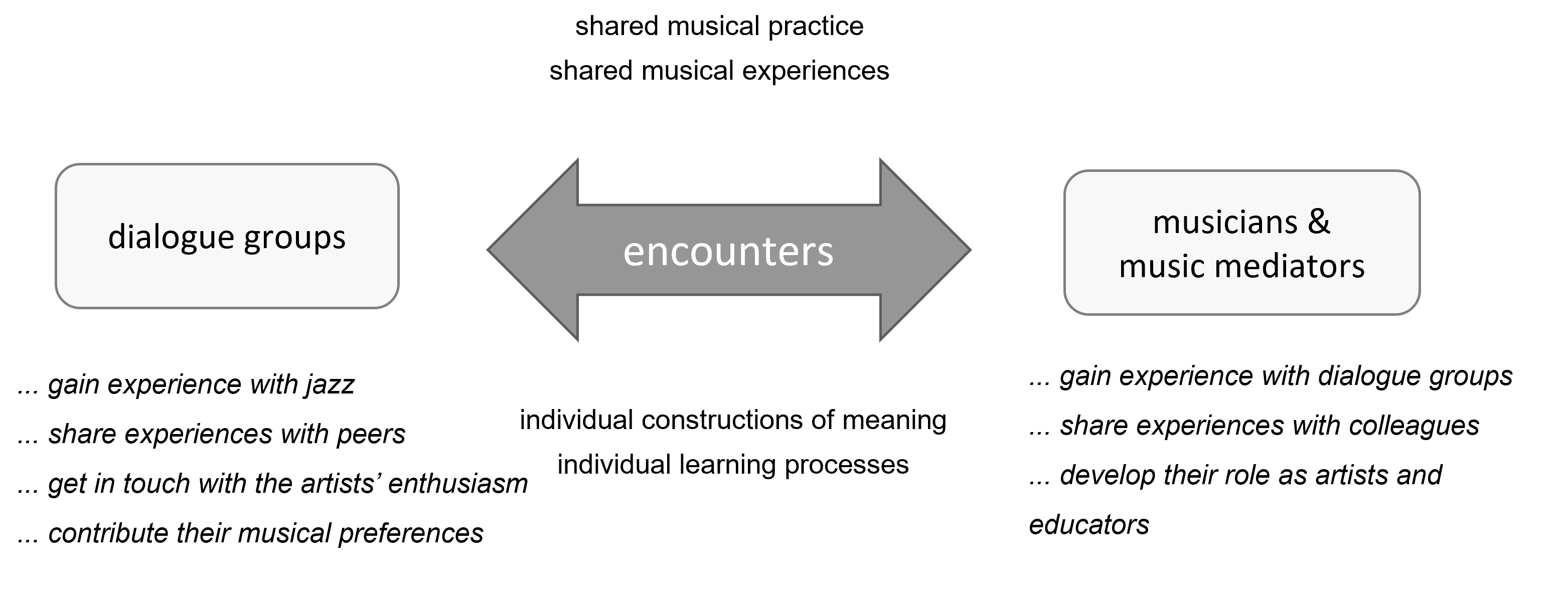
These considerations result in new requirements for jazz musicians and mediators: it is essential that they not only have enthusiasm for jazz, but also a strong interest in the encounter with the dialogue groups. Openness to new experiences with people who have probably had little contact with jazz is an essential prerequisite, in order to facilitate further development in their roles as artists and educators. Centering the interest in performance opportunities and audience generation as dominating factors is not only questionable from a socio-political point of view, but usually also shows less effect. Furthermore, the frequently formulated claim of jazz to offer more scope for interaction and communication than other musical genres cannot be realised.
Concepts that address these issues must focus on jazz processes and practices (see above) as the centre of encounters. Members of the dialogue groups are thus given the opportunity to discover this kind of “musicking” for themselves and find links to cultural practices with which they are already familiar. If interest in further shared experiences can be aroused, such joint practice can promote community building and open up “third spaces”.
This can only be achieved if we not only create one-off encounters but also establish continuity. The effect is much more sustainable if additional projects are implemented that ensure longer-term accessibility to the field of jazz practice and give opportunities for co-design. As most projects cannot achieve this on their own, cooperations with schools, music schools and other educational institutions or cultural organisations must be established. Teachers and educators should be involved in jazz mediation projects as partners. In this way, more sustainability can be achieved, while a further perspective is added, making it easier to ensure an encounter between dialogue groups and actors that can be experienced as enriching.
As mentioned at the beginning, innovative concepts of Musikvermittlung in jazz that take into account many of the aspects suggested here already exist. Nevertheless, I still see a need for further development within the jazz scene and in educational institutions in order to enable musicians to professionalise themselves more adequately when it comes to sharing their own artistic activities with other people. The still widespread distance between jazz musicians and educational institutions also constitutes a hurdle in this respect.
In order to intensify the exchange on these topics among jazz musicians and to initiate mediation and encounter projects, the area of further education should be expanded. In addition, a stronger integration of the subject area into the degree programme is necessary. Programmes should be designed in such a way that they broaden the spectrum of opportunities for jazz students to expand their professional self-image beyond the artistic field. Only if they are able to positively occupy themselves with music education or “mediating” activities can the field of “jazz mediation and encounters” be appropriately developed and find answers to social, cultural-political and educational challenges.
This can take place, for example, within the framework of the co-operative conception of mediation and encounter projects, which are reflected upon as part of the course. By gaining experience with different dialogue groups, engaging with their perspectives and sharing these experiences with others, students have good conditions for discovering new fields of work for themselves and building a positive self-image in the educational field. At the same time, these study contents can also provide impulses for their own artistic work by finding new musical paths and forms of interaction.
Further education and networking can provide space for current issues, such as handling diversity and social crises. Throughout its history, jazz has always been linked to political and social developments and can also contribute to addressing these issues in the present day. Jazz encounters have potential in this respect.
Another positive effect could be that gearing towards new dialogue groups may advance the development of jazz education as a whole, since aural, interactive and cooperative learning practices, which were originally characteristic of jazz, are once again gaining significance, and theory-based academic teaching traditions are losing importance. This could also help to make the field of jazz accessible to more people than before.
Three key aspects have emerged as crucial for advancing the topic area:
1. Understanding Musikvermittlung in jazz as a “jazz encounter” favours the design of projects that view their dialogue groups as partners (from a power-critical perspective) while taking their needs seriously.
2. Openness and learning from other people’s experiences – especially from the music mediation discourse in the classical music sector – is an important prerequisite if advancing the topic in the field of jazz is desired. At the same time, however, we as a jazz community should go our own way. The necessity for this arises not only from the different financial and cultural framework conditions, but also in particular from the specific practice of jazz, as jazz processes enable the integration of different types of music and experiences more than many other forms of making music. This specific potential for musical encounters should not be left dormant.
3. Economic interests should not dominate the organisation of jazz mediation. Instead, music education and socio-political goals should be prioritised. Only by embracing diverse musical experiences and cultural backgrounds can jazz fulfil its potential as a musical “melting pot” within a transcultural society fostering meaningful interactions among people from different levels of musical experience and cultural backgrounds.
German quotations have been translated by the author.↩︎
The metaphor of the melting pot has been widely criticized in relation to social acculturation processes for being overly assimilative (see Orosco 2016). In my view, however, this criticism applies only to a limited extent to jazz. Considering jazz as a process or practice, diverse musical traditions can be integrated and reinterpreted (Dorn 2018), and the different influences actually give rise to a new, shared form of music that cannot be reduced to its individual components.↩︎
German town with 74.000 inhabitants.↩︎
On the one hand because of their prevalence, and on the other because “encounter” is also already used in other contexts and must therefore be explained from the respective context. “Jazz encounters” is used, for example, for events as part of jazz competitions or as a title for specialist conferences.↩︎
Ake, David. 2002. Jazz Cultures. Berkley and Los Angeles: University of California Press.
Barth, Dorothee. 2015. “Vermittlung oder Erfahrung von Popmusik? (K)ein Unterrichtsgegenstand ohne bildungstheoretische Fundierung.” In Popmusik-Vermittlung. Zwischen Schule, Universität und Beruf, edited by Michael Ahlers, 69-81. Berlin: LIT.
Barth, Dorothee. 2018. Ethnie, Bildung oder Bedeutung? Zum Kulturbegriff in der interkulturell orientierten Musikpädagogik. Augsburg: Wißner.
Born, Georgina. 2005. “Musical Mediation: Ontology, Technology and Creativity.” Twentieth Century Music 2, no. 1: 7-36. DOI: 10.1017/S147857220500023X.
Buchborn, Thade, Thomas De Baets, Georg Brunner, and Silke Schmid. 2022. “Music Is What People Do! Perspectives on Music (Education) as a Praxis.” In Music is what people do, edited by Thade Buchborn, Thomas De Baets, Georg Brunner et al., 7-14. Rum/Innsbruck: Helbling.
Buscot, Camille, Jakob Fraisse, Urs Johnen, Jan Monazahian, Lise Philippen-Burdich, Ulrike Schwarz, Lennart Smidt, Julian Schunter, Magdalena Otto, and Corinna Danzer. 2023. “Vorwort.” In Jazzpilot:innen. Jazzvermittlung und Demokratieförderung, edited by Deutsche Jazzunion and Bundeszentrale für politische Bildung, 10-13. Accessed April 11, 2025. deutsche-jazzunion.de/wp-content/uploads/2025/04/JPDokumentation_online_final.pdf.
Castro Varela, María do Mar, and Nikita Dhawan. 2015. Postkoloniale Theorie: Eine kritische Einführung. Bielefeld: transcript. DOI: 10.1515/9783839411483.
Chaker, Sarah, and Axel Petri-Preis. 2022. “Musikvermittlung and Its Innovative Potential.” In Tuning Up! The Innovative Potential of Musikvermittlung, edited by Sarah Chaker and Axel Petri-Preis, 11-38. Bielefeld: transcript.
Dannhauer, Michael. 2020. “(Über-)Leben als Popmusiker*in: Eine empirische Untersuchung zur tertiären Ausbildung, dem Tätigkeitsprofil sowie den professionellen Herausforderungen und Kompetenzbeständen von Berufsmusiker*innen im Bereich Populärer Musik.” Lüneburg: Leuphana University. DOI: 10.48548/PUBDATA-610.
Dorn, Frank. 2018. Jazz als Prozess: Ästhetische und performative Dimensionen in musikpädagogischer Perspektive. Hildesheim/New York: Georg Olms.
Dunkel, Mario. 2023. “Jazz und Identität.” Aus Politik und Zeitgeschichte 73: 26-31.
Elliott, David J. 1995. Music Matters: A New Philosophy of Music Education. New York: Oxford University Press.
Fette Hupe. n.d. Jazzcape room. Accessed October 5, 2025. fettehupe.de/jazzcape-room/.
Galper, Hal. 1993. “Jazz in Academia: Another Look.” Jazz Notes Magazine 1/1993. Accessed April 11, 2025. halgalper.com/articles/jazz-in-academia/.
Hennion, Antoine. 2015. The Passion for Music: A Sociology of Mediation. London: Taylor & Francis Ltd.
Hüttmann, Rebekka. 2009. Wege der Vermittlung von Musik. Ein Konzept auf der Grundlage allgemeiner Gestaltungsprinzipien. Augsburg: Wißner.
Johansen, Guro Gravem. 2014. “On My Own. Autonomy in Learning Practices Among Jazz Students in Higher Education.” Finnish Journal of Music Education 17, no. 2, 35-54.
Johnen, Urs, Jakob Fraisse, Susanne Marquardt, and Rüdiger Nübling. 2022. Jazz study 2022. Living and Working Conditions of Jazz Musicians in Germany. Berlin. Accessed May 16, 2025. deutsche-jazzunion.de/wp-content/uploads/2024/02/Deutsche_Jazzunion_Jazz_Study_2022.pdf.
Klingmann, Heinrich. 2012. “Transkulturelle Musikvermittlung: Musikpädagogik im musikkulturellen Niemandsland?” In Transkulturalität und Musikvermittlung, edited by Melanie Unseld and Susanne Binas-Preisendörfer, 201-218. Frankfurt am Main: Peter Lang.
König, Bernhard. 2015. “Tarnkappe des Uneigentlichen.” In Best of junge Ohren 3/2015, 6-8. Accessed May 16, 2025. jungeohren.de/wp-content/uploads/2019/06/NJO_BOMagazin_3_WEB.pdf.
Krause, Martina. 2007. “Kulturkonstruktion durch Bedeutungskonstruktion? Perspektiven für einen Musikunterricht als Ort der Konstituierung von Kultur.” In Interkulturalität als Gegenstand der Musikpädagogik, edited by Norbert Schläbitz, 53-68. Essen: Die Blaue Eule.
Leidinger, Nora, and Kristin McGee. 2024. “Breaking Boundaries in Festival Programming: Gendered and Cultural Transformations at the JazzFest Berlin.” Popular Music History 15, no. 2-3: 137-155. DOI: 10.1558/pomh.26942.
Mandel, Birgit. 2016. “Audience Development, kulturelle Bildung, Kulturentwicklungs-planung, Community Building: Konzepte zur Reduzierung der sozialen Selektivität des öffentlich geförderten Kulturangebots.” In Teilhabeorientierte Kulturvermittlung: Diskurse und Konzepte für eine Neuausrichtung des öffentlich geförderten Kulturlebens, edited by Birgit Mandel, 19-50. Bielefeld: transcript.
Mautner, Hendrikje. 2007. “Musikvermittlung – Zwischen Bildung und Marketing.” In Musikforum 5, no. 2: 13-15.
Mautner-Obst, Hendrikje. 2018. “Musikvermittlung.” In Musiklernen. Bedingungen – Handlungsfelder – Positionen, edited by Wilfried Gruhn and Peter Röbke, 335-357. Innsbruck/Esslingen/Bern-Belp: Helbling.
Müller-Brozović, Irena. 2023. “Musikvermittlung zwischen Affirmation und Transformation.” In Handbuch Musikvermittlung – Studium, Lehre, Berufspraxis, edited by Axel Petri-Preis and Johannes Voit, 259-268. Bielefeld: transcript.
Niederauer, Martin. 2014. Die Widerständigkeiten des Jazz. Sozialgeschichte und Improvisation unter den Imperativen der Kulturindustrie. Frankfurt am Main: Peter Lang.
Orosco, José-Antonio. 2016. Toppling the Melting Pot: Immigration and Multiculturalism in American Pragmatism. Bloomington: Indiana University Press. DOI: 10.2307/j.ctt2005wtt.
Petri-Preis, Axel. 2023. “Musikvermittlung – eine terminologische Spurensuche.” In Handbuch Musikvermittlung – Studium, Lehre, Berufspraxis, edited by Axel Petri-Preis and Johannes Voit, 31-36. Bielefeld: transcript.
Petri-Preis, Axel, and Johannes Voit. 2023. “Was ist Musikvermittlung?” In Handbuch Musikvermittlung – Studium, Lehre, Berufspraxis, edited by Axel Petri-Preis and Johannes Voit, 25-30. Bielefeld: transcript.
Petri-Preis, Axel and Johannes Voit. 2024. “What is Music Mediation?” International Journal of Music Mediation 1: 1-9. DOI: 10.71228/ijmm.2024.14.
Pieper, Stefan, and Bernd Zimmermann. 2016. Jazz we can. Eine Analyse des Jazz in Nordrhein-Westfalen. Published by NRW Jazz e.V. Accessed June 17, 2017. nrwjazz.net/netzwerk/2016_broschuere_screen.pdf.
Prouty, Kenneth E. 2012. Knowing Jazz: Community, Pedagogy, and Canon in the Information Age. Jackson: University Press of Mississippi.
Renz, Thomas, and Maximilian Körner. 2016. Jazzstudie 2016: Lebens- und Arbeitsbedingungen von Jazzmusiker/-innen in Deutschland. Hildesheim: Institut für Kulturpolitik. Accessed November 2, 2025. miz.org/de/dokumente/jazzstudie-2016.
Richter, Christoph. 2018. “Musikvermittlung für erwachsene Laien, verstanden als Begegnung mit Musik.” Diskussion Musikpädagogik, Special Edition S9, 108-117.
Rolle, Christian. 1999. Musikalisch-ästhetische Bildung: über die Bedeutung ästhetischer Erfahrung für musikalische Bildungsprozesse. Kassel: Bosse.
Sachsse, Malte. 2023. “Musikvermittlung zwischen Tradition und Innovation.” In Handbuch Musikvermittlung – Studium, Lehre, Berufspraxis, edited by Axel Petri-Preis and Johannes Voit, 277-284. Bielefeld: transcript.
Schippling, Joshua, and Johannes Voit. 2023. “Musikvermittlung zwischen Kunstwerk-, Dialoggruppen- und Lebensweltorientierung.” In Handbuch Musikvermittlung – Studium, Lehre, Berufspraxis, edited by Axel Petri-Preis and Johannes Voit, 219-226. Bielefeld: transcript.
Schulz-Koehn, Dietrich. 1959. Jazz in der Schule: mit Vorwort, didaktischem Teil und methodischer Darstellung einer Fünf-Stunden-Reihe von Walter Gieseler. Wolfenbüttel: Möseler.
Schunter, Julian. 2023. “Jazz als Melting Pot. Überlegungen zum Konzept der Transkulturalität in der Jazzpädagogik.” In Jazzpilot:innen. Jazzvermittlung und Demokratieförderung, edited by Deutsche Jazzunion and Bundeszentrale für politische Bildung, 36-39. Accessed April 11, 2025. deutsche-jazzunion.de/wp-content/uploads/2025/04/JPDokumentation_online_final.pdf.
Schwarz, Ulrike. 2023. “Jazz als Demokratieförderung – Geht da was?” In Jazzpilot:innen. Jazzvermittlung und Demokratieförderung, edited by Deutsche Jazzunion and Bundeszentrale für politische Bildung, 44-55. Accessed April 11, 2025. deutsche-jazzunion.de/wp-content/uploads/2025/04/JPDokumentation_online_final.pdf.
Siedenburg, Ilka. 2018. “Jazz für Kinder! Potentiale und Herausforderungen zwischen Improvisation und Groove.” Zeitschrift Ästhetische Bildung 10, no. 1.
Siedenburg, Ilka. (in preparation). “Jazz und Pädagogik.” In Handbuch Jazz, edited by Mario Dunkel and Magdalena Fürnkranz. Stuttgart: Metzler.
Small, Christopher. 1998. Musicking. The Meanings of Performing and Listening. Hanover: University Press of New England.
Stoffers, Nina. 2023. “Machtkritische Perspektiven auf Musikvermittlung.” In Handbuch Musikvermittlung – Studium, Lehre, Berufspraxis, edited by Axel Petri-Preis and Johannes Voit, 107-112. Bielefeld: transcript.
Terhag, Jürgen. 2009. “Zwischen Distanz und Nähe: 50 Jahre Populäre Musik in der Schule.” Musik und Bildung, no. 3: 10-14.
Voit, Johannes. 2023a. “Begründungsfiguren und -diskurse der Musikvermittlung.” In Handbuch Musikvermittlung – Studium, Lehre, Berufspraxis, edited by Axel Petri-Preis and Johannes Voit, 37-42. Bielefeld: transcript.
Voit, Johannes. 2023b. “Geschichte der Musikvermittlung.” In Handbuch Musikvermittlung – Studium, Lehre, Berufspraxis, edited by Axel Petri-Preis and Johannes Voit, 67-74. Bielefeld: transcript.
Ilka Siedenburg has been Professor of Music Education at the University of Münster since 2014. Prior to this, she held various positions as an instrument teacher and school music teacher, jazz musician and university lecturer, before becoming Professor of Pop Music Education at Osnabrück University of Applied Sciences. Within music education, her work focuses on jazz and pop music, gender, improvisation and digital media.
ISSN 2943-6109 – Volume 2/2 (2025) – DOI: 10.71228/ijmm.2025.31
This paper is published under a Creative Commons Attribution 4.0 International License. Parts of an article may be published under a different license. If this is the case, these parts are clearly marked as such.
