
This reflection on practice is based on an Interview with jazz musician and educator Harald Rüschenbaum and explores his pedagogical philosophy and practice through the lens of his work with the Bavarian State Youth Jazz Orchestra and their concerts in state schools. Rather than viewing music as a fixed curriculum or performance, Rüschenbaum frames it as a process of encounter, openness, and mutual discovery. His approach emphasizes improvisation, both musically and pedagogically. Acting simultaneously as a performer, mediator, and mentor during these concerts, Rüschenbaum creates spaces where children and musicians from the orchestra can engage experientially with jazz. He advocates a learning-by-doing model supported by reflection, where individual curiosity and collective connection are central. This article highlights how his methods aim for genuine engagement and position jazz-oriented music mediation as a dynamic interplay between people, sounds, and context – being less about conveying knowledge and more about enabling shared musical experiences.
Ce « billet du terrain » s'appuie sur un entretien avec le musicien de jazz et éducateur Harald Rüschenbaum et explore sa philosophie et sa pratique pédagogiques au prisme de son travail avec l'Orchestre de jazz des jeunes de Bavière et leurs concerts dans les écoles publiques. Plutôt que de considérer la musique comme un programme ou une performance figée, Rüschenbaum la présente comme un processus de rencontre, d'ouverture et de découverte mutuelle. Son approche met l'accent sur l'improvisation, tant sur le plan musical que pédagogique. Agissant à la fois comme interprète, médiateur de la musique et mentor lors de ces concerts, Harald Rüschenbaum crée des espaces où les enfants et les musiciens de l'orchestre peuvent s'initier au jazz de manière expérientielle. Il prône un modèle d'apprentissage par la pratique, soutenu par la réflexion, où la curiosité individuelle et la connexion collective occupent une place centrale. L'article souligne comment ses méthodes visent un engagement authentique et positionnent la médiation musicale orientée vers le jazz comme une interaction dynamique entre les personnes, les sons et le contexte – moins axée sur la transmission de connaissances que sur la création d'expériences musicales partagées.
Diese Praxisreflexion basiert auf einem Interview mit dem Jazzmusiker und Musikpädagogen Harald Rüschenbaum. Sie beleuchtet seine pädagogische Einstellung im Rahmen seiner Arbeit mit dem Bayerischen Landesjugendjazzorchester und deren Vermittlungskonzerte an allgemeinbildenden Schulen. Anstatt Musik als festgelegten Lehrplan oder Aufführung zu begreifen, versteht Rüschenbaum sie als Prozess der Begegnung, Offenheit und gemeinsamen Entdeckung. Sein Ansatz betont Improvisation – sowohl musikalisch als auch pädagogisch. In den Schulkonzerten agiert er zugleich als Musiker, Vermittler und Mentor und schafft Räume, in denen Kinder sowie junge Musiker_innen des Orchesters Jazz erfahrbar erleben können. Er plädiert für ein erfahrungsbasiertes Lernen, das durch Reflexion begleitet wird und in dem individuelle Neugier sowie kollektive Verbindung im Zentrum stehen. Der Beitrag zeigt auf, wie seine Methoden echte Teilhabe beabsichtigen und konturiert Rüschenbaums Auffassung von Jazzvermittlung als dynamisches Zusammenspiel zwischen Menschen, Klängen und Kontext – weniger als reiner Wissenstransfer, sondern als Ermöglichung gemeinsamer musikalischer Erfahrungen.
Bavarian Youth Jazz Orchestra, mediation, education, performative approach, improvisation, experience-based process
The Bavarian State Youth Jazz Orchestra [Landes-Jugendjazzorchester Bayern – LJJB1] is a publicly funded institution that supports young musical talent between the age of 16 and 25. It is financed by the Free State of Bavaria and the Association of Bavarian Singing and Music Schools. Over the course of four project phases throughout the year, the young musicians gather at various locations across Bavaria. There, they rehearse and perform – in both “diverse big band formations and their individual sections” (Landes-Jugendjazzorchester Bayern n.d.-a) – under the guidance of multiple instructors. In addition to that, the LJJB offers special support programs in which, for example, selected members lead workshops and perform concerts at state schools, music schools and other institutions. These workshops are intended to supplement music lessons, but also as an opportunity for local teachers to experience “new aspects of big band conducting, sound control and improvisation”2 (Landes-Jugendjazzorchester Bayern n.d.-b) and to enter into an informative and direct exchange with the team of lecturers.
With the aim of “mediating music on a subconscious level” (Landes-Jugendjazzorchester Bayern n.d.-c), a variety of workshop-formats are offered that differ in the level of participation of the students3 from the state schools (age 6-19). These include more traditional forms of music mediation, such as concerts in which the artistic director explains musical aspects as part of the moderation (ibid.). In addition, more interactive formats are offered, where members of the LJJB make music together with the students in small ensembles, as in a workshop. Here, the artistic director provides “practical impulses for collective music-making through perception, interaction, listening, and responding” (Landes-Jugendjazzorchester n.d.-c). This participatory music-making takes place in various ways: through singing, clapping, using percussion instruments that are handed out, or inviting individual students up onto the stage to play single notes on the piano, guitar or bass, while the rest of the ensemble plays as usual.
A key figure in the development and implementation of this concept is the jazz drummer Harald Rüschenbaum. For over 30 years he was the artistic director of the LJJB and played a key role “in the ongoing development of the orchestra’s own pedagogical concept” (Landes-Jugendjazzorchester Bayern n.d.-c). From my own experience, I can say that Rüschenbaum is always doing music mediation. Even at traditional concerts he energetically interacts with the audience. By letting them sing notes or chords, clap polyrhythmic patterns or sing call and response phrases, Rüschenbaum wants the audience to actively participate at a concert. His retirement from the position as artistic director of the LJJB, as well as the special edition of this magazine, served as an opportunity to invite him for an interview to talk about his work with children and young people and members of the LJJB. My aim was to learn more about his views and attitudes towards jazz-oriented music mediation and teaching jazz. In the following practical reflection, I present three central aspects of this interview that took place on April 29, 2025. First, I discuss Rüschenbaum’s understanding of music and jazz and the role they play in his mediation work. Next, I use selected interview passages to show how he reports on his work as a jazz mediator. Finally, I present his view of the role of the LJJB members within the support programs. The interview excerpts were edited for clarity and presented to Harald Rüschenbaum for validation.
I first met Harald Rüschenbaum when I was a member of the LJJB myself. This gave me the opportunity to experience him at first hand as a jazz mediator within the framework of the aforementioned support programs. In addition, I’ve been playing in his band “Klangland” for several years now. With this group, we also perform mediation concerts at state schools. For the interview, we met in his rehearsal space in Munich. Although I never asked him directly what music means to him personally, we quickly got talking about this topic:
When I play, I want to express something – something that I have inside me, a clear idea. But this expression only succeeds if we share this idea as a band. Otherwise, it’s just four paths running in parallel. But when we are truly connected, the four of us become one. And this alignment happens all the time. When I’m playing with the band, I’m always checking what’s happening. But you have to be open to that. For me, that’s the essence of making music.
Rüschenbaum describes music, and jazz in particular, as something deeply situational and interactive. Central to his understanding is the empathetic connection between the players, without which collaborative music-making would hardly be possible. In hindsight, it’s not surprising that this very theme also plays a central role in his mediation work – after all, he is doing jazz in those settings. However, for him it’s not about demonstrating or presenting something, but about acting spontaneously and situationally in this new context.
I: And is that what you want to show the students?
HR: I don’t want to show that. I want to give music the opportunity to appear. I can’t force it. We can’t force music. But when this gift does happen – and it often does – it has a lot to do with joy. Something emerges; something suddenly comes together. In such moments, there’s a kind of compass. The musicians sense: “Yes, this is the way.” And you let go. You stop ‘doing’ – and then music arises. Afterwards you simply say: “That was great. Really great.” The more I engage with music, the more I realize: it is always a process of letting go. Especially in the jazz context.
I: Why in a jazz context?
HR: Because you have a natural kind of freedom there. And when you prioritize the attempt to play freely, it doesn’t matter in the end whether it ‘works’ or not. The audience feels whether you tried – and that’s often enough. And if it works: wow. And if a piece doesn’t work – also okay. Because this desire, this yearning for real music, still shows itself. Not in the sense of working, but: it shines through. But if you have four people, four leaders, and everyone says: “Today we’ll do it this way, I’ll play like this, and I’ll play like that” – then that can create a block. They might be great musicians, but nothing collective emerges. Everyone wants something different – and then it doesn’t come together. There’s a barrier. That’s just how it is: sometimes it happens, sometimes it doesn’t. You can’t force music. But if the impulse is there to truly allow something to happen, then – this is my experience – music gives something back.
For Rüschenbaum, music is much more than the mere production of sounds. For him, it arises from a deeper process of encounter and openness. “This process is the actual music”, he says. Music is not a goal, but a path – a medium through which people connect and come to perceive themselves and one another.
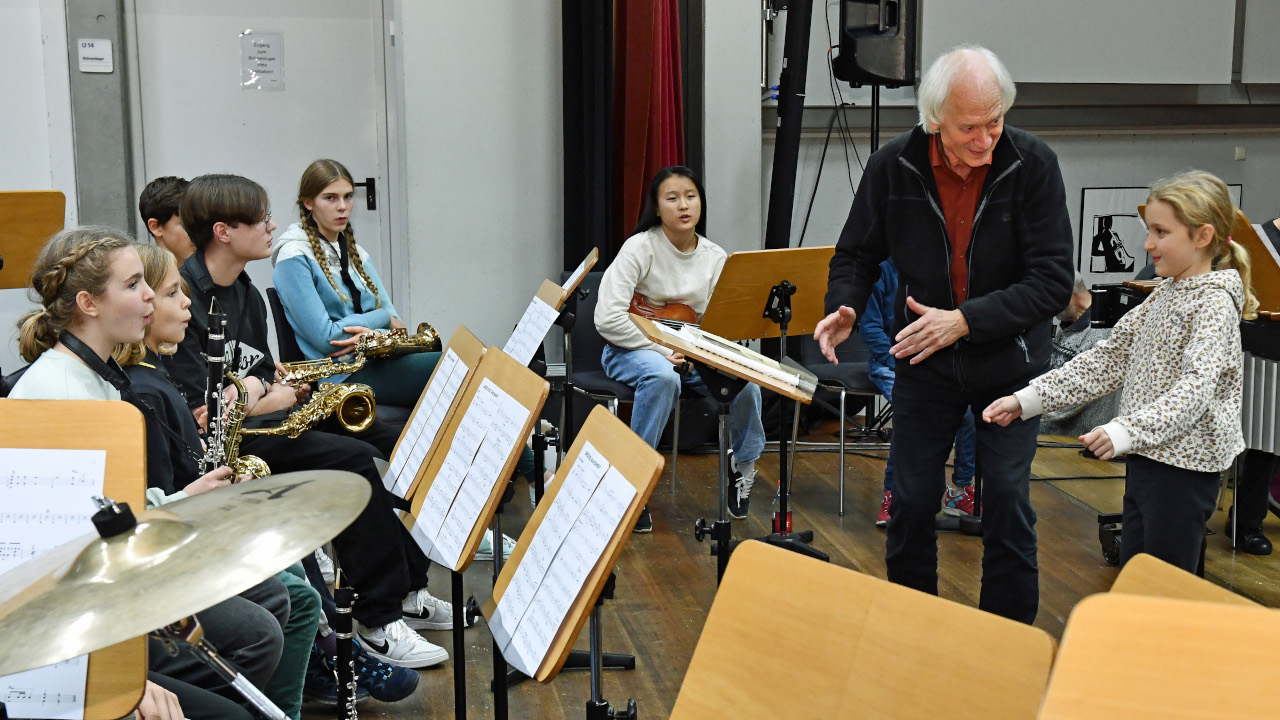
Music doesn’t even need to be played in order to exist:
Music is already there – even when we’re playing. When we play a piece like Ana Maria, we tap into something that has been going on forever. We step into a stream that is already flowing. We are just a glimpse of it – a moment in the whole. The groove is already running. That’s where music truly lives, for me. And right now, the two of us at this very moment, talking, we wouldn’t even need to play. What we’re hearing right now – you and I, right here – the potential is incredible. That, for me, is music.
Rüschenbaum describes making music as a process of searching and finding – relating to the playing situation, the connection between the musicians, the shared intention, the positioning in a tradition of some kind, etc. For him, the act of opening up, letting go and connecting is the music. This resonates with the observations of Petri-Preis and Voit, who describe music mediation as “a broad artistic and educational practice that fosters diverse relationships between people and musics” (2024, 4). In Rüschenbaum's account, it becomes clear: making music and improvising can themselves be understood as a process of mediation – as a form of connecting, for instance, the present moment with an ongoing stream. Jazz mediation, in this sense, could be seen – in analogy to a fractal structure – as composed of many smaller versions of itself. Following Petri-Preis and Voit (2024), jazz mediation could thus be understood as establishing relationships between people and between acts of connection themselves.
According to Rüschenbaum, music is a process of experience and encounter that has the potential to connect people. He does not see music as a transfer of knowledge or solely a performance, but as a process of allowing and opening up. He describes his work in school concerts in a similar way: openness, presence, and the enabling and allowing of experience are all central elements of his mediating activities.
HR: It’s not about working through a fixed program. We go to the school and see what happens there. From that, we then decide what to do – with the goal that the children come into contact with the people making the music. The focus is therefore not the same as in traditional music lessons. Rather, we ask: What happens in a band? How does communication work there? What are the dynamics between people? And: Can we make what emerges there audible for the children? Can we leave tracks for them – paths they can follow to get a sense of what is involved in this musical process?
I: So when you go in there – you really have no idea what will happen?
HR: How could I? I don’t know the children, I don’t know what will happen. Of course, I've built up a huge repertoire of possibilities over the years – but basically, I only use this repertoire to open them up. If they are open, anything is possible. Yes.
It is noteworthy here that Rüschenbaum describes his approach as highly improvisational and performative (Volbers 2014, 1): It is only through the actions of Rüschenbaum and his group that the reality of jazz mediation emerges. Without prior planning, they act situationally – essentially improvising. There are similarities to Ulrich Mahlert’s “teaching as inspired improvisation” (2011, 114) or to Corinna Eikmeier’s (2024) concept of improvisational pedagogy. Being able to connect appears to be a central aspect of mediation for Rüschenbaum. This refers, on the one hand, to the ongoing groove and the need to recognize one’s personal role as part of a larger whole:
This is where silence comes into play. Silence is the canvas. It’s always there, in the background. Everything else – whether it’s red, or a groove, or whatever – just lies in front of it. All the sounds are right here. Now. That’s what I want to open when I look into the eyes [of someone] – that’s what I want to bring out.
On the other hand, this notion of connection also relates to a subjective, personal dimension. Rüschenbaum emphasizes how important it is to spark the children's enthusiasm. In the following excerpt, he draws a connection between moments in his own artistic practice as a jazz musician and his experiences as a jazz mediator.
[When I play] with Marco Lobo [virtuoso percussionist from Brazil, comment by the author], I become the child. I follow him. And I learn so much from that. And when a child is there and I can tell the child that la la la la [he sings a few notes with enthusiastic expression] – then there is amazement. And the amazement – that's the master. And then comes curiosity. This “wow!” – and suddenly it all happens on its own. It’s this playful curiosity where learning takes place. Like children in a sandbox. Or an infant who tries to climb up the chair because he wants to stand and walk – and falls over. What do we do? “Oh, great! Try again! Yay.” And the child tries again. And again. At some point it stands. Falls again. Doesn’t matter. Imagine if making a mistake was forbidden? There are no mistakes. What it takes is courage to begin. Beginning is the key.
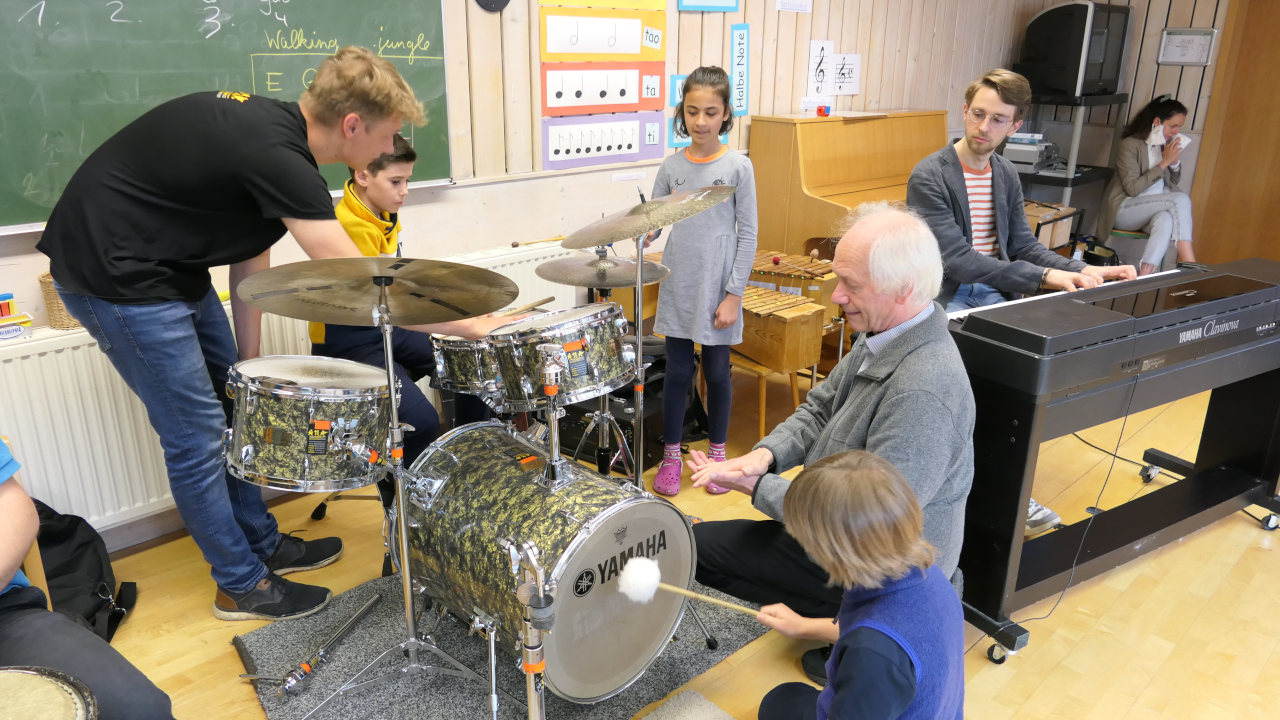
The support programs organized by the LJJB are not only jazz concerts for public schools but also learning opportunities for the orchestra’s members who participate. On the one hand, these concerts aim to demonstrate the highly situational nature of jazz; on the other, they serve to teach the members how this kind of mediation actually works. Rüschenbaum, therefore, operates in at least two roles during these concerts: on one side, as a music mediator for the school classes, and on the other, as mentor for aspiring music mediators from the LJJB. Even in this context, Rüschenbaum does not describe his teaching as a transmission of knowledge, but rather as a shared practice: “Yes, they [members, comment by the author] come along and together we explore what’s happening there. Of course, I do tell them in advance, ‘You’ll start by playing two pieces.’” After this more or less fixed beginning, however, Rüschenbaum focuses on the active involvement of the members, encouraging them to observe and experience firsthand how he himself interacts with the students in these concerts.
Yes, it's about experiencing it. That you don't have to know exactly what's going to happen. That's also what I experience myself: I often don't know what I'm going to do next. What matters is responding to the situation as it is. Can I take someone with me now? Such questions arise spontaneously. And that’s what I try to model for them. And it has an effect on them.
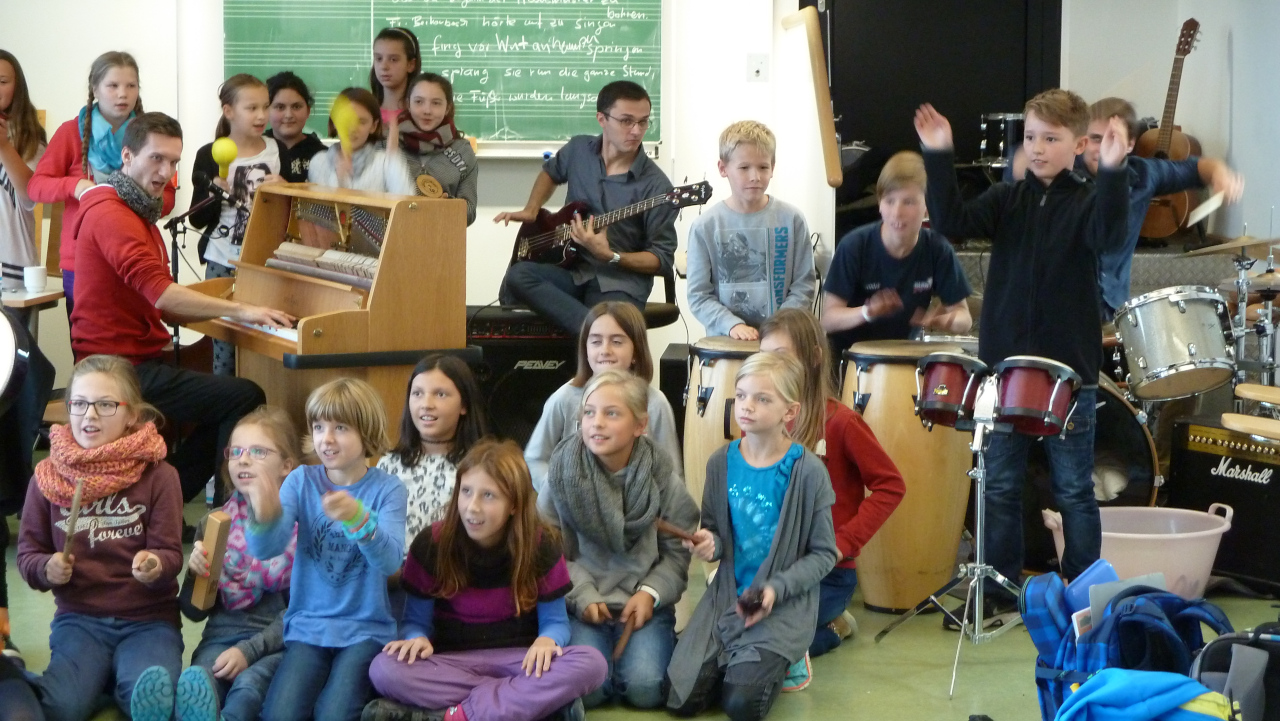
Rüschenbaum wants to give the members the opportunity to experience and feel what unfolds in these situations, rather than telling them what to do. This again reveals his fundamental attitude: he sees himself as an enabler. He provides a space intended to foster individual development.
On the one hand, it’s learning by doing, but I always try to include a short reflection session afterwards – like an osmotic process: the young people experience the situation [during the mediation concerts, comment by the author] one, two, three times – and they start to notice things. Then they begin asking questions. And from that point on, it often happens by itself - the container starts to fill. When the questions come, I know: aha, they've understood. A coin has dropped or a Eureka has happened. And that's when we can fill this Eureka because the space is open for it. Not because I tell them: “You have to do this, and this, and this.” – because when I do that, they stop thinking for themselves.
Like Rüschenbaum, the members of the LJJB take on multiple roles during mediation concerts: firstly, as musicians performing jazz together, but also as music mediators who actively involve children and young people in the process of making music. Through openness and interaction, they are encouraged to facilitate encounters – between themselves, the audience, and the music. Their active participation should help listeners perceive themselves through the experience of music. At the same time, the members as musicians remain learners themselves, implicitly gaining insight into how musical experience can be made accessible – by observing and working alongside Rüschenbaum as an experienced jazz mediator.
In summary, Rüschenbaum describes his responsibility as a mediator and mentor as opening a space in which students and members can become active themselves and make their own discoveries. Instead of offering ready-made solutions, he seeks to foster an open and curious mindset. His focus is on the joy of music and making music together as an experience-based process. He is not interested in imparting knowledge or demonstrating something, but in creating opportunities to let the music appear. For him, the decisive moments are those in which he senses that “something opens up”.
Rüschenbaum had a significant influence on the ongoing development of the orchestra’s own pedagogical concept. Thanks to the broad reach of the membership organization, which functions as a pool of musicians rather than a traditionally staffed big band, there is, in my experience, hardly any Bavarian jazz musician who has not, at some point in their career, worked with Rüschenbaum and been exposed to his ideas about music and mediation. From my perspective, the concept of the institution seems to be tailored to the person of Harald Rüschenbaum. His ability to inspire and captivate people is a central aspect of both the LJJB’s working phases and its concerts. Although Rüschenbaum has stepped down as artistic director, he continues to contribute as a tutor for rhythm sections in LJJB projects. Nevertheless, it remains exciting to see how the LJJB will develop without him as artistic director and to what extent his ways of thinking will be carried forward. One challenge could be maintaining his expectations regarding musical and music mediation situations. In contrast to a maybe more traditional notion of having high artistic standards, Rüschenbaum wishes to distance himself, as a mediator, from imposing specific demands and expectations: “I don’t want to show something – I want to give music the opportunity to appear.” His aim is therefore not to present something specific but to experience something together with the students and members.
As I mentioned at the beginning, I had the opportunity to experience Rüschenbaum’s work as a jazz mediator first hand – both as a member of the LJJB and as a saxophonist in his ensemble Klangland. In my experience, his approach – reminiscent of a performative approach (Volbers 2014) – holds the potential to release great energy and joy in both audiences and musicians. The moments that arise in Rüschenbaum’s mediation concerts through attentive mutual listening and reciprocal interaction between the musicians and the audience resemble the principle of emergence “as an autopoietic principle of formation and structural development” (Maschat 2016, 240): it is not the musicians who determine the course of the mediation concert, but rather the concert that “demands” (Figueroa-Dreher 2016, 302) something from the mediators. Consequently, the conditions for success are not based on pre-defined templates but – following Figueroa-Dreher (2016) – on the development of the process of the mediation itself, rather than through strict adherence to predetermined plans.
This became especially clear to me during a situation when we, as Klangland, visited a lower secondary school in the greater Munich area one morning. As a quartet, we gave two concerts for two sixth-grade classes. There was hardly any preparation – only six pieces were loosely discussed as possible options – and Rüschenbaum’s motto was: “Let’s just see what happens”. My reception of the two concerts could not have been more different. In the first concert, a strong dynamic unfolded, characterized by interaction, curiosity, and creative participation on the part of the students. After an introductory piece, Rüschenbaum interacted with the class, led clapping exercises, invited them to sing along, try instruments, and more. The students’ response was remarkable and had a direct effect on us as a band. We ended up playing only the first of the previously discussed pieces, as the evolving energy of the concert called for different music than originally intended. From my perspective, I sensed a deep emotional resonance among the students – a sense of wonder, which I might interpret as a so-called key experience (Khittl 2024).
The second concert, however, felt very different. Though we began in the same way, the interaction did not take off. The students seemed more distracted and less receptive to the experience, showing limited engagement with us as performers and mediators. Rüschenbaum responded by increasing his energy and trying to further animate the group, which to me resulted more in chaotic agitation than in genuine connection. Again, the students’ behavior had an impact on us as a band: we ended up playing the exact set of pieces from the first concert, even though that hadn’t been our plan. It felt as though we reverted to familiar, seemingly reliable patterns because we didn’t quite know how to respond to this new situation.
Reflecting on these two contrasting experiences, I feel a growing curiosity – both as mediator and researcher – to better understand this kind of situational, open-ended and emergence-oriented mode of mediation. What prevented the second group from becoming engaged? Was it due to the time of day, group dynamics, the accompanying teachers – or perhaps my own expectations to replicate the success of the first concert? What alternative actions might have better matched the energy of the second group? And did my fellow musicians perceive the situation as I did?
In my view, the potential of this kind of open, non-linear, and performative mediation practice, as far as I was able to observe, seems well worth examining more closely – not in order to develop rigid action plans or to constrain spontaneous behavior, but rather to better understand the conditions under which key experiences or emotional resonance are more likely to occur.
ljjb.de/landes-jugendjazzorchester-bayern/ (accessed October 24, 2025).↩︎
German quotations have been translated by the author.↩︎
For clarity, I will use the word “students” for the students from the state schools and the word “members” for the musicians of the LJJB in the rest of this text.↩︎
Eikmeier, Corinna. 2024. “Improvisierende Pädagogik im Instrumental- und Gesangsunterricht.” In Instrumentaldidaktik künstlerisch gedacht, edited by Hannah Lindmaier and Peter Röbke, 99-116. Münster: Waxmann.
Figueroa-Dreher, Silvana. 2016. Improvisieren: Material, Interaktion, Haltung und Musik aus soziologischer Perspektive. Wiesbaden: Springer VS.
Khittl, Christoph. 2024. “Ent-Didaktisierung der Musikalischen Bildung und Ent-Bildung der Musikdidaktiken: Eine theoretisch-narrative Studie zur musikalischen Bildung.” In Instrumentaldidaktik künstlerisch gedacht, edited by Hannah Lindmaier and Peter Röbke, 209-236. Münster: Waxmann.
Landes-Jugendjazzorchester Bayern. n.d.-a. “Landes-Jugendjazzorchester Bayern (LJJB).” Accessed May 19, 2025. ljjb.de/landes-jugendjazzorchester-bayern.
Landes-Jugendjazzorchester Bayern. n.d.-b. “Pädagogisches Konzept.” Accessed May 19, 2025. ljjb.de/paedagogisches-konzept/.
Landes-Jugendjazzorchester Bayern. n.d.-c. “Jugend Jazzt: Fördermaßnahmen und Kurse.” Accessed May 28, 2025. ljjb.de/foerdermassnahmen-und-kurse/.
Mahlert, Ulrich. 2011. Wege zum Musizieren: Methoden im Instrumental- und Vokalunterricht. Mainz: Schott.
Maschat, Mathias. 2016. “Improvisation – Performativität – Ästhetik / Improvisation – Performativity – Aesthetics: Von der Performance musikalischer Improvisation zur Improvisationsästhetik / From Performing Musical Improvisation to Aesthetics of Improvisation.” In Improvisation erforschen – improvisierend forschen, edited by Reinhard Gagel and Matthias Schwabe, 229-247. Bielefeld: transcript.
Petri-Preis, Axel, and Johannes Voit. 2024. “What is Music Mediation?” International Journal of Music Mediation 1, no. 1. DOI: 10.71228/ijmm.2024.14.
Volbers, Jörg. 2014. Performative Kultur: Eine Einführung. Wiesbaden: Springer.
Jonas Brinckmann is a jazz saxophonist, educator, and researcher in the field of music education. He is affiliated with the Hochschule für Musik Dresden, the Gustav Mahler Privatuniversität für Musik Klagenfurt, and the Musikschule Unterschleißheim. His research focuses on jazz pedagogy, and his doctoral dissertation examines how instrumental teachers at music schools talk about teaching and learning jazz improvisation. As a musician, he performs regularly with ensembles such as the Christian Elsässer Jazzorchestra, Grapha or Klangland.
ISSN 2943-6109 – Volume 2/2 (2025) – DOI: 10.71228/ijmm.2025.32
This paper is published under a Creative Commons Attribution 4.0 International License. Parts of an article may be published under a different license. If this is the case, these parts are clearly marked as such.
