
This article reflects on the project Jazz macht Schule – Schule macht Jazz uniting students and professionals from the artistic backgrounds of creative writing, bodymusic, the visual arts, instrumental tuition, media and dance, in order to foster engagement with the world of jazz. The project aimed to introduce the musical and historical dimensions of jazz, but also to encourage creative expression, collaboration and critical engagement with the art form, in alignment with the Austrian lower secondary school music education curriculum. It highlighted female jazz musicians and was conceptually anchored in the vision of International Jazz Day, which it celebrated with a collaborative performance, live music and exhibitions.
Cet article propose une réflexion sur le projet Jazz macht Schule - Schule macht Jazz (le jazz fait école – l’école fait du jazz) qui rassemble des étudiant.es et des professionnel.les issu.es de l’écriture créative, du body music, des arts visuels, de l’enseignement instrumental, des médias et la dance pour favoriser l’engagement dans le monde du jazz. Le projet visait à présenter les dimensions historiques et musicales du jazz, mais aussi à favoriser l’expression artistique, la collaboration et le développement d’une posture critique vis-à-vis de l’art en concordance avec les attentes du programme d’enseignement en vigueur dans les collèges autrichiennes. Il mettait en avant les femmes musiciennes de jazz et s'inspirait de la vision de la Journée internationale du jazz, qu'il célébrait par un spectacle collaboratif, de la musique live et des expositions.
Der Artikel setzt sich mit dem Projekt Jazz macht Schule – Schule macht Jazz auseinander, welches Schüler_innen mit Musiker_innen und Künstler_innen der Sparten Kreatives Schreiben, Bodymusic, angewandte Kunst, Instrumentalmusik, Medien und Tanz zusammenbrachte. Das Projekt wollte eine Lernumgebung schaffen, in welcher die jungen Teilnehmer_innen in die Welt des Jazz eintauchen konnten. Es hatte zum Ziel die musikalischen und historischen Dimensionen des Jazz (insbesondere auch die Rolle der Frauen im Jazz) zu beleuchten sowie kreatives Ausdrucksvermögen, Zusammenarbeit und kritische Auseinandersetzung mit der Kunstform zu fördern. Das Projekt wurde in Anlehnung an den österreichischen Lehrplan für die AHS Unterstufe geplant und war tief verankert in der Vision des International Jazz Day. Unter anderem hatten die Schüler_innen auch die Möglichkeit mit ihren Freund_innen instrumentale Jazzmusik zu spielen, unterstützt von erfahrenen Jazzmusiker_innen. „Jazz macht Schule – Schule macht Jazz“ feierte den internationalen Jazztag mit einer gemeinsamen Performance, Live-Musik und der Ausstellung von Kunstwerken, die im Rahmen von vorher durchgeführten Workshops entstanden waren.
interdisciplinary performance, external educational workshops, lower secondary school cooperation, female jazz artists, student performance
Jazz macht Schule [Jazz Goes to School] was initiated in the second semester of the 2024–2025 school year by Markus Osztovics, Katharina Osztovics and Peter Janisch – educators with an academic background in music education and/or jazz performance, and with established careers across the fields of jazz, education, and music mediation. Driven by a shared passion for jazz, they set out to create a collaborative, interdisciplinary learning environment that would align with the Austrian lower secondary school music education curriculum.
The recognition that musical practice reflects society not only promotes conscious, active participation in musical life, but also contributes to the shaping of society. Public performances, concerts and visits to music theatres, as well as collaborations with external educational partners, expand and enrich learning with and through music.1 (Bundesministerium für Bildung, n.d.)
The project established a framework for collaboration between students and various art professionals within the educational context and aimed to open new pathways into jazz for young people. It was structured around three core pillars: a two-day school workshop and a public workshop for young instrumentalists, both taking place under the title Jazz macht Schule [Jazz Goes to School] and a public event entitled Schule macht Jazz [School Does Jazz]. The project’s core objective was to foster an environment where the young participants could engage with the world of jazz, including its music and history, through language, movement, rhythm, media, or the visual arts. In addition to the internal Jazz macht Schule workshops held in a school setting, the project also aimed to include young musicians from other educational institutions. For this reason, another workshop open to the public was included in the outline of Jazz macht Schule (see Fig. 1). It was given prior to the public event Schule macht Jazz, which marked the end of the project and served as a platform for the participants to share their work, but also to introduce the audience to various aspects of jazz, such as spontaneity, improvisation, historical background, swing rhythm or the canon of so-called jazz standards.

Jazz macht Schule targeted young people aged ten to fourteen whose curriculum does not have a special focus on music. The project was implemented in partnership with Bundesgymnasium Gröhrmühlgasse in Wiener Neustadt, Lower Austria, where co-initiator Peter Janisch holds a teaching position in music education. A key conceptual decision within the project was to predominantly feature female artists and musicians, thereby foregrounding female perspectives in jazz music and its history – an area often underrepresented (see Fig. 2).

The initiative culminated in a public event entitled Schule macht Jazz, which brought together all participating students, artists, and musicians. The event was held in celebration of International Jazz Day and featured performances by student ensembles, as well as presentations from the various interdisciplinary workshop groups involved in the project (see Fig. 3).
Following the school headmaster’s agreement to participate in the project, the initial step involved assessing the willingness of the teaching staff to contribute and identifying year groups that would most benefit from involvement. It was decided to collaborate with one first-year group (age 10 to 11), four second-year groups (age 11 to 12), one third-year group (age 12 to 13) enrolled in the Media Informatics branch, as well as the instrumentalists from the school band. Although the school does not specialise in music, an elective course entitled School Band was introduced by Janisch in September 2024, as an initial step toward fostering extracurricular music-making opportunities. Up to that point, the ensemble’s repertoire had not included a specific focus on jazz.
Once the project schedule, structure, and workshop options had been finalised, the details were presented to all participating students, who were then invited to rank their preferred workshops. Students were subsequently assigned to groups based on their first or second choices. The third-year group, given their prior curricular exposure, engaged in a workshop focused on jazz and media, while the School Band worked on performing instrumental jazz pieces, mentored by Markus Osztovics, one of the workshop leaders and an experienced jazz musician. In total, six workshop groups were formed, each comprising between 15 and 35 participants. These workshops explored jazz from various interdisciplinary perspectives, including language, movement, rhythm, media, the visual arts, and musical performance in a band setting.
Apart from the project coordinators (Peter Janisch and Markus Osztovics, who worked with the school band, and Katharina Osztovics, who mentored the media group), the other workshop leaders were not specialists in jazz performance or history. A painter, a creative writing specialist, a body music artist and a dancer completed the team of workshop leaders. All six workshop leaders were established professionals in their respective artistic disciplines and were united by their interest in jazz or jazz culture. To support those who were not professionally affiliated with jazz, the project coordinators developed a framework offering pedagogical resources, musical materials and guidance, enabling each artist to design their sessions in alignment with their own field of expertise, while still contributing meaningfully to the overarching jazz theme of the project.
Each group participated in two full workshop days, scheduled on two dates in the second semester, which allowed all groups to work simultaneously. Each student group was accompanied by their school teacher, who supported the assigned artist with organisational matters, such as locating equipment, arranging materials, and coordinating the use of school spaces. As the workshops were not bound by the usual school timetable, breaks could be scheduled flexibly, in accordance with the workflow and creative process. Each day lasted five school periods, excluding the time allocated for post-processing activities. Supervision during break periods was shared between the school teacher and the artist, ensuring the safety and well-being of all participants, who were minors. The project culminated in a public event on Saturday, April 26, in Wiener Neustadt, where the outcomes of all workshops were presented either as performances or exhibitions. Furthermore, an additional workshop, involving the Jazz macht Schule Workshop Band was offered on April 26, prior to the public event. It aimed specifically at students already engaged in instrumental tuition. This workshop was exclusively led by female jazz musicians. Both the school workshop groups and the Jazz macht Schule Workshop Band performed at the public event Schule macht Jazz on April 26, in the afternoon, as will be further explained later in the text.
The project Jazz macht Schule was conceptually anchored in the vision of International Jazz Day, celebrated annually on April 30. The purpose of this global event, as articulated by UNESCO, is “to celebrate the power of jazz as a force for peace, dialogue and mutual understanding […] and to foster greater appreciation – not only for music, but also for the contribution it can make to building more inclusive societies” (UNESCO, n.d.). In alignment with this mission, the project culminated in a public presentation on April 26, 2025 – the weekend preceding International Jazz Day – in Wiener Neustadt. Jazz macht Schule was one of 30 projects across Austria to receive official funding during the 2024/25 academic year through the initiative Kunst ist Klasse!, coordinated by the OeAD (Austrian Agency for Education and Internationalisation).
The majority of students at Bundesgymnasium Gröhrmühlgasse do not have regular access to music education or instrumental instruction beyond the standard music curriculum. To address this gap and provide further enrichment, an additional workshop was offered specifically for students already engaged in instrumental training. This workshop was held prior to the public event and was also open to young apprentices or students from other schools. Young musicians and singers of all ages with at least three years of instrumental or vocal tuition were invited to join the Jazz macht Schule Workshop Band, which was led by professional female jazz musicians. This was intended to initiate a discussion aimed at gaining a deeper understanding of professional careers in jazz and popular music from a female perspective.
There was no limitation concerning which instrumentalists could participate and there was no prerequisite regarding experience in the field of improvisation or jazz. Hence, the mentors welcomed saxophonists, flutists, drummers, violinists, trombonists and vocalists, united by their openness for jazz. All in all, the band comprised fifteen musicians between the age of ten and nineteen, eight of which were female (see Fig. 4).
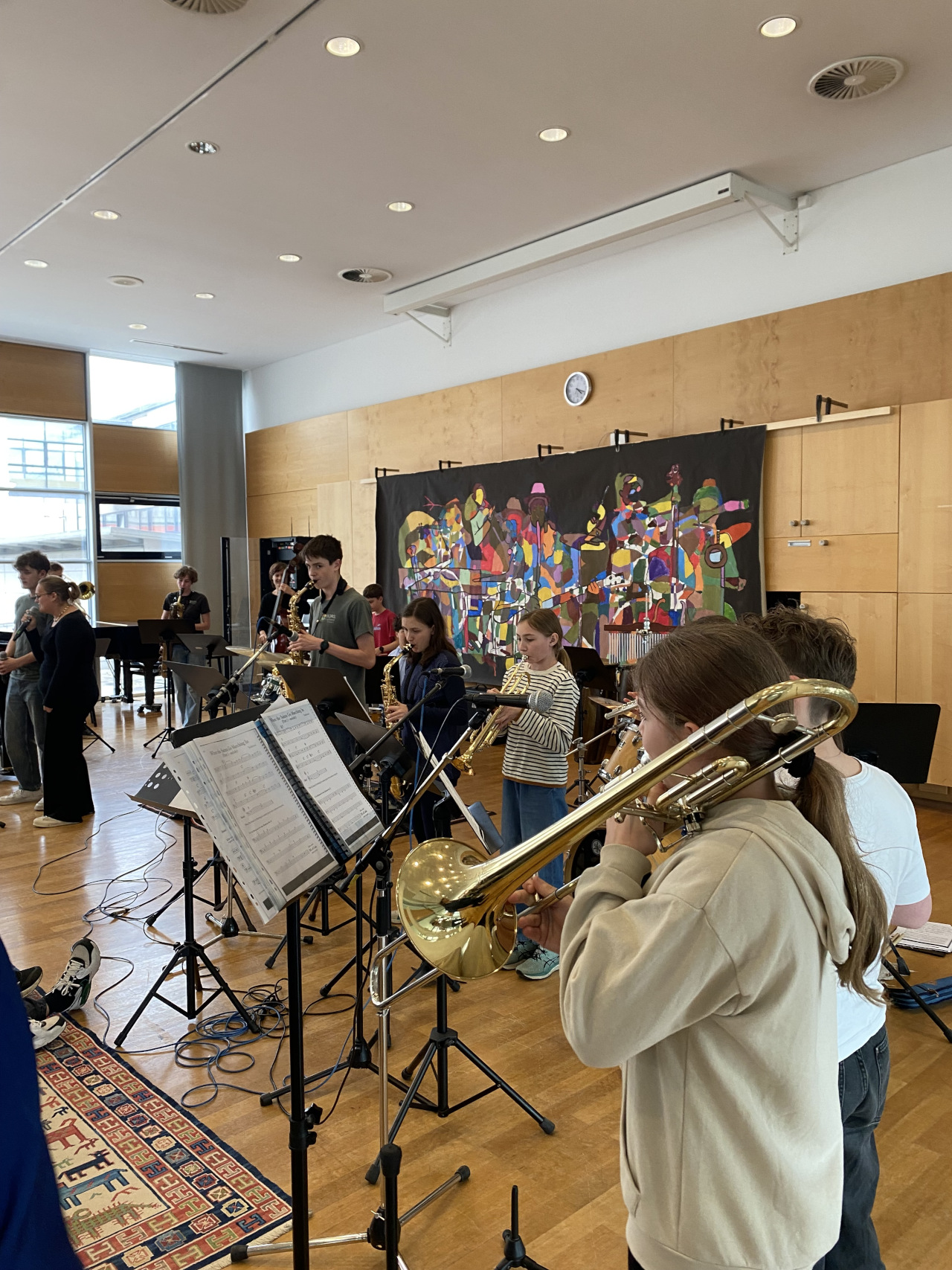
The Jazz macht Schule Workshop Band rehearsed for two and a half hours, spending the first hour divided into five groups, each led by one female mentor: a singer, a saxophonist and clarinetist, a pianist, a drummer and a bassist. This was intended to enhance the range of coaching possibilities and ensure that each participant received the attention they needed. The five groups were formed according to instruments and age. All groups worked on the same three jazz standards, practising phrasing, scales, improvisation techniques or the structure of a solo. Lead sheets for three songs (Mercy, Mercy, Mercy by Joe Zawinul, Work Song by Nat Adderly, Oh when the Saints – traditional) were distributed to all Workshop Band participants two weeks in advance. This arrangement, which was also clearly communicated to the participants, ensured that no one would face the stressful situation of sight-reading during the session and allowed participants to rehearse the jazz standards with their teachers if needed. The second part of the workshop was a one-and-a-half-hour ensemble rehearsal with all fifteen members of the Jazz macht Schule Workshop Band and all five female musicians. This culminated in a live concert serving as the opening of the public event Schule macht Jazz on the same day, where the outcomes of both the Jazz macht Schule workshops and the workshop band were presented.
The final public performance offered a vibrant and multifaceted representation of jazz. Schule macht Jazz took place on April 26 from 4pm to 6pm at Bundes-Oberstufenrealgymnasium Wiener Neustadt, Lower Austria, and celebrated the outcomes of the interdisciplinary workshops held at Bundesgymnasium Gröhrmühlgasse in Wiener Neustadt during the second semester of the 2024-2025 school year. At the same time, it served as a platform for the Jazz macht Schule Workshop Band. In this way, Schule macht Jazz combined the presentation of the outcomes of the workshops embedded within two school days with the final presentation of the non-formal educational workshop centred on jazz music and improvisation for instrumentalists and vocalists. The workshop band rehearsed in the school building of Bundes-Oberstufenrealgymnasium Wiener Neustadt, which is also where, due to organizational matters, the event Schule macht Jazz took place later in the day.
The event was disabled-accessible and the seating arrangement was informal, offering the audience chairs, space to stand during the performances or sit on large rugs at the front. A 30-minute break and the open end of the event allowed space for audience interaction and ensured that everyone had enough time to look at the exhibits, talk to the workshop participants, artists and musicians, or listen to the podcasts.
This event was moderated by Katharina Osztovics and started with the performance of the Jazz macht Schule Workshop Band, during which she introduced the audience to the concept of jazz standards, the practice of applauding after a solo and let the audience vocalise short call and response phrases which they could later recognise in the themes of the jazz standards played by the band. Furthermore, the practice of trading fours was explained and showcased. The audience put emphasis on beat two and four by snapping or clapping to experience the weight difference to clapping and snapping on beat one and three. Through this collaborative concert introduction, the audience was able to experience jazz as a living, participatory art form. The event was offered free of charge and served as a celebratory contribution to International Jazz Day, making jazz accessible to a broader audience through live performance and shared musical practice.
The performance of the group that had worked with the body music artist, combined rehearsed sequences with improvised elements, all choreographed to jazz music. They used body percussion to physically articulate complex time signatures and odd meters to emphasise the connection between eurythmics and jazz. During the workshop days, they were introduced to body music fundamentals, odd meters, the history of funk music, examined the music of the Dave Brubeck Quartet from a rhythmic perspective and worked on their own choreographed rhythmic movements, also focusing on the difference between straight and shuffled rhythms (see Fig. 5).
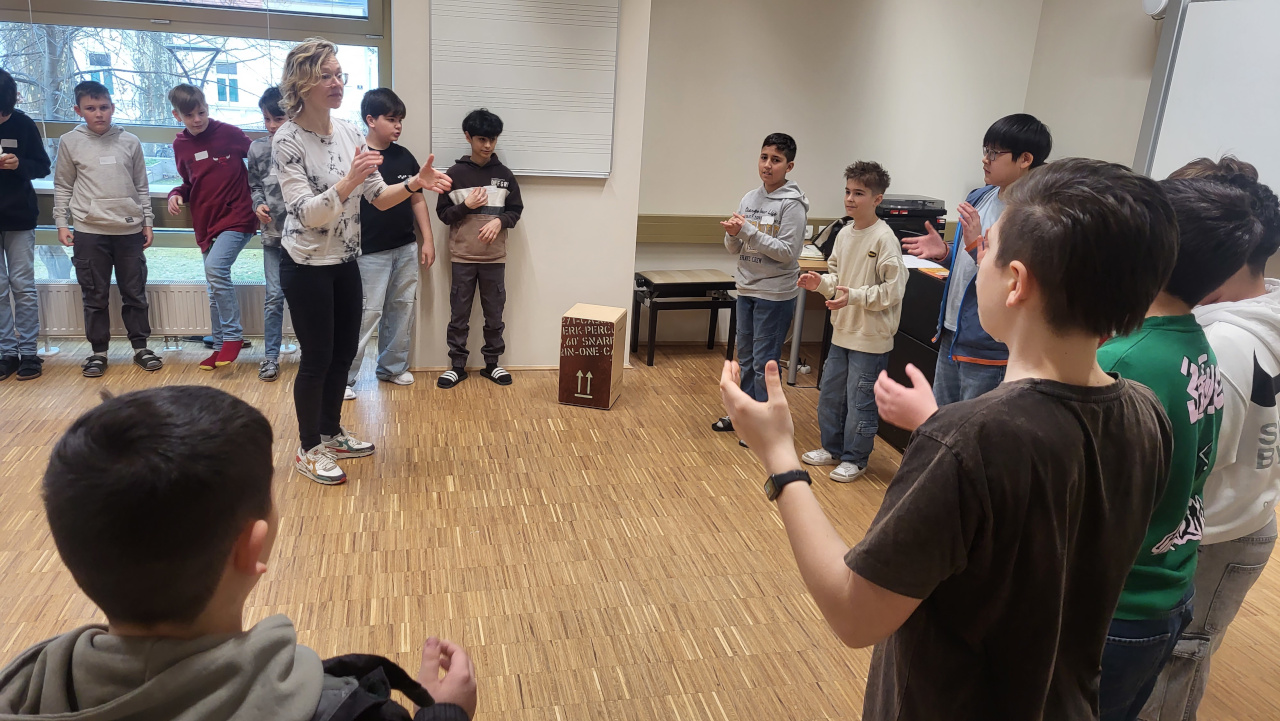
The group that had worked with the dancer performed a sequence of movements set to jazz music, combining both rehearsed and improvised elements. During the workshops the focus lay on the intrinsic relationship between jazz and dance/movement. The participants translated common jazz terms into movement. Hence the pitch of certain notes was adapted to the ceiling height, the respective notes being shown by positioning the body at a certain height in the room. Musical improvisation was paired with movement improvisation in a partner setting, and the principle of call and response was introduced as a game combining movement and body percussion.
The school band presented jazz-infused arrangements of familiar themes from children’s television series, highlighting student soloists on instruments such as the recorder, saxophone and drums, showing that jazz can be played on every instrument. Previously explained jazz terms such as trading fours, call and response, swing, shuffle or clapping after a solo were revisited and used to interact with the audience.
The groups working with creative writing, media and painting did not perform at the event Schule macht Jazz. However, their works were displayed in the room and the participants were invited and encouraged to explain the work process.
A language booth was established with a display of several copies of the handbound brochure which the participants of the creative writing group had worked on. It comprises texts written by the students. Each text is accompanied by a QR code linking it to the piece of music that had inspired the writing, allowing the audience to experience the interplay between sound and language. Students and artist staffed the booth and explained the respective workflow that had led to the texts. This was done before and after the performances, as well as during the break. In addition, poems focusing on jazz, written by the participants of the creative writing group were displayed on a washing line. The audience could pick as many of them as they wished to take home (see Fig. 6).

During the workshops the students built a bridge between language and jazz music under the leadership of the creative writing educator. Through various individual approaches, the young authors explored the diversity of jazz literature, engaging with unfamiliar, unconventional, challenging, and enriching audio and text materials. Inspired by self-selected musical pieces, they created texts that, through variation, repetition, objectivity, precision, and creative experimentation, reflect different literary approaches and stylistic exercises, echoing the musical principles of composition, improvisation, as well as personal expression.
The media group produced five episodes of a new podcast series entitled BRG Talk Tour, which explored topics such as jazz genres, performance practice, and notable figures or locations in jazz history. These episodes, edited and narrated by students, were accompanied by large-format posters displayed at the event venue. Each poster included contextual information and a QR code linking to the corresponding podcast episode on the school server. The posters now serve as a lasting educational resource, publicly displayed at Bundesgymnasium Gröhrmühlgasse for use in music education classes (see Fig. 7).

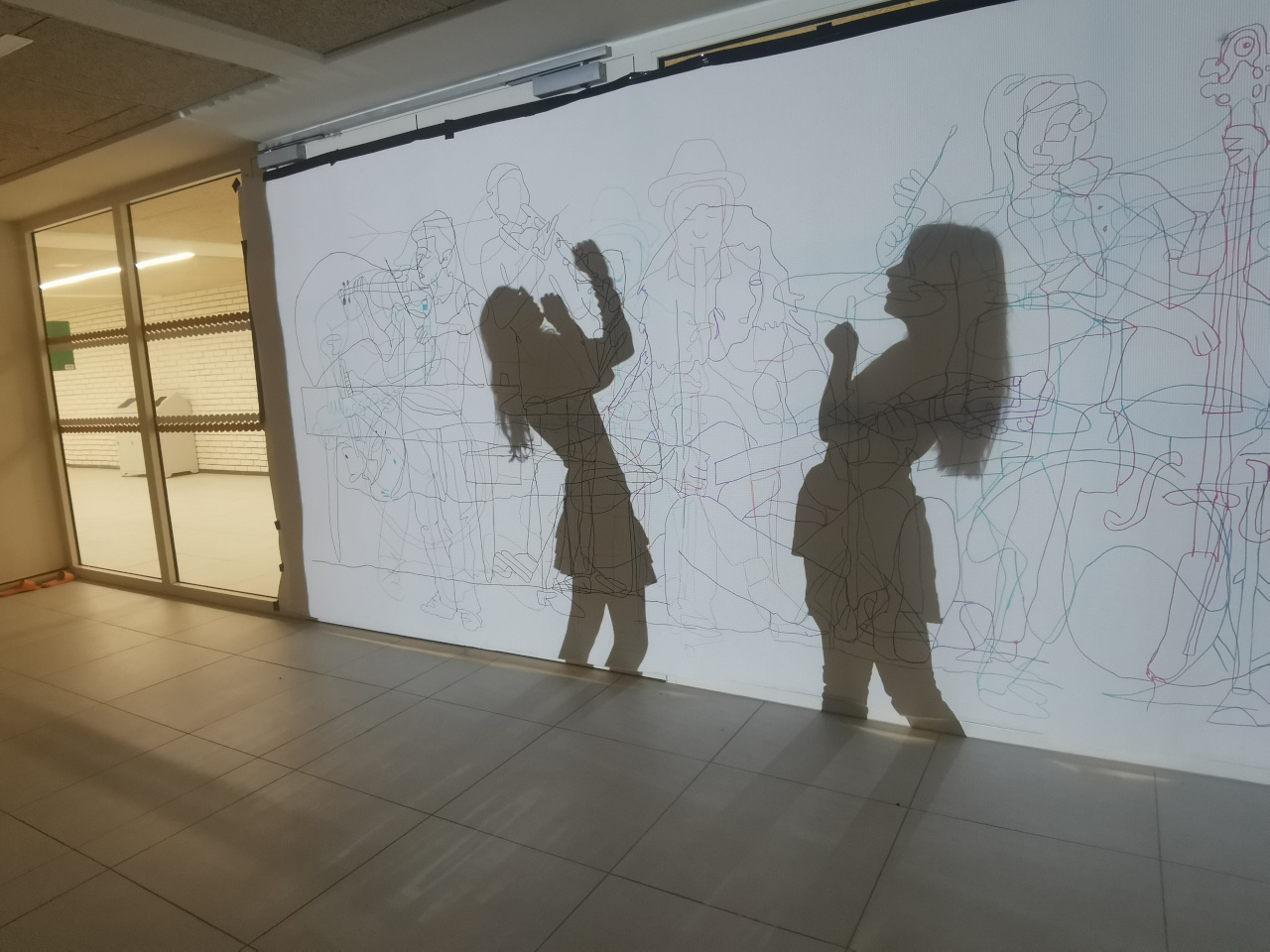
The visual arts group created a 10-by-7-meter mural depicting male and female jazz musicians playing their instruments. Alongside the completed work, preparatory sketches and conceptual drafts were exhibited. The students themselves introduced the creative process of listening, sketching, and painting, offering insights into their artistic journey. This striking artwork also functioned as the backdrop for the performance stage, visually enhancing the live presentations (see Fig. 2).
An interactive language game focusing on spontaneous interaction amongst the audience offered the possibility to voice an instant reaction to the performances, the project and the event, and also gave the audience a chance to experience the power of improvisation. Overall, the audience experienced two immersive hours of jazz, engaging eyes, ears, body, and soul – an interdisciplinary celebration of the genre’s expressive and unifying potential.
In total, Jazz macht Schule engaged 180 students, six lower secondary teachers (all of whom were assisting during the school workshops) across the subjects of Music Education, German, Art and Physical Education, as well as eleven professional artists and/or musicians, ten of them being female, who either led school workshops or were part of the team coaching the workshop band. Two of the project coordinators were also engaged in leading workshops.
Conducting six simultaneous workshops within an active school setting posed significant logistical challenges, especially given the ongoing presence of other students and staff. Each workshop group had distinct spatial and acoustic requirements: for instance, the media group required three quiet rooms for sound recording, the movement group needed a large space with access to loud music, and the writing group worked in open free-writing areas along the corridor. Despite these challenges, the majority of students expressed satisfaction with their workshop selection, and generally knew where to go and whom to join. This was evaluated by Peter Janisch at the end of the first workshop day at school, letting the participants rate their satisfaction with hand-signs as well as in open discussion. Since he was not leading any of the workshops and was responsible for the organisational aspect at school, he was chosen to evaluate participants’ satisfaction and experience. The decision to hold each workshop over five school periods per day was based on practical considerations: any deviation from the regular timetable impacts the schedules of multiple teachers and student groups. However, it became evident that student concentration waned after approximately three lessons, necessitating frequent short breaks. Due to the limited number of workshop days – March 11 and April 8 – before the final public performance on April 26, many students struggled to retain and rehearse their contributions. These dates were carefully selected to avoid conflict with tests, exams and school excursions. As all participants were minors, attendance at the final performance depended on caregivers providing transportation. Consequently, not all students were able to present their work; in some groups, only around 50% of participants attended the final event, limiting the representation of the full workshop outcomes.
Due to government funding, the event was free of charge, which was important for accessibility, as some families might not have been able to join due to financial reasons. In Austria, school is free of charge and costs for extracurricular activities are required to be kept to a minimum. However, the scope of funding determined both the number of workshop leaders and the maximum working hours per individual. It proved challenging to strike a balance between the students’ time investment, the school’s increased organizational burden, the committed funding, and the pedagogical and artistic visions of the workshop facilitators. Overall, most of the school staff involved were open for the process and positive about the impact that projects like Jazz macht Schule have on students. However, projects which take place within a school setting will always have a much narrower framework than projects not connected to a school’s timetable, tests, excursions or the curriculum. The question for the future will be how these frameworks can be widened and how projects like Jazz macht Schule can be an eye-opener for teachers, highlighting the benefits, since the teachers’ willingness to participate plays a vital role in the success of large scale school projects. Without funding, Jazz macht Schule would not have taken place. Hence, the government also plays a decisive role in determining which projects will be implemented in the future.
Jazz macht Schule not only aimed to introduce the musical and historical dimensions of jazz, but also to encourage creative expression, collaboration, and critical engagement with the art form. For many participants, Jazz macht Schule – Schule macht Jazz marked their first solo appearance on stage. For some participants, as well as some members of the audience, it was their first encounter with jazz music, and some had never experienced a concert before, a fact that they shared with the team of Jazz macht Schule after the event. While many of them articulated that they would never have chosen to work on the topic of jazz, some of them grew more interested in it since the project gave them the chance to gain a deeper insight into the genre, its history and its culture.
The aim of the public event was to offer a platform for students to share their work and celebrate their engagement with jazz in a collaborative and interdisciplinary context, but also to target an audience where the majority is not affiliated with jazz music. By creating an open space, where questions, negotiations and new interests could develop, both children and adults in the audience were able to benefit from the event. They gained a deeper understanding of what the participants had worked on during the workshops and were able to enjoy jazz music. The moderation of the event supported this by offering background information, fostering curiosity, and guiding the audience’s understanding of what takes place on stage during a jazz concert.
The opportunity to engage with artists from different disciplines, as well as a diverse range of jazz musicians, most of whom were female, aligns with UNESCO’s vision of jazz as a form of dialogue and mutual understanding, as promoted in the context of International Jazz Day.
The interdisciplinary nature of the project allowed the audience to engage with the theme of jazz from various perspectives. While some could relate more to the idea of dancing to jazz music, others connected with the idea of drawing, because it was a hobby they regularly engaged in. The interactive language game gave everyone an insight into how art can be created spontaneously by improvisation and made the audience feel the tickle and excitement that occurs when you leave guided paths and open yourself for a solo. This is where the future strengths of interdisciplinary music education became most evident. The various art forms with which students are already familiar can be used to access less familiar topics or art forms and thus build a bridge between previously acquired knowledge and new experience.
With enough funding, a school that offers a flexible framework, enthusiastic teaching staff and eager musicians, Jazz macht Schule could be established as a regular event in any lower secondary school, or, if methods and content are adapted, even in primary schools or upper secondary schools.
However, some adaptions should be made in the event of the resumption of the project in lower secondary education. During the process of Jazz macht Schule, it became evident that small, age-homogeneous groups could ease the working process. Our idea was to work with three year-groups, in order to minimalise the age gap; however, during the workshops, team-building and group formation still took a lot of time, since the students’ stage of emotional development differed significantly between year one, year two and year three. Furthermore, the groups should ideally comprise at least fifteen students, as the difference in knowledge can be tackled more easily in a small group and individual assistance can also be offered more easily. In Austrian cities, the presence of language barriers is particularly evident. Small groups also ease the process of explaining tasks and exercises. All in all, the school workshops involved more than 150 students, which required a considerable organizational effort. To ease the process, the number of year-groups involved, could be limited. All workshop leaders proposed that, in future projects, the workshops should last three school periods instead of five, although with the option of having more than two workshop days at the school. Those should be held nearer to the date of the presentation. In the context of Jazz macht Schule, these options were actually considered prior to the project’s launch. However, due to the school’s framework and limited financial resources, none of them could be implemented.
Within the project itself, it was easy to find jazz musicians to work with, however it took some effort to connect them, find a common base for the workshop topics and establish leadership, since they had not previously worked together in an educational setting. For future projects it might be sensible to schedule more time for this, or to work together with music schools with a faculty for jazz and popular music, which would also have the benefit of reaching more young people and of working with a team of musicians that is already familiar with each other. Depending on where the project is held, institutions such as music universities could be potential partners, as there is a mutual benefit for jazz music mediation and student education. Furthermore, it opens new perspectives for both university students and participants. Bringing together secondary and tertiary educational institutions would thus help to ease the work process and make jazz more accessible to young audiences at the same time. Student jazz musicians and their teachers can engage in designing educational or interpretive activities to help workshop participants understand, experience, and connect with jazz music. This would maybe also help establish long-lasting partnerships between university and school, bridging gaps between the jazz musicians, audiences, and educational institutions.
All in all, funding, the willingness of the school and staff, small workshop groups and a flexible framework are the factors that are most vital for the resumption of the project. Students need to be given more time to work on a lighter content load, allowing them even more time to listen, improvise and engage with jazz from various perspectives.
The German quotation has been translated by the author.↩︎
Bundesministerium für Bildung. n.d. “Lehrplan der allgemeinbildenden höheren Schulen.” Accessed June 2, 2025. ris.bka.gv.at/NormDokument.wxe?Abfrage=BundesnormenGesetzesnummer=10008568Artikel=Paragraf=Anlage=1Uebergangsrecht=.
UNESCO. n.d. “International Jazz Day.” Accessed May 10, 2025. unesco.org/en/international-jazz-day.
Katharina Osztovics studied English and Music at the University of Vienna and the University of Music and Performing Arts Vienna, where she also completed the Diploma Program in Elementary Music Education. She later became a diploma-qualified voice artist, performing in concerts and working on the radio. Her work emphasizes interdisciplinary approaches to learning, integrating language, arts, movement, and music for learners of all ages – from kindergarten to tertiary education and teacher training.
ISSN 2943-6109 – Volume 2/2 (2025) – DOI: 10.71228/ijmm.2025.36
This paper is published under a Creative Commons Attribution 4.0 International License. Parts of an article may be published under a different license. If this is the case, these parts are clearly marked as such.
