A Multi-Perspective University Jazz Mediation Programme for Elementary School Children
Ulrike Schwarz
Department of Reflection, Communication and Education, University of Music Saarland, Saarbrucken, Germany
Correspondence: U.Schwarz@hfm.saarland.de
Abstract
Jump into Jazz is a one-year university programme, designed by Corinna Danzer and Ulrike Schwarz, which addresses not only jazz students, but also students in teacher training. Highlight is a jazz concert with children. To reach children regardless of their cultural and socio-economic background, we cooperate with public elementary schools. Jump into Jazz aims to make jazz accessible to a wider audience. We want to achieve this by training jazz musicians for jazz mediation and by supporting both current and future music teachers to incorporate aspects of jazz education into their repertoire. The third edition of Jump into Jazz was staged in 2024, in collaboration with the Frankfurt University of Music and Performing Arts and the Frankfurt Radio Big Band. This article outlines the multi-faceted concept and asserts that jazz mediation should join forces with jazz education to obtain lasting effects.
Jump into Jazz est un programme universitaire d’un an créé par Corinna Danzer et Ulrike Schwartz, et qui s’adresse non pas seulement à
des étudiant.es en jazz, mais aussi à des étudiant.es en enseignement musical. Le programme culmine avec la création d’un concert de jazz pour enfants. Pour offrir l’occasion à ces enfants de participer à ce concert indépendamment de leur condition sociale et culturelle, nous coopérons avec des écoles primaires publiques. Jump into Jazz a pour objectif de donner accès au jazz à une audience élargie. Pour atteindre ce but, nous voulons former les musicien.nes de jazz à la médiation de la musique et soutenir les enseignantes actuelles et à venir dans l’intégration, dans leur répertoire, de certains aspects de l’enseignement du jazz. La troisième édition de Jump into Jazz a eu lieu en 2024 en collaboration avec l’Université de Francfort pour les arts vivants et le Francfort Radio Big Band. Cet article met de l’avant le concept multifacette de la médiation du jazz et affirme qu’il faudrait l’associer à l’éducation au jazz pour renforcer ses effets et les rendre durables.
Jump into Jazz ist ein einjähriges Projekt für Jazz- und Lehramtsstudierende von Corinna Danzer und Ulrike Schwarz. Höhepunkt des Projekts ist ein Jazzkonzert mit Kindern. Um Kinder unabhängig von ihrem kulturellen und sozioökonomischen Hintergrund zu erreichen, arbeiten wir mit Grundschulen zusammen. Mit Jump into Jazz möchten wir Jazz einem breiteren Publikum zugänglich machen. Um dies zu erreichen, qualifizieren wir Jazzmusiker_innen für Jazzvermittlung und unterstützen sowohl zukünftige als auch aktuelle Musiklehrkräfte dabei, Aspekte aus der Jazzpädagogik in ihr didaktisches Repertoire zu integrieren. Die dritte Projektrunde von Jump into Jazz wurde 2024 in Kooperation mit der Hochschule für Musik und Darstellende Kunst Frankfurt am Main und der hr Bigband realisiert. Dieser Artikel stellt das vielschichtige Konzept vor und plädiert für eine Verknüpfung von Jazzvermittlung und Jazzpädagogik, um nachhaltige Effekte zu erzielen.
Keywords
higher music education, elementary school, children’s concerts, jazz education, improvisation
Introduction
A vibrant jazz scene that also includes children and adults new to jazz – this is the vision pursued by Corinna Danzer and Ulrike Schwarz through Jump into Jazz. We see great potential in jazz, especially for children, and we want to empower young jazz musicians to bring their music to a new audience. How can they host a show for children while maintaining the young audience’s natural curiosity? How can they communicate and collaborate with teachers to prepare children for a live concert? How can they skillfully involve children in the music – maybe even on stage?
Jump into Jazz is a one-year university programme that addresses not only jazz students but also students in teacher training. To reach a broad range of children regardless of their cultural and socio-economic background, it is helpful to cooperate with state elementary schools. Current teachers participating with their classes receive support in preparing their students for the concert. The programme culminates in two shows at the Frankfurt Radio Broadcast Hall (HR Sendesaal). On stage is a professional jazz band including our jazz students. The programme leaders are involved as musicians and hosts of the show. One class of children joins the band for one tune, with some even improvising solos. All classes are familiar with the participation elements they will perform from within the audience and know most of the tunes. We wanted the children’s overall emotional tone of the jazz experience to be positive. So, we were delighted to hear one girl say shortly before the concert, “I’m looking forward to the performance and it’s really a lot of fun!”1
Jump into Jazz took place in 2019, 2021 and 2024. The first two editions were slightly smaller and did not yet include jazz students. Those two concerts were staged in cooperation with an established concert venue in Frankfurt/Main, the Alte Oper. The 2024 edition was made possible by Frankfurt University of Music and Performing Arts (HfMDK), Netzwerk Musik und Schule (a government-funded programme promoting music projects in schools), and the HR Bigband (Frankfurt Radio Big Band).
I will first present the program as a whole, then explain some of the major underlying decisions regarding musical material and approach. After sharing some thoughts on the relationship between jazz mediation and jazz education, I will close with a look back on the 2024 edition and invite readers to discuss possible conclusions for the future of music mediation in the field of jazz.
The programme structure
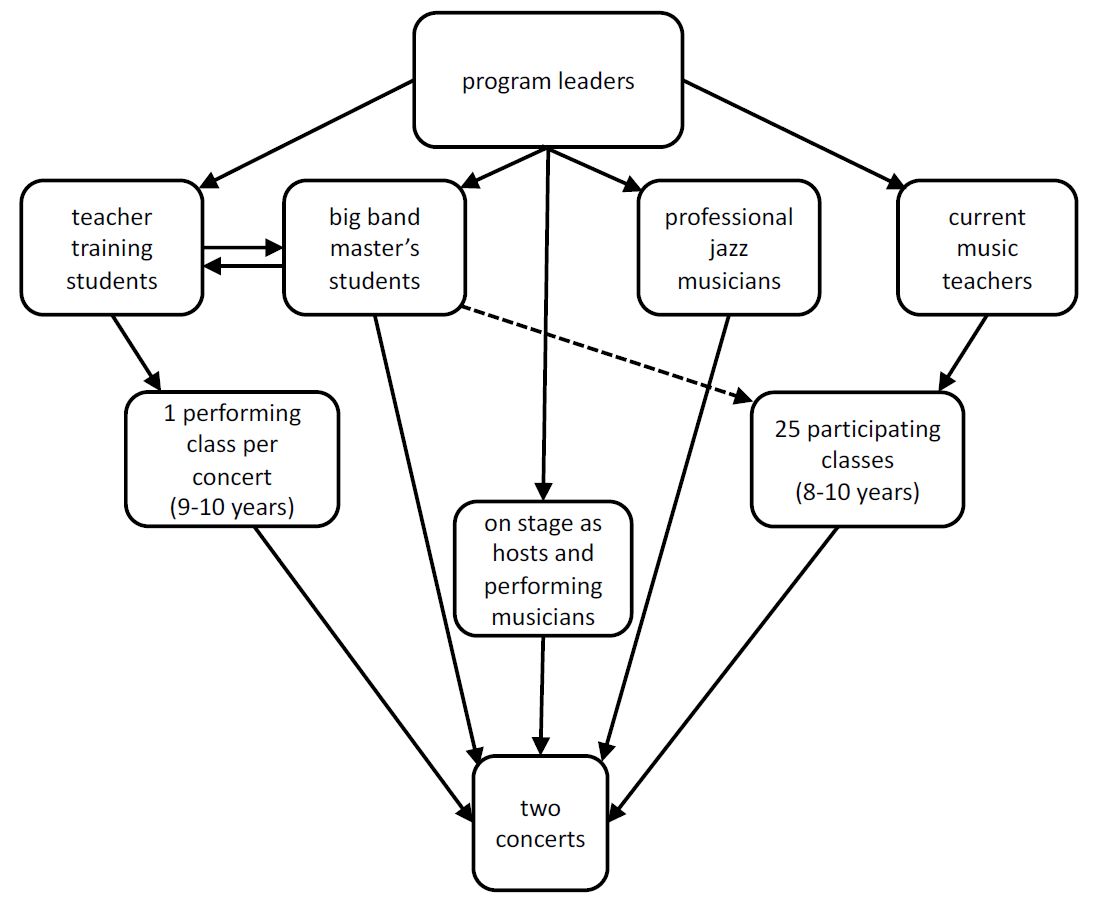
A particularly distinctive feature of this programme is its multi-perspective approach. The project aims to offer children low-threshold access to jazz. However, we want to achieve this in the long run by training jazz musicians for jazz mediation and by encouraging music teachers in elementary schools – both current and future teachers – to incorporate aspects of jazz education into their music didactic repertoire. In addition, we wish to establish communication channels between both groups and promote future collaboration among musicians, schools, and institutions. These are the groups we address:
Children
Children aged 8 to 10 participate with their elementary school class in the 3rd or 4th grade. There are two ways for classes to take part in the programme: one so-called performing class (4th grade) per show – two in total – and several participating classes (3rd and 4th grade) per show. The performing class performs on stage with the jazz band for one participation piece. To prepare this performance, two teams of university students conduct a series of four to five workshops in the respective schools, supported by the programme leaders. The participating classes are in the audience and carry out participation elements from their seats. All children recognise most of the music from what they learned in class beforehand. However, the participating classes are not prepared directly by a university team. Instead, their current music teachers attend an extensive hands-on workshop with the programme leaders and then prepare the children themselves.
Current music teachers
Music teachers are invited to register their classes for the concert. Once registered, they receive an invitation to a full-day teacher’s workshop with the programme leaders. Only a few of these teachers have prior experience teaching jazz. Some are not even formally qualified in music; they are simply helping to meet demands, since there is a severe shortage of music teachers in Germany. Generally, all participants are very open and ready to explore new ground. In this workshop, many improvise for the first time in front of others. Some aspects of the workshop are intended to prepare for the concert, while others are more general and aim to expand the teachers’ repertoire, enabling them to teach jazz in elementary school – even beyond this specific programme.
Future music teachers – university students in teacher training
As part of their studies, the teacher-training students at HfMDK must complete a two-semester project seminar. Jump into Jazz is one of their options. Most students have little or no experience with jazz when they join the programme. First, they learn about jazz themselves: experiencing the physical feel of swing music, singing and playing instruments, embodying form, and exploring improvisation are crucial components. They listen attentively and analytically to original recordings of the concert pieces, develop a jazz vocabulary, and discuss their findings. Learning about the origins of jazz is important as well. Following these areas of learning are moments of reflection, focusing on jazz teaching methods. The university students in teacher training build two teams – one for each performing class – and conduct the workshops.
Jazz students
The jazz students involved are enrolled in a big band master’s programme recently launched by the HfMDK in cooperation with the Frankfurt Radio Big Band. They choose one of three categories for their studies: big band musician, conductor, or composer. In addition to focusing on artistic development, their studies include other important aspects of being professional jazz musicians, such as in the module Research and Mediation. Jump into Jazz is one option for completing this module. Some jazz students have experience teaching music to children; others do not. However, most have very little or no experience teaching jazz to elementary school children or working with music mediation formats.
They begin with the fundamentals of jazz mediation and gain insights in current formats and their reflection. Additionally, they learn about elementary-level jazz teaching methods. In the following semester, they collectively compose a piece designed to include children from the audience. They then develop an appropriate presentation for their composition and test it in a workshop with one of the participating classes. This workshop offers the children a rare opportunity to meet jazz musicians in class and is highly valuable for the jazz students, who receive direct feedback from the children. In addition, the jazz students observe their peers in teacher training with the performing classes in elementary school at least once. During the show, they support the professional jazz band by playing their respective instruments. In addition, some take on small speaking roles as co-hosts during the performance.
Professional jazz musicians
The professional musicians in the show are not formally instructed within this programme. However, we have repeatedly experienced that performing a concert aimed at involving children presents unique requirements. For example, when soloing, children need support to maintain their orientation within the musical form. This can be achieved by using recurring phrases as aural markers toward the end of a four-measure phrase. Generally, most jazz musicians are unaware of these requirements, as they are not part of their everyday artistic practice. The following scheme shows how the groups relate to each other.
Figure 1. Groups involved. Source: own illustration.
What happens when?
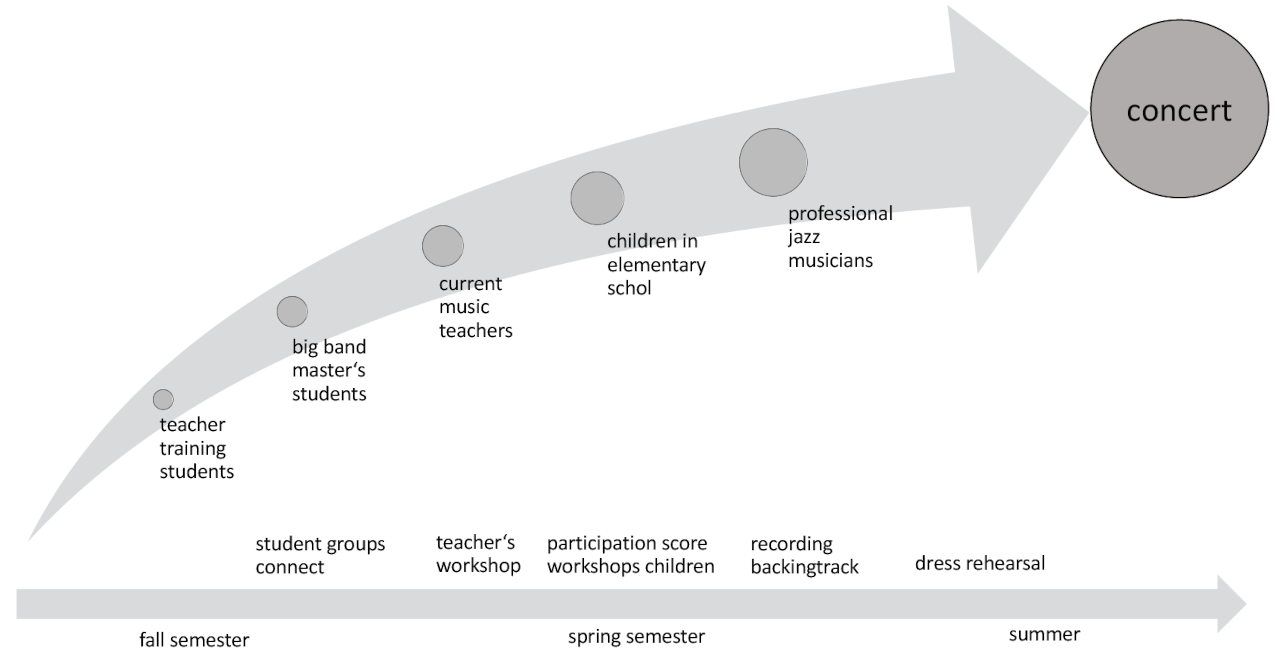
First, both university groups develop their skills in the field that is new to them. Toward the end of the first semester, they meet. The students in teacher training share their music-teaching tools through warm-up exercises. In return, the jazz students offer a jazz band workshop, introducing their fellow students to rhythm-section instruments. They also teach them to play some of the concert pieces, and they jam together.
Now, both university student groups are familiar with the concert repertoire and share some experience in teaching and learning jazz. On this basis, they decide on the participation piece for the performing classes. In 2024, they chose C Jam Blues
(Duke Ellington). In earlier years, students selected Killer Joe (Benny Golson), Splanky (Neal Hefti), and Milestones (Miles Davis). The challenge is to involve the entire class in performing the piece and to have some children improvise.
At the same time, the current music teachers gather for the workshop with the programme leaders. They go through all the steps they need to prepare their classes for the concert – and beyond.
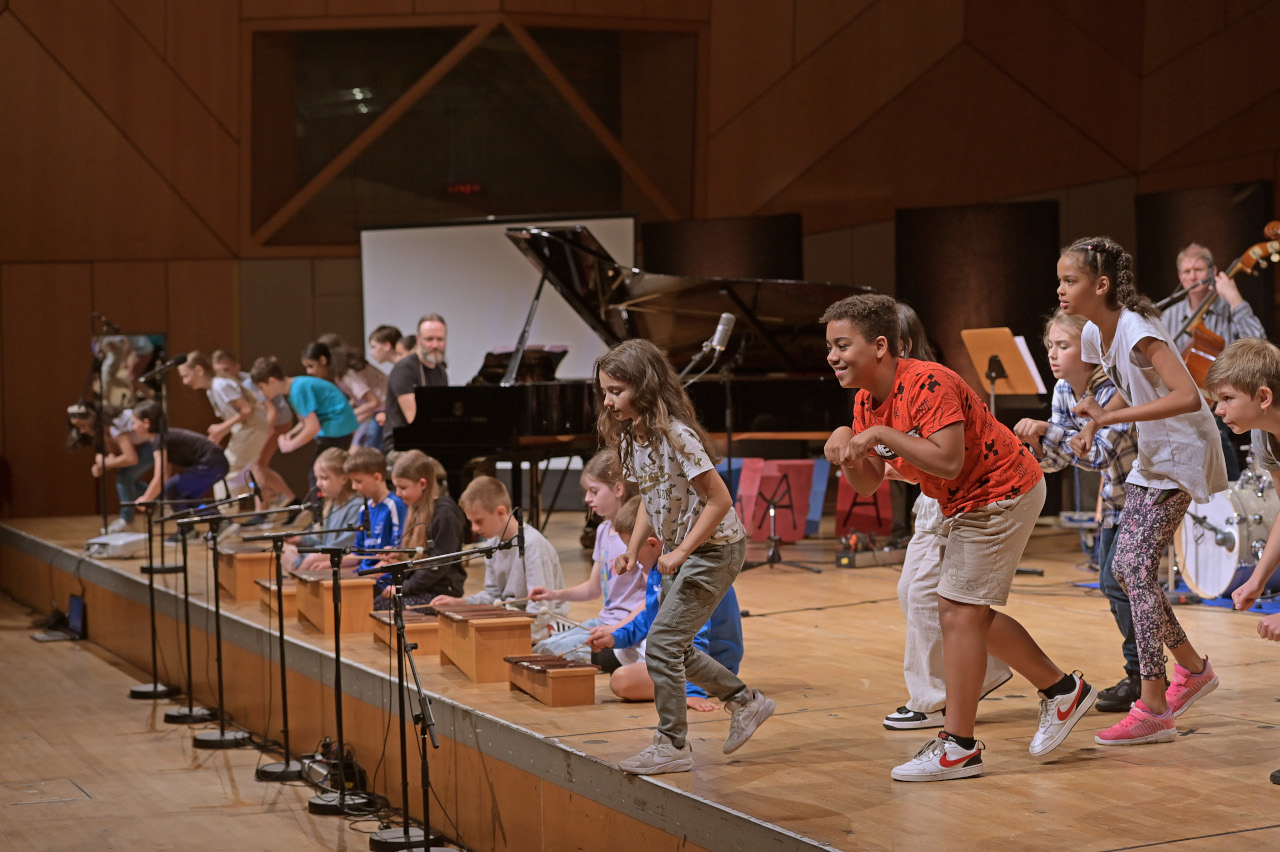
About five weeks before the concert, the students in teacher training begin the workshop series for the performing classes. In a back-and-forth process, they develop the participation score, considering what they view as realistic goals for the children they are working with. They receive close support from the programme leaders throughout all these steps. In the 2024 edition, the participation score became a veritable choreography that the children performed during the show.
The following university session serves as a crystallizing point in the programme’s progress and is crucial to the success of the children’s performance. The jazz students, together with the programme leaders and the professional band, create an arrangement based on the participation score – reflecting the needs of the children – and record a backing track of the arrangement. The students in teacher training are present to provide insights into the children’s skills and needs.
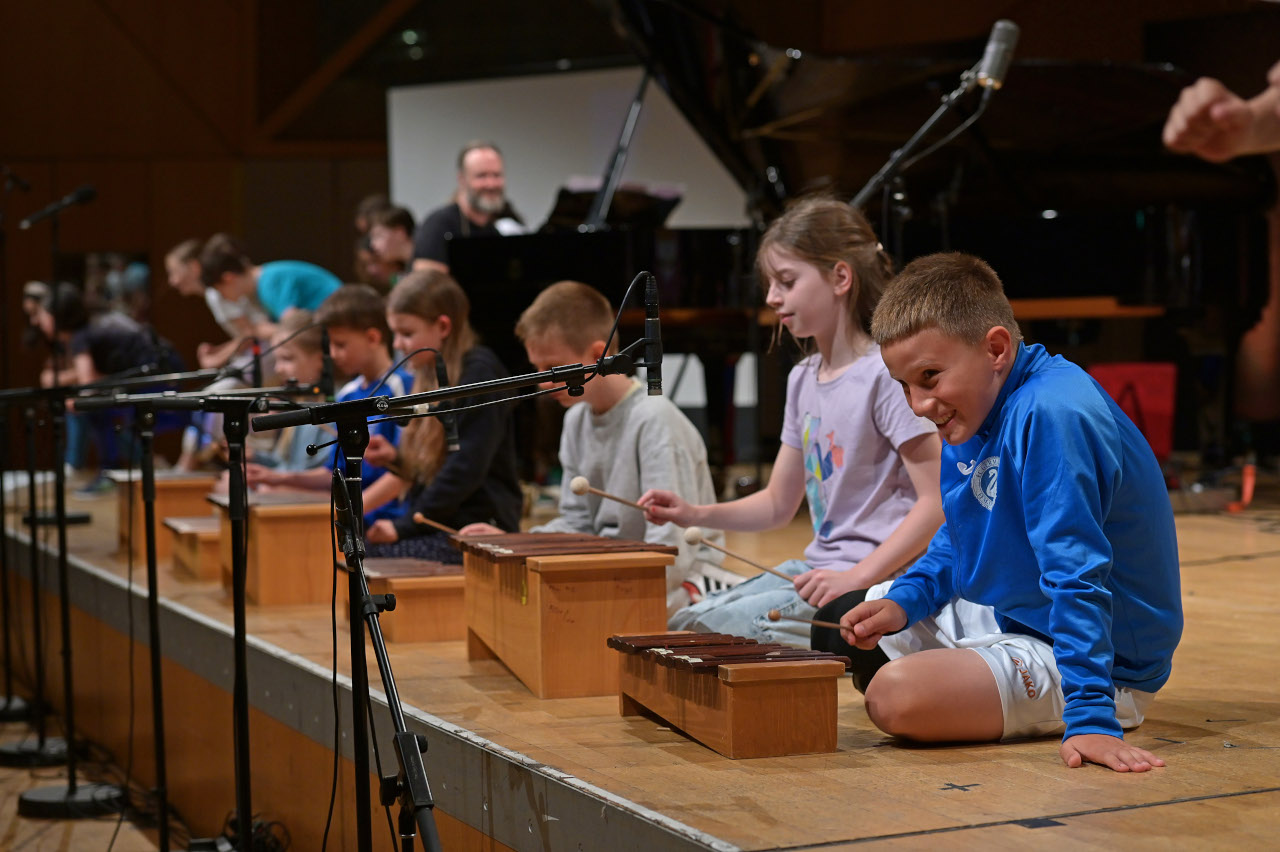
This backing track later allows the children to rehearse their musical contribution, including the improvised solos. In our 2024 edition, the university students decided to have the children play short improvised solos on xylophones – each over four measures of C Jam Blues. In the backing track, the musicians marked the end of each four-measure segment with a short fill. They used the same fill in the live show to support the children’s sense of form.
On dress rehearsal day, everything comes together on stage at the Frankfurt Radio Broadcast Hall. The programme’s multi-perspective approach makes the dress rehearsal structure a real challenge as far as meeting everyone’s needs is concerned. The performing classes
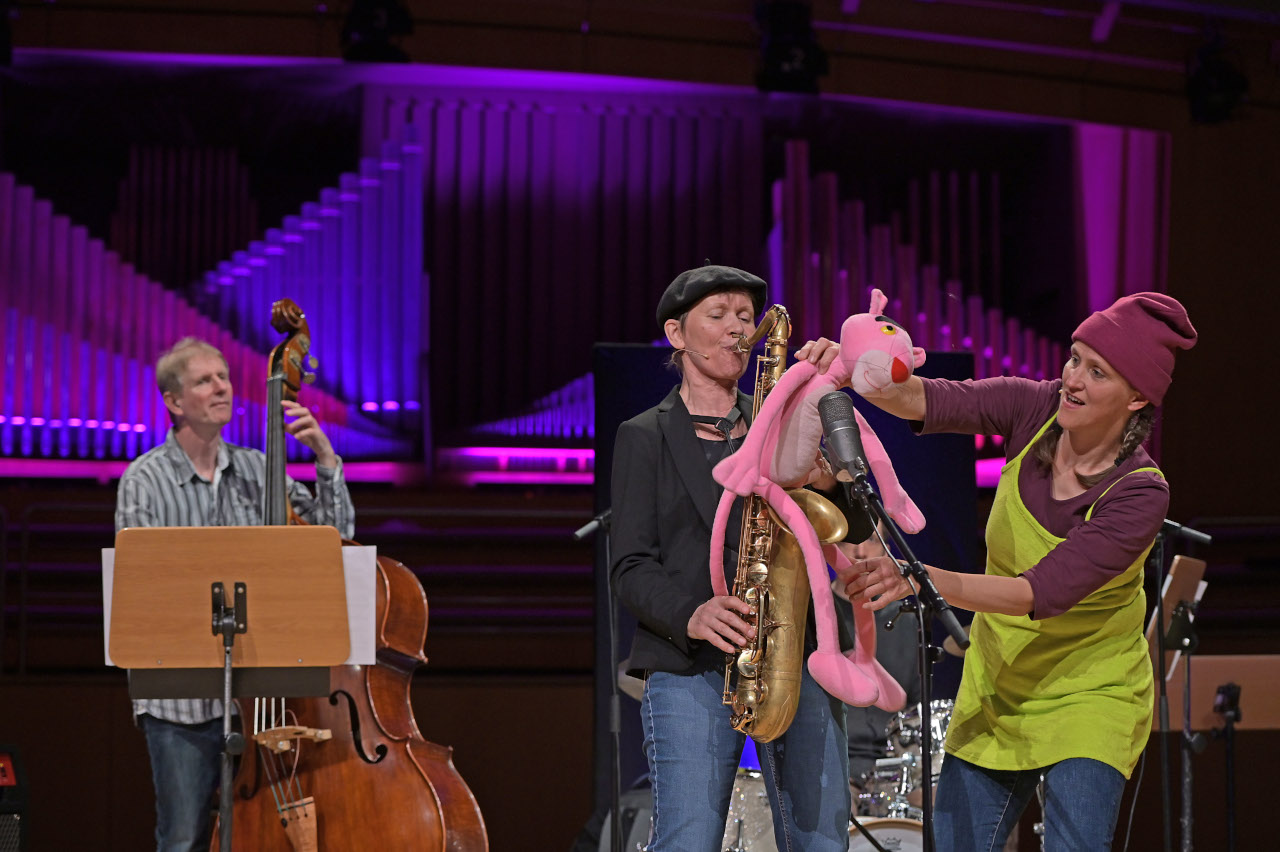
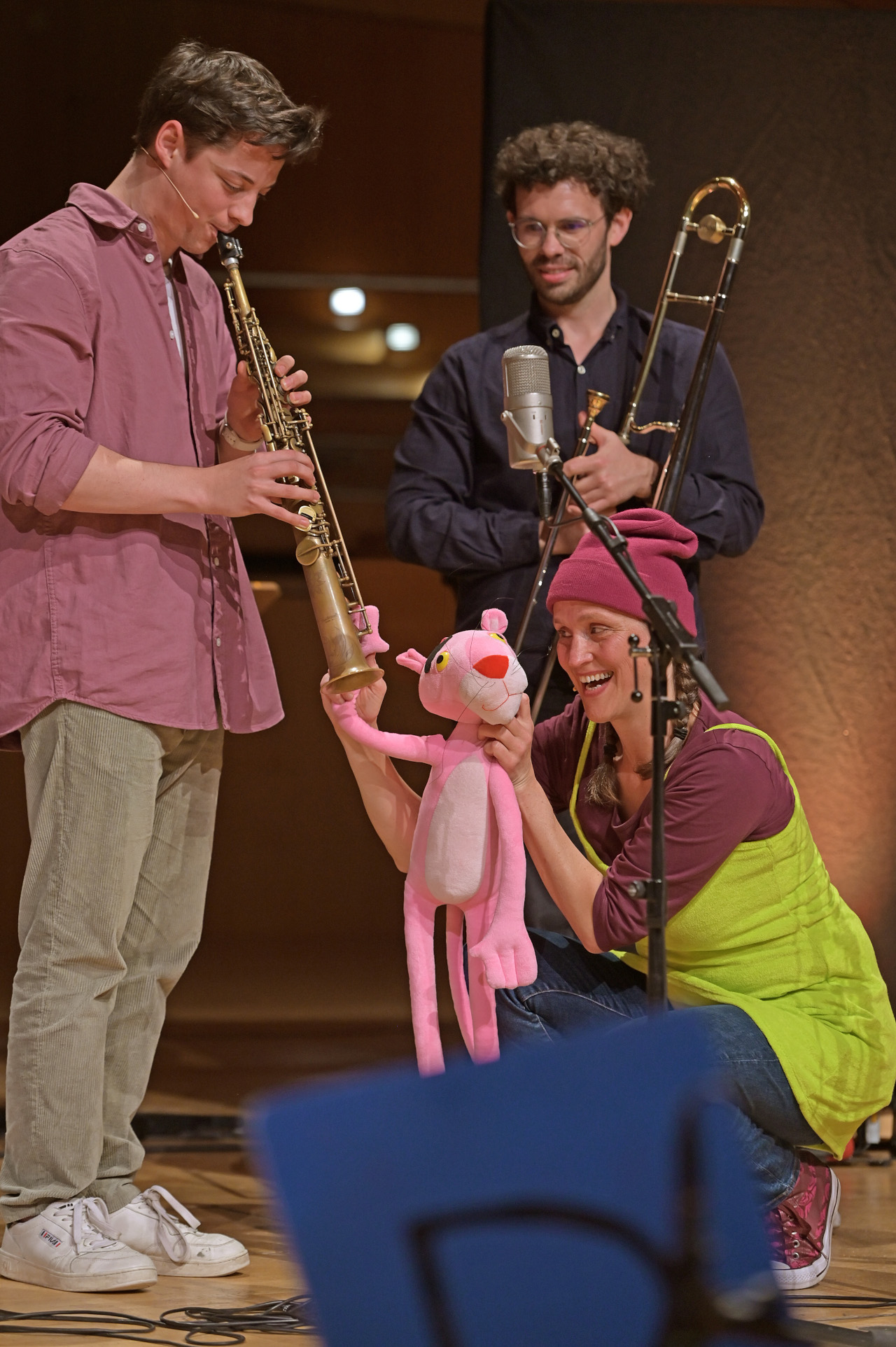
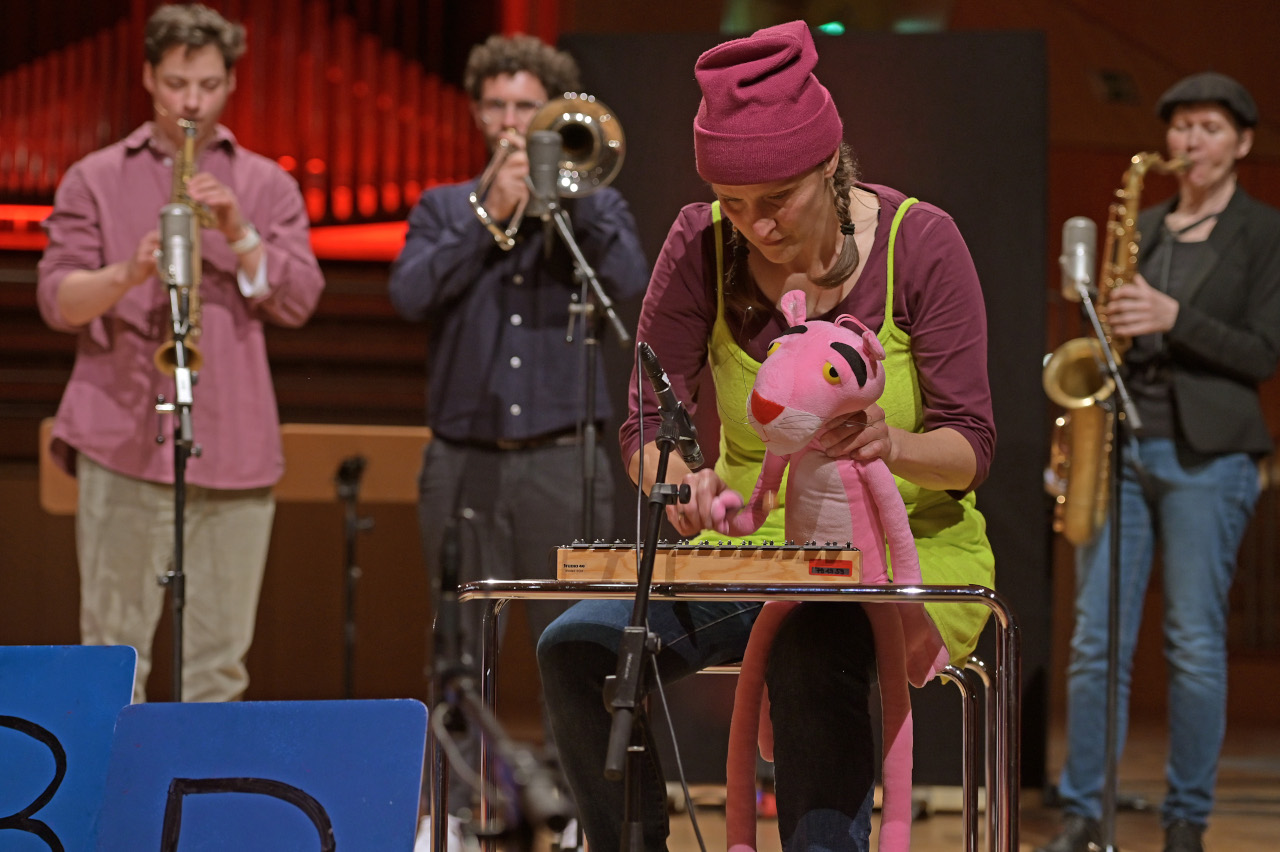
are welcomed and introduced to the stage by the programme leaders, then rehearse their performance with the band. In addition, the entire show must be rehearsed, lighting and sound need to be arranged and checked. The jazz students also rehearse their own composition, including instructions for the audience. The host’s clownesque, interactive scenes with the Pink Panther puppet – the main character of the show – also require rehearsal. The participating classes do not take part in the dress rehearsal; they attend only the concert a few days later. Overall, the programme expands over a period of nine to ten months.
Figure 4. Timeline of the programme. Source: own illustration.
Putting the show on stage
Hundreds of children settle in on their seats at Frankfurt Radio Broadcast Hall. The lights fade. Darkness falls on the stage; excitement fills the air. Seemingly out of nowhere, finger snapping can be heard in the audience. The university students seated among the audience pick it up from the band and help spread it throughout the auditorium. Piano sounds join in. Then, a spotlight shines on the pianist. Darkness returns, with only finger snapping audible. Now, the sound of a double bass emerges – spotlight on the bassist – and darkness again. The drummer is the last to be introduced in this manner. As soon as the full rhythm section establishes the groove and the stage is lit, the tenor saxophonist (Corinna Danzer) appears and plays the melody of The Pink Panther by Henry Mancini.
While the children are still applauding, the show host (Ulrike Schwarz) runs onto the stage, apparently looking for someone named Paule. Paule, a true jazz lover, had wanted to attend the concert but no one has seen him, not even the children in the audience. So, the host begins the show without him and welcomes everyone.
Next, the participation elements that the teachers taught their students in elementary school are refreshed with the audience – a fun warm-up to ensure that everyone is familiar with these elements and can easily join in when the pieces are performed later. At the end of this warm-up, strange sounds from the piano reveal Paule’s hiding place: it turns out that the Pink Panther doll has been inside the piano! From this point on, Paule serves as an identification figure for the children.
Together with the host, Paule explores the core elements of jazz. He demonstrates the swing feel with his famous shuffling step sequence and fools around with large signs labeled A and B. He gets the band to perform the A and B sections of Milestones in his own manner until he is called to order by the band members. He then listens as the band performs all sections in the correct order and arranges the signs accordingly (AABBA). Curious about the wind instruments of the jazz students, he wants to join in. Fortunately, there is a glockenspiel of a suitable size for him.
The audience witnesses the process of negotiating solo parts –
gaining insight into the practice of jazz performance with head arrangements.
For the presentation of C Jam Blues with the performing class, Paule sits to the side, watching carefully. Then the jazz students take the stage to host and perform their original composition. After a call-and-response game with the audience, leading into Neal Hefti’s Splanky, the concert concludes with everyone – on stage and in the audience – performing the choreography to this great Count Basie repertoire piece.
Positioning of the project in the broad field of jazz
Because jazz encompasses a wide range of styles and concepts, creating a jazz mediation programme requires making deliberate choices. Below are some of the key considerations and decisions that shaped our approach, including thoughts on jazz mediation and teaching processes. All aspects of music learning apply to both young and adult jazz learners.
Selection of musical material: Swing and Hard Bop
Jump into Jazz focuses on jazz tunes from the swing and hard bop eras. We do not use popular music or children’s songs as starting points, as we believe children are capable of engaging with authentic jazz music. Tunes must be chosen carefully, taking into account the complexity of harmony, formal and melodic structure, singability of lines, presence of strong accompanying riffs, and their overall potential to capture children’s curiosity. The music does not need to be simple; it just needs to offer an entry point for creative solutions that allow children to participate – whether on stage or in the classroom.
Improvisation, form, and swing feel
We consider improvisation, form, and swing feel to be fundamental elements of jazz. To give children and adults new to jazz a lasting and meaningful jazz experience, we invite them to improvise and get a taste of this potentially delightful experience – enjoying the unique combination of individual self-expression and participation in a larger musical whole in real time. It can be challenging to balance complex musical requirements with participants’ existing prerequisites, since improvising within a given frame demands certain skills in the metric, rhythmic and tonal fields. At this point, the programme moves beyond jazz mediation and enters the realm of jazz education. To help participants develop a repertoire of melodic and rhythmic patterns, we use relative solfège and Edwin Gordon’s rhythm syllables in vocal call-and-repeat exercises that encourage audiation. With the goal of creatively employing and varying internalised patterns, we employ call-and-response exercises. The entire group responds to the call with individual answers. The simultaneity of responses ensures that no single participant stands out, creating a safe space within the group for everyone to experiment. This principal also applies when soloing on xylophones or kazoos. Our goal is to create musical situations that are both aesthetically fulfilling and manageable for participants.
A significant challenge for jazz beginners is maintaining orientation within the musical form. Developing listening skills helps learners recognise various formal parts of a certain piece. We teach form through body movement and relative solfège, as in the choreography for C Jam Blues – a sequence of steps in specified directions representing chord roots of the blues form, while singing corresponding syllables and using hand gestures. Once participants internalise both the body movement and the sung chord roots in relation to the underlying blues form, their improved listening skills enhance their orientation in the piece.
Swing feel is not an essential feature of all jazz, as many outstanding jazz works employ other time concepts. Nevertheless, we consider swing feel to be a key component in understanding jazz as a genre, especially in swing and hard bop. Based on our teaching experience, children and adults are more likely to enjoy the energetic character of swinging jazz if they are capable of both physically and mentally acting out swing feel. Again, embodied learning is the key approach. With increasing internalization of the physical experience through practice, participants can effortlessly perform finger snapping or hand clapping on the backbeat. In vocal call-and-repeat and call-and-response exercises, jazz learners experience swing subdivisions, as well as phrasing and articulation. Using kazoos allows them to experiment with their voice without feeling overexposed, helping to reduce inhibition among less experienced singers. A kazoo is a musical instrument consisting of a tube with a membrane on one side. The player holds it to the mouth and sings into it, causing the membrane to vibrate and produce a distinctive buzzing sound. The tongue is used for phrasing and articulation.
Conveying the cultural background of jazz: a selection of jazz originals
Participants listen to the original recordings in preparation of the concert, and later experience rearranged and improvised live music on stage. In doing so, they encounter jazz as both a historical and living art form – deeply rooted in its African American heritage, yet constantly evolving and open to participation. We emphasise this heritage throughout the programme. When listening to recordings, we name the musicians, show photographs, and share their stories. This practice extends to the stage: after each piece, we honour the original musicians by displaying their images on a large screen as the audience applauds them. To underscore that jazz is alive, with new music constantly emerging, the setlist also includes one original composition. In the 2019 and 2021 editions, this was a piece by Corinna Danzer or Ulrike Schwarz. Now, with the inclusion of jazz students, this segment has become their opportunity to learn how to compose and host a piece for audience participation.
Promoting gender equality in jazz
According to studies by the German Jazz Union, only 27 percent of jazz musicians in Germany were women in 2022 – an increase from 18 percent in 2016 (Johnen et al. 2022, 41). How can we support this upward trend? We believe that role models are very important. Women in jazz must be visible, and it is crucial for girls to see women performing jazz on stage. For example, we use audio and video material by Barbara Lynn, a rhythm and blues guitarist and bandleader, to teach the blues form through movement. We also recommend a video of the International Sweethearts of Rhythm, an all-female jazz orchestra from the 1940s. Furthermore, both programme leaders are women and active members of the Jump into Jazz band. In our experience, the social expectation for girls to be reserved can make them less likely to volunteer for improvisational tasks. It is therefore the teacher’s responsibility to create a classroom situation where improvisation is simply the norm for everyone.
Jump into Jazz – a programme between jazz mediation and jazz education
To achieve our vision of a vibrant jazz scene that includes children and new audiences, we must strive for long-term impact. Expanding music mediation into the domain of music education appears to be key to achieving this goal. Several core assumptions guide our conceptual framework:
The experience of active participation in jazz is fundamental and far more likely to foster a lasting positive attitude toward the genre than simply enjoying a one-time entertainment event, even of high quality. This applies to both children and adults.
Children need continuity over time to develop the metric, rhythmic, and tonal skills necessary for jazz improvisation. Their musical and creative potential to thrive in a supportive musical surrounding is enormous.
Music teachers are more likely to incorporate jazz into their teaching if they personally experience its potential for young students – for instance, by participating in a mediation programme like Jump into Jazz. Teachers must also feel confident playing jazz on a basic level themselves. A variety of jazz teaching methods and a selection of jazz tunes with appropriate participation elements needs to be at hand.
To achieve lasting effects in their own mediation work, jazz musicians need an understanding of how children learn music and how best to engage with them.
Preparation is crucial. The better children are prepared for a live jazz experience, the more they benefit from it. Obviously, this preparation cannot be accomplished by jazz mediators alone. They should join forces with music teachers to make the most of the children’s encounter with jazz.
Looking back on the 2024 edition
The jazz students reported that working with the elementary school children, combined with expanding their repertoire of teaching methods –
such as using relative solfège – was highly beneficial. They were impressed by the teacher-training students’ ability to establish a sense of community within the classes, while recognizing their own contribution through musical expertise and enthusiasm for jazz. They also learned the importance of concise language and simple phrasing when leading workshops or hosting shows for children. Composing a piece for audience participation as a team was a new and positive experience. One student who hosted the piece during the show said shortly before the concert: “I'm especially looking forward to standing in front of the children – or rather, being in the room with so many children. Two hundred, and then, at the second performance, four hundred elementary school children together with us in the broadcast hall!” Later, reflecting on the experience, he wrote that he appreciated the in-depth work on his moderation – not only theoretically, but also through classroom rehearsal and feedback.
In a reflective session after the show, both teacher-training and jazz students acknowledged the high level of commitment and time flexibility the programme required – at times, a challenge. We discussed the possibility of providing a stronger structure, where students have to make fewer decisions. Some students considered this to be helpful, while others felt the high level of identification with the programme would not have been possible without the corresponding responsibility and creative freedom.
Organizationally, the programme was also demanding for the schools with performing classes. They had to allocate time slots and classroom space for the university workshops and coordinate transportation for the dress rehearsal and concert. Close communication between teachers, programme leaders and some of the teacher-training students was essential. In meetings and phone calls, they frequently discussed the children’s challenges, needs, and strengths – both musically and individually. Together, they sought ways to support each child effectively and ensure meaningful inclusion for everyone.
The collaboration with the Frankfurt Radio Big Band, initiated by the programme leaders, took place outside any of their current programme. This created some uncertainty about how to promote the project effectively. For a large institution, longer-term planning would be better.
Nonetheless, a rewarding moment came when the big band manager remarked on the audience after the first show. He was impressed by the children’s level of engagement and by their competence as jazz listeners – something he was clearly unaccustomed to.
Beyond its multi-perspective approach, the programme has another defining feature – one we consider to be both strength and weakness. The two programme leaders carried out a large portion of the project themselves: developing the concept, establishing contact with coordinating partners, teaching, writing the show’s narrative, designing lighting, and performing as hosts and musicians. Their presence across all these levels allowed them to seamlessly fit together the many parts of the programme. Their struggle for details and their love of both jazz and children certainly contributed to Jump into Jazz’s success. However, there is another side to this coin. Not only was it at times quite demanding to manage so many responsibilities, it also makes the programme highly dependent on these two specific individuals – each uniquely qualified as both performing musicians and experienced educators. If the responsibilities were divided between a teaching specialist and a jazz specialist, we are uncertain whether communication of crucial details would be maintained. With a larger budget, delegating aspects such as stage direction and lighting design might help reduce this concentration of tasks. In 2024, administrative support from the HfMDK jazz and teacher-training programmes proved helpful and could be further expanded.
Conclusion
Jump into Jazz demanded significant effort from everyone involved. That dedication made it both successful and unique – yet also challenging to implement on a regular basis.
By sharing this reflection on Jump into Jazz, I hope to contribute to the ongoing discourse about the future of jazz mediation and inspire sustainable concepts. For a vivid impression of Jump into Jazz, I invite you to watch the full documentary or trailer (both in German).
Ulrike Schwarz is a German improvising musician, music educator and researcher. She has been working as a fully trained music teacher in music schools, as well as in elementary schools, for many years and was a staff member of Frankfurt University of Music and Performing Arts (HfMDK) for eight years. Now she is a professor of music didactics in elementary schools at the University of Music in Saarbrucken (HfM Saar). She has studied instrumental music pedagogy (flute) and elemental music pedagogy (main instrument saxophone) at Folkwang University of the Arts, Essen and holds a master’s degree (M.Mus.) in Improvisation from the University of Music and Theatre, Leipzig. Her focus in higher music education is on teaching improvisation and training future music teachers. In her latest research project … and then, it was louder and more beautiful!, she investigates children’s aesthetic criteria for free improvised music. As an artist, she has played with (a. o.) Mariá Portugal (dr), Uwe Oberg (p), Carl Ludwig Hübsch (tuba), Steffen Roth (dr) and Jeremy Viner (ts)
and is regularly performing throughout Germany in various line-ups, including transdisciplinary ensembles such as PingPengPerformances.
This paper is published under a Creative Commons Attribution 4.0 International License. Parts of an article may be published under a different license. If this is the case, these parts are clearly marked as such.