
This article provides a theoretical introduction to the topic of jazz concerts for children and offers practical guidelines for jazz musicians interested in performing for children. Drawing on the authors’ personal experiences, as well as on relevant literature, it proposes six “thought clouds” – aspects to consider when designing (jazz) concerts for children: interaction & active audience engagement, overarching themes, repertoire & mediation content, the people involved, narrative arcs, and venues & atmosphere. The text explores how these elements can be implemented in a jazz context, highlighting the improvisational and interactive potential of jazz. To illustrate this, the authors provide insights into their thought processes during the development of two concert programmes. The article concludes by advocating the integration of music mediation practices into jazz study programmes and closer collaboration between Music Education and Jazz Departments, the aim of which is to unlock new creative opportunities for both musicians and young audiences.
Cet article propose une réflexion théorique sur les concerts de jazz pour enfants et offre des conseils pratiques aux musicien.nes de jazz souhaitant se produire devant un jeune public. S'appuyant sur les expériences personnelles des auteurs ainsi que sur la littérature spécialisée, il propose six « nuages de réflexion » – aspects à prendre en compte lors de la conception de concerts (de jazz) pour enfants : interaction et participation active du public, thèmes généraux, répertoire et contenu de la médiation, personnes impliquées, arcs narratifs, lieux et ambiance. Le texte explore la manière dont ces éléments peuvent être mis en œuvre dans un contexte jazz, en soulignant le potentiel d'improvisation et d'interaction du jazz. À titre d'illustration, les auteurs donnent un aperçu de leur processus de réflexion lors de l'élaboration de deux programmes de concerts. L'article se termine par un plaidoyer en faveur de l'intégration des pratiques de médiation musicale dans les programmes d'études jazz et d'une collaboration plus étroite entre les départements d'éducation musicale et de jazz, dans le but d'ouvrir de nouvelles perspectives créatives tant pour les musiciens que pour le jeune public.
Der Artikel bietet eine theoretische Einführung in das Thema Jazzkonzerte für Kinder und gibt Anregungen für Jazzmusiker_innen, die für Kinder spielen möchten. Basierend auf den persönlichen Erfahrungen der beiden Autoren sowie auf der Analyse einschlägiger Literatur werden sechs Aspekte vorgestellt und diskutiert, die bei der Entwicklung von (Jazz-)Konzerten für Kinder bedacht werden sollten: Interaktion und aktives Einbeziehen des Publikums, übergreifende Themen, Repertoire und Vermittlungsinhalt, involvierte Personen, erzählerischer Bogen sowie Konzertort & Atmosphäre. Der Beitrag zeigt auf, wie sich diese Bereiche im Kontext des Jazz gestalten lassen und hebt dabei besonders dessen improvisatorisches und interaktives Potenzial hervor. Zur Veranschaulichung geben die Autoren Einblicke in ihre Überlegungen bei der Konzeption zweier Konzertprogramme. Abschließend plädiert der Beitrag für eine stärkere Integration musikvermittelnder Elemente in Jazzstudiengänge sowie für eine intensivere universitäre Zusammenarbeit zwischen (Elementarer) Musikpädagogik und Jazz, um neue Erfahrungsräume sowohl für Musiker_innen als auch für ein junges Publikum zu erschließen.
music mediation, jazz, concerts for children, interaction, improvisation
With this article, we aim to contribute to the academic discourse in the field of music mediation by discussing established approaches to concerts for children in the context of jazz. Furthermore, we address jazz musicians who are interested in exploring children as a new concert audience and engaging with practices of music mediation in jazz.
Music mediation in jazz has received little attention in either academic research or the formal education of jazz musicians. Accordingly, the authors’ personal encounters with this topic were individual or even, to some extent, coincidental.
Julian Schunter: My first engagement with designing concerts for children took place during my studies in jazz saxophone and music education at the Nuremberg University of Music. I participated in the course “A Concert for Every Child”, offered by Doris Hamann and Michael Forster, teachers of Elemental Music Pedagogy (EMP). Through the guided development of a concert for children, a whole new world of possibilities opened up for me. In the following years, I established a monthly jazz concert series at the children’s theatre Theater Mummpitz in Nuremberg and became the regular director of the Jazz for Kids programme at the annual jazz festival Ingolstädter Jazztage.
Martin Krechlak: My first encounter with the field of music mediation happened more or less by chance. It had nothing to do with my jazz saxophone studies but rather arose through a personal connection – a family member involved in music management and classical music mediation. Through this connection, I became aware of the Netzwerk Junge Ohren, of key figures, important literature, and further education opportunities in the field. Captivated and inspired by the innovative ideas and approaches I discovered, I went on to complete a master’s degree in Music Mediation/Concert Pedagogy at the University of Augsburg – all of this while already participating in, or independently designing, numerous music mediation projects, such as at the Ingolstädter Jazztage.
After more than ten years of designing and playing jazz concerts for children, we would like to share some of our experiences and relate them to relevant literature in the fields of jazz education and music mediation – hoping to offer inspiration, guidance, and a starting point for further exploration of the potentials of jazz in the field of music mediation. We identified six central elements in the conception of jazz concerts for children, which will be presented below. As already mentioned, the framework presented in this article tries to connect existing ideas and approaches in the light of our personal mediation practice. However, it does not represent the outcome of a specific research project and would therefore benefit from further examination – for example, concerning its transferability to concepts not developed by us.
From the six core elements identified, particular emphasis is placed on interaction and active audience engagement, as jazz offers an especially wide range of participation opportunities. Furthermore, we advocate for a stronger integration of music mediation into university-level jazz programmes and recommend that young jazz musicians be given opportunities to gain initial experience in this important and emerging field.
Mark Tucker and Travis A. Jackson (2020) approach the definition of the term jazz from different yet connected perspectives:
1) a musical tradition rooted in performing conventions that were introduced and developed early in the 20th century by African Americans; 2) a set of attitudes and assumptions brought to music-making, chief among them the notion of performance as a fluid creative process involving (group) improvisation; and 3) a style characterized by melodic, harmonic, and timbral practices derived from the blues and African American religious musics, cyclical formal structures, and a supple approach to rhythm and phrasing known as swing.
For the practice of music mediation, the interactional potential of improvised group performances – as emphasised in the second definition –
appears particularly significant. This aspect will therefore be examined in greater detail in the following discussion.
Interaction – understood as “dynamically reacting to each other”1 (Müller 2017, 104), involving the simultaneous sending and receiving of (musical) impulses – is a core element of musical improvisation and jazz. Daniel Martin Feige (2014, 109, emphasis in original) summarises this concisely: “Jazz is a musical practice that is also and above all essentially interactive.” It is certainly reasonable to point out that interactivity is not a feature unique to musical processes in jazz. Musicians in a classical string quartet, for instance, also interact closely with one another – for example, in terms of expression and intonation. However, the often more flexible, spontaneous, and dynamic structures of jazz allow for a comparatively higher degree of interaction on different levels. Reflecting on highly deterministic structures, Christian Kaden observes: “Fixed structures do not entirely exclude interaction, but they hinder it as much as they can” (1993, 59).
In 2016, Benjamin Givan presented his paper Rethinking Interaction in Jazz Improvisation in order to clarify the often loosely defined concept of interaction in jazz. In his publication, he differentiates between three types of interaction that co-occur during collective improvisational processes. The first type, which he refers to as “microinteraction” (Givan 2016, 3), denotes subtle mutual processes of coordination and calibration on a fine-grained musical level. As Givan explains:
Microinteraction takes place at a very fine level of musical detail, too small in scale to be quantified by standard Western notation, and includes such phenomena as the tiny adjustments in tempo, dynamics, pitch, and articulation that musicians make while playing together. (ibid.)
This form of interaction is not exclusive to music which is strongly characterised by improvisation and can be found across all styles and forms of ensemble music-making. Givan’s second category, “macrointeraction” (ibid., 4), refers to coordination processes operating on a more structural level. These involve parameters such as texture, formal structure, stylistic development, dramaturgy, and overall intensity. In jazz, macrointeraction can be observed, for example, in the gradual and collectively shaped build-up of a solo and its accompaniment, where the ensemble dynamically contributes to the unfolding musical trajectory. A third form of interaction is identified as “motivic interaction” (ibid.). This form has become an increasingly prominent focus within jazz interaction research and relates to mutual exchange, development, transformation, and continuation of melodic, rhythmic, and harmonic fragments (Pfleiderer 2018, 17). Motivic interactions may be subtle – audible only in individual notes or rhythmic gestures – or highly explicit, as exemplified by the well-known call-and-response principle, which is deeply rooted in the jazz tradition (Kernfeld 2003) and establishes “a very direct relationship between the interacting musicians on a rhythmic, melodic and harmonic level” (Dorn 2018, 167).
While some forms of interaction may be selectively emphasised or remain less pronounced in other musical styles and formats, jazz places considerable emphasis on all three levels of interaction. Such qualities point to a strong potential for music mediation approaches in jazz that encourage audiences to engage with the music on a participatory level, even though empirical research on the interaction between performers and audiences in jazz concert contexts remains relatively scarce (Pfleiderer 2018, 17). However, one of the few existing studies – conducted by Brand et al. (2012) – suggests that, in principle, it is not only the musicians on stage who influence the audience, but also the audience who, through their reactions (or lack thereof), exert an influence on the musicians and, by extension, on the music itself (ibid., 640-642). Cheers and applause during or after a solo can have a noticeably positive and creativity-enhancing effect on the playing, whereas the absence of audience reactions may be perceived as unsettling or even inhibiting (ibid., 640-641). Brand et al., however, caution against developing an excessive dependence on such feedback:
However positive the response from the audience, becoming too dependent on it could become distracting, almost detrimental to future creative progress. The audience’s power is held at bay, as a strategy for the musicians to maintain their perspective and grip on their performance.2 (ibid., 640)
Frank Dorn (2018, 250) further argues that the audience at a jazz concert interacts with the performers not only through audible responses, but also through their physical co-presence and attentive reception – thus enabling a moment of co-performance. His work provides a valuable approach to music mediation and interactions in jazz concerts for children, as he articulates a processual view of jazz (Dorn 2018). This perspective aligns closely with Christopher Small’s influential book Musicking: The Meanings of Performance and Listening (1998), which has been widely acknowledged within the field of music mediation and likewise promotes a process-oriented understanding of music – albeit not specifically within the context of jazz. By conceptualizing music as an actively engaging process, Small introduces a relational dimension that connects all participants involved in a musical event. To capture this idea linguistically, he proposes using the term music as a verb, offering the following definition: “To music is to take part, in any capacity, in a musical performance, whether by performing, by listening, by rehearsing or practicing, by providing material for performance (what is called composing), or by dancing” (Small 1998, 9). Drawing, among other things, on the impulses of Small’s work, music mediation is likewise understood as a relationship-building practice (Müller-Brozović 2024, 152). The active and intensified shaping of the relational dimension within a concert can, in particular, unfold through interaction – an aspect that, as discussed above, is especially prominent in jazz. Building on this, jazz as a multidimensional, interactive process offers a strong foundation for a relationship-oriented music mediation.
This chapter outlines key considerations in preparing jazz concerts for children, drawing on both existing literature and personal experience. It addresses core elements such as interaction & active audience engagement, overarching themes, repertoire & mediation content, people involved, narrative arcs, and venues & atmosphere. These elements are visualised as loosely arranged thought clouds in the illustration below. The arrangement of these clouds follows neither a specific order nor a hierarchical structure. Most importantly, they should not be understood as prescriptive or exhaustive. Rather, the elements are fluid, often overlapping, mutually influencing, or merging into one another – echoing the fluid nature of clouds. The empty clouds symbolise this openness and are intended to encourage readers to expand upon the identified key aspects based on their own experiences. This cloud model does not constitute a definitive or apodictic guideline for designing jazz concerts for children. Instead, it should be understood as an open framework to support the planning and critical reflection of such concert formats.
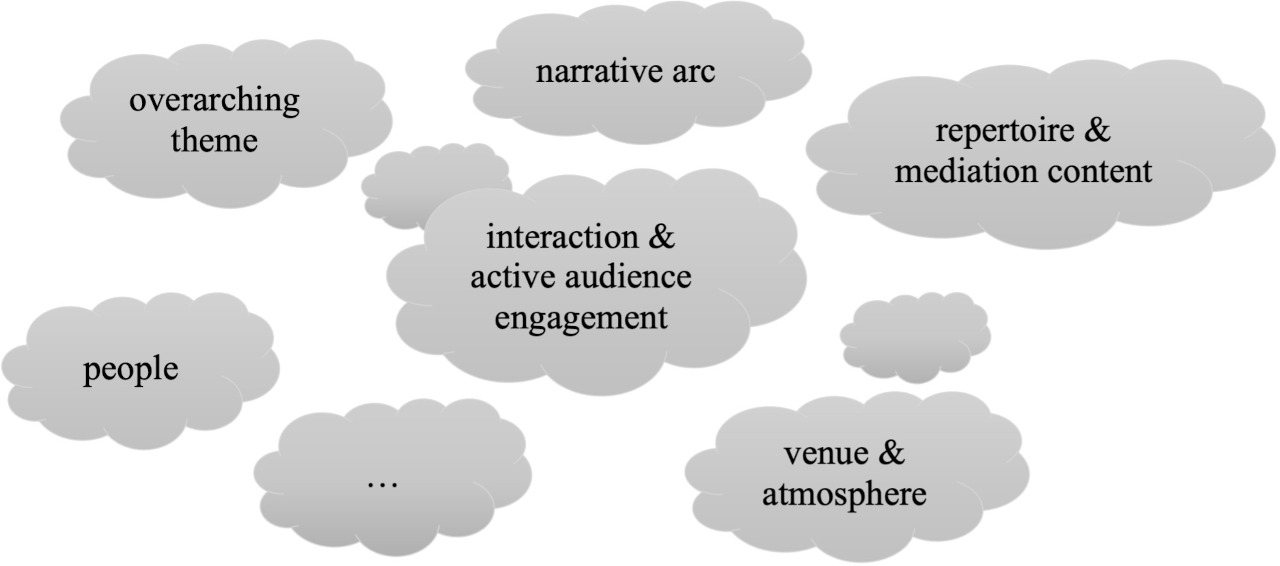
In the following sections, we address each of the six core elements separately. After every three, an excursus will illustrate the three aspects just introduced, with an example from our own work. This is not intended as a best practice showcase; rather, our intention is to draw upon our own experience of designing jazz concerts for children in order to offer insight into our thoughts during the design process. In line with the literature, we consider (self-)critical reflection indispensable – particularly with regard to (hidden) power structures (Stoffers 2023). Therefore, at the end of each excursus on practice we provide examples of the outcomes of our critical reflections.
Barbara Stiller (2008, 127) emphasises the key role of communication and interaction for music mediation in concerts for children. She calls for a multi-layered communicative exchange between stage and audience that creates an awareness for music, fosters sensitivity (ibid., 60) and describes a wide range of interactive possibilities (ibid., 60-63). The European initiative Jazz for Young People recommends seeking “a connection with your audience from the very start” (Europe Jazz Network 2017, 15). “[A] communicative platform and atmosphere must be established. Communication can happen through music, sounds, words, grimaces/mimicry or other ways, but there needs to be a well-functioning channel of communication” (ibid., 6).
The following practice is particularly well-suited to jazz. While repeating an open form – playing variations of a melody or improvising lines – musicians are not confined to a music stand and can move freely around the room, bridging the distance between stage and audience and engaging directly with the children. In such a musical practice, it appears intuitive and uncomplicated to respond to the behavior of individual children – by adjusting dynamics or density, or by playing certain accents or motives.
Some forms of interaction include the active involvement of children in the musical process. “Interaction by means of clapping, dancing, call and response and so on, are often utilised as integrated or improvised activities in concerts for children and young people” (Europe Jazz Network 2017, 14). Following Ernst Klaus Schneider, concerts for young audiences should “actively involve children in a co-creative way” (2011a, 41). That enables self-directed musical learning processes (Stiller 2008, 106) and helps the children to stay attentive: “Young audiences are usually more successful in following the course of a concert when they are musically involved in such an active way that they can perceive and experience themselves as a central part of the presentation” (Stiller 2011, 27).
Given the particular importance of improvisation in most jazz performances (Nettl et al., 2001), and the key role of ensemble interaction within jazz improvisation (Monson 1996), an important question is how to involve children in improvisational processes. The jazz musician and mediator Jörn Marcussen-Wulff claims that “we need to think about how to structure these elements [mainly improvisation and interaction, comment by the authors] so that our target audiences can get to know them independently and autonomously” (Marcussen-Wulff 2022, 42). One possible approach involves enabling children to provide impulses that shape the musicians’ improvisation, e.g. through their movements, the children may influence the mood, energy, dynamics, note length, pitch range, or instrumentation of an ongoing improvisation. A notable example of this is found in the programme Mile(s)tones by the Belgian Zonzo Compagnie (Crête-Reizes 2023). While recounting the life of Miles Davis – not only a seminal figure in the history of jazz, but also an enthusiastic amateur boxer – the performers at one point invited children onto the stage, equipped them with boxing gloves, and had them spar with a punching ball. The child could choose the direction to hit the punching ball toward one of the three musicians, who would then pick up the child’s energy and respond by improvising.
In some of our programmes, we implemented similar forms of conducted improvisation. Depending on the respective storyline, children find magic brushes that ‘paint’ music into the air, for example, or magic dragon hairs, that conjure up music. Children can trace lines or dots, move faster or slower, lower or higher, softly and gently or more expressively, and the musicians follow in their improvisation, translating the children’s movements into music. Renate Reitinger stresses the importance of movement in concerts for children, saying that “active and meaningful listening to music becomes possible primarily through the connection of music and movement” (2011, 165). Alongside the many opportunities she outlines for children to move to the music in concerts (ibid., 164), the situation described in the examples above is rather the inverse – the children’s movements directly affect the music. The children become part of the musical performance and experience the spontaneous improvisational co-creation of music, as it is considered a core component of jazz music. Since most jazz musicians regularly improvise and interact on stage, such elements in a concert for children can naturally resonate with their artistic practice and identity.
Other strategies also exist for enabling children to actively shape jazz performances on stage. Often jazz music is based on relatively short forms, that are repeated indefinitely. Soloists and accompanying instruments take turns for improvisation choruses. In several of our programmes, the children were given the agency to determine who should perform: for example, there is a chair in front of each musician and children can decide by sitting down or standing up, whether a certain band member should join an ongoing jazz tune or pause. An interactive game between the children and the band members starts, and the audience can experience what the different musical layers and instruments of a jazz combo sound like. A similar principle, using carpets, is described by Marika Crête-Reizes (2023) – also as part of the programme Mile(s)tones.
In his book Now’s The Time. Teaching Jazz To All Ages Doug Goodkin (2004) advocates for the integration of the Orff Approach and jazz. He presents numerous possibilities for musical games, the involvement of voice and body, and elementary instrument playing, that are rooted in the jazz tradition. Alongside the Berklee publication Jazz is Elementary (Hanley and Kipp 2022), it can serve as a great resource for preparing audience involvement in jazz concerts for children.
If one wants to encourage children to sing, the call-and-response method is particularly suitable in a jazz context. A repeated riff melody, as it is common in jazz (Robinson 2001), can be sung along on scat syllables or with a text that is adapted to the overarching theme of the concert and the children’s language. Additionally, the Afro-American roots of jazz offer a rich tradition of dancing (Goodkin 2004, 81-86) and rhythmic speech (ibid., 63). Besides body percussion, speech can be perfectly used for rhythmical audience involvement in concerts for children and serves as a vehicle for or a key to jazz rhythms: “Language opens the door to the house of rhythm” (ibid., 49).
When discussing the repertoire to be selected, a fundamental question must first be addressed: Is it not actually inappropriate to play jazz for children, given that it might be perceived as a music for adults (Johansen 2021, 156-157)? Shouldn’t jazz musicians, instead, consider preparing a repertoire specifically designed for a young audience? This is not necessarily the case. Michael Dartsch emphasises that music played for children should be characterised by “a serious and authentic form of expression” (Dartsch 2011, 53). Similarly, the Europe Jazz Network highlights that, in the context of concerts for children, “playing the music they [the musicians, comment by the authors] like and know themselves, is definitely the best way to make things work, rather than trying to play something they think the children would like, or to make things ‘easier’” (Europe Jazz Network 2017, 7). This suggests that rather than turning to a designated ‘children’s repertoire’, jazz musicians should focus on the music they are most familiar with and personally identify with. Complementing this, children in general tend to be open-eared and curious when it comes to new and unfamiliar sounds. They are capable of perceiving even experimental noises and sound gestures with remarkable sensitivity (Stiller 2002, 38).
Moreover, it is helpful to choose musical pieces that are age-appropriate in terms of addressing the intended dialogue group’s attention span (ibid., 37). Jazz proves particularly suitable in this regard due to its predominantly chorus-based and flexible structures. Unlike more predetermined genres, such as classical music, jazz pieces can often be spontaneously and easily adapted in length – by shortening solos or repeating or omitting sections – allowing performers to respond directly to the audience’s level of attention. A further aspect is the level of difficulty of the tunes. For instance, when preparation time is limited, it may be advisable to select songs with a reduced harmonic or structural form, but to perform them by heart. As outlined above, this allows for spontaneous interaction and a more direct engagement with the audience. Because of the complexity jazz solos can unfold in the moment, the musical material can be kept simple (e.g., a blues), without falling into what Holger Noltze provocatively called the Leichtigkeitslüge (2010), the trap of shallow reductionism. The significance of playing without sheet music is also emphasised by Small, who warns that scores may reinforce hierarchical structures (composer ⇒ performer ⇒ audience) and sees music stands as potential barriers to relationship and communication (Small 1998, 115; Müller-Brozović 2024, 150).
In addition to the repertoire, our respective thought cloud includes what we refer to as mediation content. This term refers to considerations about content that either arises directly from the selected musical repertoire or influences the choice of specific pieces. Christoph Richter proposes to design concerts for children by “starting from the music” (Richter 2002). “Concerts for children [...] serve [...] to help them become familiar with the presented music [...], its structure, its form and design, and the ways it can affect people” (ibid., 91). Following this thought, it is necessary to think about and choose the core aspects of a certain music that are to be given importance in the mediation process. Concrete examples will be provided in a later section.
The thought cloud overarching theme represents a central idea, an initial concept, or a foundational thought that guides the design of a concert. The design and development of a concert for children may originate from a wide range of thematic starting points (Schneider 2011a, 36-39). These overarching themes can take many forms – including references to fixed dates and holidays in the annual calendar, books and stories, a dramaturgical idea (e.g. time travel), particular artists and their biographies, the broader concert context, a specific composition, or certain musical parameters (Stiller 2002, 37-38). These overarching themes can serve as a foundation for further dramaturgical considerations and repertoire selection, though they may also emerge from those very processes. In turn, aspects such as performance venues, participating artists, or ideas for audience interaction may shape or influence the overarching theme.
The various thought clouds presented in Figure 1 often influence one another, making it difficult – if not impossible – to identify a single point of origin. Even if the idea of an overarching theme remains somewhat vague, it can still prove highly valuable in practice.
Existing jazz concerts for children, for example, address different aspects of the history of jazz music, certain musical components of jazz, like blues, swing, and improvisation, or socio-political issues, such as the role of jazz in the Civil Rights Movement (Jazz at Lincoln Center, n.d.). They portray important personalities of the jazz tradition (Crête-Reizes 2023; Zonzo Compagnie, n.d.), or they relate jazz to an appealing theme of the children’s world, like the world of circus (NUEJAZZ for Kids, n.d.-a).
Overarching themes can serve as a foundation for further dramaturgical considerations and repertoire selection, though they may also emerge from those very processes. In turn, aspects such as performance venues, participating artists, or ideas for audience interaction may shape or influence the overarching theme. The various thought clouds often influence one another, making it difficult – if not impossible – to identify a single point of origin. Even if the idea of an overarching theme remains somewhat vague, it can still prove highly valuable in practice.
Below, Julian Schunter will describe and reflect on his personal experience in developing a concert for children between 6 and 10 years. The subsequent section accordingly adopts a first-person perspective.
Originally, the programme Big Band! was commissioned by the festival Ingolstädter Jazztage in 2022, later we also played it with the student jazz orchestra at my university, opening the symposium Wege zum Jazz in Klagenfurt in 2024, which provided the impetus for this jazz issue of the International Journal of Music Mediation. Besides the big band, two actors participated, functioning as mediators between the musicians and the audience.
In the following, I will present this programme as an example of the first three thought clouds discussed in the text. As the big band format was decided in consultation with the festival, I took the topic big band as an overarching theme. The idea was for the children to discover the different instruments, typical tunes and the various musical components of big band music together with the actors. My task – following Richter, by starting “from the music” and engaging with that music “intensively and imaginatively” (Richter 2002, 92) – was to think about important elements of big band music and engagement opportunities for children. The choice of repertoire & mediation content, and the possibilities for interaction & active audience engagement influenced each other in the process of programme design.
What first came to my mind was the sectional structure of a big band and the typical call-and-response interplay between the different sections. I chose the famous piece Splanky, composed by Neal Hefti for the Count Basie Big Band, as a clear example of this arrangement technique. After a short introduction by piano and bass, the brass section commences with a riff-like melody. In the second chorus, the saxophone section joins in, answering the brass by repeating various fragments of the riff. I highlighted this section-based buildup by having the musicians enter the stage in groups, according to their sections: Two actors discover and lift a sign with a painted rhythm section on it, prompting instruments of that section to start playing. When they lift a sign with a trumpet on it, the brass section appears from behind the audience, walks through the crowd while playing, and comes onto the stage. The saxophone section follows in the same manner. Section solos by the trumpets, trombones, and saxophones further introduce the individual instrument groups.
Later in the piece, the idea of sections beginning to play when their respective sign is lifted is transferred to the children: they are invited onto the stage and can decide when their section should play or pause. This provides the children with an experience of musical agency and enables the audience to clearly perceive the multi-layered structure of the arrangement, as well as the effect of cueing individual instrument groups in and out.
As a further aspect, I wanted to illustrate the possibilities of tempo within a big band context, for which it seemed helpful to choose a very fast tune. I chose the classic Jumping at the Woodside composed by Count Basie and his band, as it perfectly demonstrates the possibly fast-paced character of swing music and the essential role of the rhythm section in maintaining this tempo. Conducted by one of the actors, the characteristic bass motive of the tune starts slowly, gradually speeding up according to the arm’s movements. In the following, several children get the chance to conduct the rhythm section, determining the tempo themselves.
Furthermore, I chose the piece Sing, Sing, Sing by Louis Prima, because of its driving drum groove. The instantly recognizable tom-tom pattern and the extended drum solo passages are ideal to involve the children on the level of rhythm. After alternated soloing between the drums and the two actors playing on their body, the audience is animated to respond to the drums by wild collective body percussion passages – to trade with alternating short solos is a typical jazz practice (Grove Music Online 2003). Later, the actors divide the audience into two parts to advance the principle of alternated soloing to another level. This playful interaction gives the children first-hand experience of the physicality and vitality of drum soloing. At one moment, the drummer also walks through the audience, playing the groove with his sticks on the floor and on different objects in the room, establishing another form of interaction and closeness.
An additional tune I chose was Duke Ellington’s C-Jam Blues, a piece built on a simple, but swinging, riff-like melody. During the show, the children themselves build kazoo instruments using an empty toilet roll with a little hole in it, a piece of baking paper and a rubber ring. With those they can play along with the melody, experiencing playing an instrument with collective timing as part of a big band. Later they can also join a melodic improvisation over the blues form.
Short critical reflection: Reflecting on the programme Big Band!, I find myself questioning the image of jazz that we present. Jazz is a vibrant and constantly evolving musical form. Some people argue that “the essence of Jazz is the process of change itself” (DeVeaux 1991, 528). Is it appropriate, then, to portray jazz primarily as orchestral music from a bygone era? Might there be a risk of becoming entrenched in the preservation of tradition, rather than fostering contemporary approaches to jazz and improvisation? Or is it perhaps legitimate for different formats of jazz mediation to pursue diverse directions in this regard?
Another critical issue concerns cultural appropriation, which inevitably arises when presenting a genre like jazz, rooted in African-American musical traditions. I selected the tune Sing, Sing, Sing for musical reasons: its rhythmic energy seemed ideal for inspiring children. However, the piece was composed by Louis Prima, a white musician, and popularised by Benny Goodman – also white – whose (white) orchestra was promoted within a predominantly white music industry. At the same time, Goodman actively challenged racial segregation, notably by including two African-American musicians in his quartet, despite conservative resistance (Benz, 2014). How can the complexity of such historical figures be navigated when curating jazz concerts for children?
Following this practical excursion, we will now turn to the three remaining thought clouds, starting with the creation of a narrative arc. “A concert for children needs a dramatic arc that keeps both the children and the grown-ups engaged from start to finish” (Stiller 2002, 39). With a storyline connecting one piece of music to the other, it is much easier for children to keep focus. Theatrical elements can help them to relate the concert to everyday experiences (Schneider 2011a, 43).
Existing jazz programmes for children display a wide range of interdisciplinary possibilities to tell stories. For example, they use a costumed animal character as an identification figure (Busch and Rizzi 2022, 13), hand puppets (Theater Mummpitz, n.d.), live painting (Europe Jazz Network, n.d.-a; NUEJAZZ for Kids, n.d.-b), shadow play (NUEJAZZ for Kids, n.d.-c) or video screening (Europe Jazz Network n.d.-b). Schneider presents multiple options for visual design in concerts for children (Schneider 2011b).
Drawing on the standard practice of jazz concerts, jazz musicians are often not used to telling a story on stage. In this context, it can be useful to collaborate with professionals from other disciplines, especially from the field of theatre – “one should consider engaging dramaturgs, theatre directors and/or stage designers” (Europe Jazz Network 2017, 5). From our practical experience, working with actors, dramaturgs, and/or directors has been highly beneficial – not only with regard to the active performance of actors and the creation of a coherent dramaturgy, but also for developing and reflecting on the stage presence of the musicians involved. Even if the musicians on stage are not dramatically involved – whether through acting or speaking – and are simply waiting for their next musical entry, it is crucial that they visibly remain engaged with the ongoing process. This attentiveness helps maintain the audience’s focus on the unfolding action and minimises potential distractions.
Christopher Small opens up a broad understanding of the people involved in a musical performance. At some point, he even goes so far as to include cleaners, roadies, and ticket collectors (Small 1998, 9). However, such a broad perspective goes beyond the scope of this article; therefore, the focus here is limited to the audience as dialogue group and to the performers on stage.
In recent years, the term “dialogue group” has increasingly replaced the more traditional “target group.” In line with the focus of this article, this terminology highlights the importance of exchange and interaction between the performers on stage and the audience (Stibi 2023, 361).
When designing jazz concerts for children, dialogue groups should be considered with regard to factors such as age, education, gender, and cultural background (ibid.). Stiller (2002, 43-48) distinguishes and characterises five age-related categories of children attending concerts: infants and parents, pre-school children, primary school children, older pupils, and teenagers. Adapting musical content, modes of address, forms of interaction and active involvement, as well as concert dramaturgy, to suit each age group represents a central challenge for music mediators. A significant need for development exists regarding concert and mediation offerings for children and adolescents from secondary school level onwards (ibid., 47-48). Particular challenges are associated with this age group: children are generally less open-eared and open-minded toward unfamiliar music than in primary school, music preferences take on a stronger role in identity formation, and differences in educational and musical backgrounds become increasingly apparent (Hornberger 2015, 263). This is precisely where jazz may hold special potential again. As a musical “melting pot” (Schunter 2022), jazz naturally has the capability to integrate diverse musical styles and traditions. It offers the opportunity to recognise, encounter and/or integrate popular youth culture as a legitimate and equal form of artistic expression, without reinforcing hierarchical distinctions between so-called high and low culture. Instead, it fosters a space in which artistic engagement can occur on equal footing.
The term performer in the context of jazz concerts for children is broad, encompassing musicians, narrators, actors, artists from other disciplines, and mediators. Owing to the considerably less institutionalised nature of jazz compared to classical music, these roles frequently overlap and are often embodied by the same individuals. Performers in such settings thus assume multiple functions: they are not only instrumentalists or vocalists, but also storytellers, moderators, actors, and even organisers. Their ability to communicate effectively and respond sensitively to the audience is as crucial as their musical expertise. In this context, Barbara Balba Weber (2018, 7) introduces the concept of “artistic music mediation”, and argues that “the best mediation approaches often result from a pleasurable transgression of professional boundaries” (ibid., 124).
In contrast to the caution previously outlined in this text regarding the concern that interaction with the audience may distract from the artistic focus (Brand et al. 2012, 640), jazz mediation for children may benefit precisely from performers’ capacity to relinquish a fixed “grip on their performance” (ibid.) and instead embrace the dialogical nature of live interaction and active audience participation.
The last thought cloud explored in this article focuses on the significance of venue and atmosphere in the context of jazz concerts for children. As the medium in which sound is initially created and becomes perceptible, the performance venue is always, to some extent, in interaction with the musicians and the audience (Müller 2017, 170). Music mediators in jazz should carefully consider the spatial design and situational use of the venue in advance. Drawing on Stiller et al. (2002), relevant aspects include acoustics, lighting, seating arrangements, stage design, locations of action, decoration, sound technology and the (potential absence of a clear) separation between stage and audience. According to Weber (2018, 34), music mediators should also consider moving beyond the stage, integrating spaces such as side rooms, foyers, or even public areas into the musical experience.
Atmosphere4, as a concert-related concept, requires a broad definition. It is shaped not only by the spatial conditions of the venue discussed above, but also by “music, performance, [...], objects, arrangements or people and also the individual perception at the concert” (Wild 2025, 231).
To illustrate the above-described thought clouds narrative arc, people involved, and venue & atmosphere, I present the project Clazzroom – Jazz im Klassenzimmer [Jazz in the Classroom] as a practical example. I developed this concert as part of the Ingolstädter Jazztage in 2023.
The starting point for my considerations was the set of framework conditions specified by the organiser:
Concert length: 45 minutes.
Three performances, each for a 5th-grade class of approximately 10 to 11-year-old students from a secondary school (Mittelschule) located in a multicultural, and socially challenging district of Ingolstadt.
Performers: Jazz quintet consisting of five male musicians (saxophone, trumpet, piano, bass, drums), including myself on saxophone. I also served as mediator and narrator.
Performance venue: music room at school (basement, no stage, chairs, densely arranged).
Based on these fixed parameters regarding the people involved and the venue, I developed the central idea – the overarching theme – of transforming the everyday music room into a jazz club (which in Germany is also often located in basements) and thus creating a corresponding atmosphere (including music, people, objects, performance, room).
Following this concept, I designed the narrative arc of the concert, which I will now describe and unfold step by step and in its situational order:
Preparation: First, the room was arranged so that all chairs faced the setup of the instruments. I also installed a mobile stage lighting system, though it remained off and initially hidden. The room was brightly lit with the overhead lights on, which remained characteristic of a conventional school environment.
Entrance and opening: The musicians were already at their instruments when the children entered the classroom. Once everyone was seated, I brought out a large box labeled “JAZZ”, stocked with various items essential for later creating the jazz club atmosphere. Setting the box down acted as the cue for the opening piece – a blues – over whose intro I welcomed the students and the band.
Introduction to jazz: I then introduced the children (most of whom had never heard of jazz before, with just one exception) to the genre and the term jazz, highlighting its historical and cultural roots as Black Music. To connect with this theme, we played Nat Adderley’s Work Song.
Transformation of venue: After the song, we transformed the classroom into a jazz club, both visually and atmospherically. Together with the students, we darkened the room using curtains, turned on the pre-installed lighting setup in shades of blue, green, and white, and added typical club sounds – clinking glasses and the rattle of a cocktail shaker. We also hung a picture of a jazz legend on the wall – Miles Davis, in this case. The lighting change in particular had a strong, attention-grabbing impact on the students and instantly shifted the atmosphere in the room.
Active engagement: To involve the children more actively, we handed out shaker eggs and created the sound of a sandy beach. Then we used foot conducting – led by different pupils – to make footprints in this imaginary sand. Finally, we sang the phrase “Fußspur’n im Sand” [Footprints in the Sand] to the iconic bassline of Wayne Shorter’s Footprints.
Audience interaction and stank faces: Back in a more receptive setting, we introduced typical forms of audience interaction found in jazz concerts, such as solo applause, call-outs during solos, and especially stank faces – facial expressions of appreciation for musically surprising, exciting, or groovy moments. In this context, the focus was particularly on stank faces, which often look like the person is reacting with a kind of exaggerated disgust, similar to the facial expression of someone encountering a strong, unpleasant odor. I illustrated the concept with pictures of well-known stars from various fields, including jazz musicians like John Coltrane, pop icons such as Beyoncé, and even sports figures like Cristiano Ronaldo. With the children, we practiced making stank faces and using them to react to live music, which helped sharpen their perception as they attentively listened for surprising musical moments that would prompt such reactions.
Connecting with students’ (assumed) listening habits: To conclude, we used the stylistically inclusive and transcultural potential of jazz to possibly connect with the students’ presumed listening experiences. For example, we linked In a Sentimental Mood in the Coltrane/Ellington version with Mac Miller’s track Diablo, which heavily samples this very recording. We also performed an original composition by our pianist that incorporated elements of techno. During this final piece, the children were encouraged and guided to join in singing in a call-and-response style, as well as providing accompanying vocals.
Building on the core idea of my concept, we gradually created the musical, spatial, and personal atmosphere of a concert in a jazz club. The children were actively engaged, interacted with the musicians on stage, and had the opportunity to discover connections between jazz and music that might be more familiar to them. They participated in various ways – for example, by singing, conducting, playing instruments, and using body percussion – and responded directly to the music through movement, facial expressions, and spontaneous interaction. Since the dialogue groups in these concerts consisted of older pupils, I chose to forgo overly childlike storytelling and instead focused on collaboratively developing an atmosphere that could be experienced as a kind of narrative.
Short critical reflection: In my critical reflection on the concept of Clazzroom – Jazz im Klassenzimmer, I identified two main aspects that offer considerable potential for additional refinement. The first point of critique concerns my hasty assumption that highlighting the connections between jazz and hip-hop or techno would allow me to tap into the students’ listening habits. A systematic survey of the students prior to the concert – conducted, for instance, by the music teacher – could have enhanced clarity at this point. However, the idea of ‘meeting students where they are’ is problematic not only because it presumes to know the students’ perspectives in advance (Noltze 2010, 222). More importantly, this approach implies a power imbalance: between mediator and student, as well as between so-called high culture and popular culture. In this logic, students are ‘met’ in their (presumed) musical culture (e.g. hip-hop) only to be guided toward the ‘right’ kind of music (e.g. jazz). In this way, their own culture is not genuinely acknowledged and valued (Hornberger 2015, 267). A second point of critique concerns the exclusively male line-up, and the resulting absence of female role models, an issue explicitly raised by a female student during the very first concert. Although the majority of the musicians had been predetermined by the organiser, there nonetheless would have remained scope to increase the visibility of female jazz musicians. In the subsequent project the following year, I was able to expand the given ensemble by including a female trombonist. Furthermore, given that the gender ratio continued to be markedly imbalanced, I opted to focus the musical selection on compositions exclusively by female artists.
With this article we want to contribute to strengthening a practical and academic engagement with music mediation in jazz. We hope to have conveyed an impression of the rich possibilities and opportunities of creating jazz concerts for children, as well as the diverse approaches and conceptual frameworks that accompany such concerts. The six thought clouds which we provided address only a limited selection of the potentially relevant issues, but they may help as a starting point for those who want to approach the topic and/or design their own jazz concert for children.
There is a wealth of knowledge in the field of music mediation which jazz musicians can draw upon in order to make their music more accessible to children. Furthermore, Elemental Music Pedagogy offers a wide range of helpful ideas and methodical tools. At the same time, jazz, with its emphasis on improvisation and interaction, has an especially high potential for concerts for children.
In order to further explore and make use of this potential, aspects of music meditation should be integrated into higher education jazz curricula. Two contributions in this issue of the journal present models for such an implementation (Schwarz 2025; Holzapfel and Spiegel 2025). We consider the collaboration between the Departments of Jazz and those of Music Mediation and Music Education, including Elemental Music Pedagogy, to be particularly fruitful in this context. To help overcome possible boundaries, we – as jazz musicians and mediators working in the Department of Music Education at the Gustav Mahler Private University of Music in Klagenfurt – regularly invite colleagues from the Jazz Department and their students to participate in jazz mediation projects.
To further develop our proposed model and strengthen its academic foundation beyond literature review and the reflection of personal experience, conducting empirical research would be valuable. One possible direction could involve a comparative approach aimed at assessing the transferability of our thought cloud model to existing or newly emerging concepts and the conception processes of others. Pertinent questions might include: Do further essential aspects of conception crystallise? How do the various elements relate to one another? A multi-case study could moreover lead to the construction of typologies of the processes or the results of the development of jazz concerts for children.
German quotations have been translated by the authors.↩︎
This aspect will be taken up again in the section “People Involved”.↩︎
A short compilation of different scenes gives an impression of the described programme: youtube.com/watch?v=n90nsdp2Nu8 (accessed October 23, 2025).↩︎
Cornelia Wild (2025) has recently presented a nuanced and in-depth exploration of the concept of atmosphere within the field of music mediation.↩︎
Benz, Valerio. 2014. “Benny Goodman überwand nicht nur musikalische Grenzen.” Accessed October 6, 2025. srf.ch/kultur/musik/musik-benny-goodman-ueberwand-nicht-nur-musikalische-grenzen.
Brand, Gail, John Sloboda, Ben Saul, and Martin Hathaway. 2012. “The reciprocal relationship between jazz musicians and audiences in live performances: A pilot qualitative study.” Psychology of Music 40, no. 5 (September): 634-651. DOI: 10.1177/0305735612448509.
Busch, Thomas, and Anna Rizzi. 2022. “Martin – die Jazzratte: Jazzvermittlung in der Grundschule.” musikunterricht aktuell, no. 15 (Mai): 13.
Crête-Reizes, Marika. 2023. “LIVING MILES DAVIS: When musical interaction and participation are at the heart of a young audience’s experience.” In A JOYFUL REVOLUTION: Creating adventurous music projects for young audiences, 69-89. Accessed May 31, 2025. ec.europa.eu/programmes/creative-europe/project-result-content/b1e7a64f-e118-4f8b-905c-1954e9f39755/BIG_BANG_PUBLICATION.pdf.
Dartsch, Michael. 2011. “Überlegungen zur Legitimation und Qualität von Konzerten für Kinder.” In Hörräume öffnen – Spielräume gestalten: Konzerte für Kinder, edited by Ernst Klaus Schneider, Barbara Stiller, and Constanze Wimmer, 49-56. Regensburg: ConBrio.
DeVeaux, Scott. 1991. “Constructing the Jazz Tradition: Jazz Historiography.” Black American Literature Forum 25, no. 3 (Autumn): 525-560. DOI: 10.2307/3041812.
Dorn, Frank. 2018. Jazz als Prozess: Ästhetische und performative Dimensionen in musikpädagogischer Perspektive. Hildesheim: Georg Olms.
Europe Jazz Network. 2017. “Producing, promoting and presenting jazz concerts for young people: Tips & Tricks.” Accessed May 31, 2025. europejazz.net/sites/default/files/JFYP_Handbook_2017.pdf.
Europe Jazz Network. n.d.-a. “MONSTERJAZZ.” Accessed May 31, 2025. europejazz.net/monsterjazz.
Europe Jazz Network. n.d.-b. “JAZZOO BY ODDJOB.” Accessed May 31, 2025. europejazz.net/jazzoo-oddjob.
Feige, Daniel Martin. 2014. Philosophie des Jazz. Berlin: Suhrkamp.
Givan, Benjamin. 2016. “Rethinking Interaction in Jazz Improvisation.” Music Theory Online 22, no. 3 (September): 1-24.
Goodkin, Doug. 2004. Now’s the Time: Teaching Jazz to All Ages. San Francisco: Pentatonic Press.
Grove Music Online. 2003. “Trade.” Grove Music Online. Accessed May 31, 2025. oxfordmusiconline.com/grovemusic/view/10.1093/gmo/9781561592630.001.0001/omo-9781561592630-e-2000454300.
Hanley, Darla S., and Allison P. Kipp. 2022. Jazz is Elementary. Boston: Berklee Press.
Holzapfel, Benjamin, and Hans-Georg Spiegel. 2025. “Jazz Mediation at Elbphilharmonie.” International Journal of Music Mediation 2, no. 2. DOI: 10.71228/ijmm.2025.34.
Hornberger, Barbara. 2015. “Einschließen, ausschließen: Eine Skizze zur Vermittlung populärer Musik vor dem Hintergrund von Honneths Konzept von Anerkennung.” In Popmusik-Vermittlung: Zwischen Schule, Universität und Beruf, edited by Michael Ahlers, 257-275. Berlin: LIT.
Jazz at Lincoln Center. n.d. “Let Freedom Swing.” Accessed May 31, 2025. jazz.org/education/school-programs/let-freedom-swing/.
Johansen, Guro Gravem. 2021. Children’s Guided Participation in Jazz Improvisation. London, New York: Routledge.
Kaden, Christian. 1993. Des Lebens wilder Kreis: Musik im Zivilisationsprozeß. Kassel: Bärenreiter.
Kernfeld, Barry. 2003. “Call and response.” Grove Music Online. Accessed May 31, 2025. DOI: 10.1093/gmo/9781561592630.article.J072500.
Marcussen-Wulff, Jörn. 2022. “Jazzcape oder die Frage nach einer zeitgemäßen Jazz-Musikvermittlung.” In Die Jazzpilot*innen: Jazzvermittlung und Demokratieförderung, edited by Bundeszentrale für politische Bildung/Deutsche Jazzunion, 40-43. Berlin: Deutsche Jazzunion e.V.
Monson, Ingrid. 1996. Saying Something: Jazz Improvisation and Interaction. Chicago, London: The University of Chicago Press.
Müller, Christian. 2017. Doing Jazz: Zur Konstitution einer kulturellen Praxis. Weilerswist: Velbrück Wissenschaft.
Müller-Brozović, Irena. 2024. Das Konzert als Resonanzraum: Resonanzaffine Musikvermittlung durch intensives Erleben und Involviertsein. Bielefeld: transcript.
Nettl, Bruno, Rob C. Wegman, Imogene Horsley, Michael Collins, Stewart A. Carter, Greer Garden, Robert E. Seletsky, Robert D. Levin, Will Crutchfield, John Rink, Paul Griffiths, and Barry Kernfeld. 2001. “Improvisation.” Grove Music Online. Accessed May 31, 2025. oxfordmusiconline.com/grovemusic/view/10.1093/gmo/9781561592630.001.0001/omo-9781561592630-e-0000013738.
Noltze, Holger. 2010. Die Leichtigkeitslüge: Über Musik, Medien und Komplexität. Hamburg: edition Körber-Stiftung.
NUEJAZZ for Kids. n.d.-a. “Zirkus Jazzino.” Accessed May 31, 2025. nuejazzforkids.de/programme/zirkus-jazzino.
NUEJAZZ for Kids. n.d.-b. “Musikalische Bildergeschichten.” Accessed May 31, 2025. nuejazzforkids.de/programme/musikalische-bildergeschichten.
NUEJAZZ for Kids. n.d.-c. “JAZZ & PAPIER.” Accessed May 31, 2025. nuejazzforkids.de/programme/jazz-papier.
Pfleiderer, Martin. 2018. “Improvisieren als performative Musikpraxis: Zugänge und Forschungsperspektiven.” In Pop weiter denken: Neue Anstöße aus Jazz Studies, Philosophie, Musiktheorie und Geschichte, edited by Ralf von Appen and André Doehring, 11-29. Bielefeld: transcript.
Reitinger, Renate. 2011. “Mit dem Körper hören: Aspekte der Bewegung in der Musikvermittlung.” In Hörräume öffnen – Spielräume gestalten: Konzerte für Kinder, edited by Ernst Klaus Schneider, Barbara Stiller, and Constanze Wimmer, 159-166. Regensburg: ConBrio.
Richter, Christoph. 2002. “Das Orchester tanzt: Anmerkungen zur Vorbereitung für Kinder- und Moderationskonzerte von der Musik aus.” In Spielräume Musikvermittlung: Konzerte für Kinder, edited by Barbara Stiller, Constanze Wimmer, and Ernst Klaus Schneider, 91-113. Regensburg: ConBrio.
Robinson, J. Bradford. 2001. “Riff.” Grove Music Online. Accessed May 31, 2025. oxfordmusiconline.com/grovemusic/view/10.1093/gmo/9781561592630.001.0001/omo-9781561592630-e-0000023453.
Schneider, Ernst Klaus. 2011a. “Wege und Formen der Musikvermittlung in Konzerten für Kinder.” In Hörräume öffnen – Spielräume gestalten: Konzerte für Kinder, edited by Ernst Klaus Schneider, Barbara Stiller, and Constanze Wimmer, 35-47. Regensburg: ConBrio.
Schneider, Ernst Klaus. 2011b. “Das Visuelle als Erfahrungsfeld im Konzert.” In Hörräume öffnen – Spielräume gestalten: Konzerte für Kinder, edited by Ernst Klaus Schneider, Barbara Stiller, and Constanze Wimmer, 117-131. Regensburg: ConBrio.
Schunter, Julian. 2022. “Jazz als Melting Pot: Überlegungen zum Konzept der Transkulturalität in der Jazzpädagogik.” In Die Jazzpilot*innen: Jazzvermittlung und Demokratieförderung, edited by Bundeszentrale für politische Bildung/Deutsche Jazzunion, 36-39. Berlin: Deutsche Jazzunion e.V.
Schwarz, Ulrike. 2025. “Jump into Jazz: Jazz Mediation and Jazz Education in Higher Music Education and Elementary Schools.” International Journal of Music Mediation 2, no. 2. DOI: 10.71228/ijmm.2025.37.
Small, Christopher. 1998. Musicking: The Meanings of Performing and Listening. Middletown: Wesleyan University Press.
Stibi, Sonja. 2023. “Konzerte für bestimmte Dialoggruppen.” In Handbuch Musikvermittlung: Studium, Lehre, Berufspraxis, edited by Axel Petri-Preis and Johannes Voit, 361-368. Bielefeld: transcript.
Stiller, Barbara. 2002. “Inhalte und Dramaturgie: Kriterien einer altersgerechten Planung für verschiedene Zielgruppen.” In Spielräume Musikvermittlung: Konzerte für Kinder, edited by Barbara Stiller, Constanze Wimmer, and Ernst Klaus Schneider, 35-49. Regensburg: ConBrio.
Stiller, Barbara, Constanze Wimmer, and Ernst Klaus Schneider. 2002. “Glossar. ABC eines gelungenen Konzertes für Kinder.” In Spielräume Musikvermittlung: Konzerte für Kinder, edited by Barbara Stiller, Constanze Wimmer, and Ernst Klaus Schneider, 332-344. Regensburg: ConBrio.
Stiller, Barbara. 2008. Erlebnisraum Konzert: Prozesse der Musikvermittlung in Konzerten für Kinder. Regensburg: ConBrio.
Stiller, Barbara. 2011. “Konzertpädagogik im deutschsprachigen Raum. Konzeptionelle Überlegungen zur aktuellen Situation.” In Hörräume öffnen – Spielräume gestalten. Konzerte für Kinder, edited by Ernst Klaus Schneider, Barbara Stiller, and Constanze Wimmer, 21-34. Regensburg: ConBrio.
Stoffers, Nina. 2023. “Machtkritische Perspektiven auf Musikvermittlung.” In Handbuch Musikvermittlung - Studium, Lehre, Berufspraxis, edited by Axel Petri-Preis and Johannes Voit, 107-114. Bielefeld: transcript.
Theater Mummpitz. n.d. “Jazz für Kinder.” Accessed May 31, 2025. youtube.com/playlist?list=PLfsrHUY2TKwJWl2geuIcYZFpGpZiLBCi5.
Tucker, Mark, and Travis A. Jackson. 2020. “Jazz.” Grove Music Online. Accessed May 31, 2025. oxfordmusiconline.com/grovemusic/view/10.1093/gmo/
9781561592630.001.0001/omo-9781561592630-e-90000358106.
Weber, Barbara Balba. 2018. Entfesselte Klassik: Grenzen öffnen mit künstlerischer Musikvermittlung. Bern: Stämpfli.
Wild, Cornelia. 2025. Atmosphäre komponieren: Spüren und Erleben in neuen Konzertformaten. Bielefeld: transcript.
Zonzo Compagnie. n.d. “Thelonious.” Accessed May 31, 2025. zonzocompagnie.be/en/production/thelonious.
Julian Schunter is Professor of Instrumental and Vocal Pedagogy at the Gustav Mahler Private University of Music in Klagenfurt, Austria. He studied jazz saxophone and music education (M.Mus.) and has held teaching positions at the universities of music in Nuremberg and Dresden. His doctoral research (Dr. phil.), supervised by Wolfgang Lessing, explored jazz in German secondary school band classes through a qualitative interview study. Schunter regularly develops interactive jazz concerts for children and performs with internationally acclaimed ensembles such as the Monika Roscher Bigband. His academic interests focus on jazz education and instrumental pedagogy. He is currently serving as guest editor for the jazz-themed issue of the International Journal of Music Mediation.
Martin Krechlak (M.Mus., M.A.) is a jazz musician, music educator, and music mediator based in Augsburg. He develops innovative concert concepts and formats in the field of jazz mediation (e.g., for the Ingolstädter Jazztage), contributes to various children’s concert programmes, and regularly leads workshops for young audiences on topics such as music-making with apps and collective composition. Additionally, he is currently working as a project assistant at the Gustav Mahler Private University of Music in Klagenfurt. Krechlak studied jazz saxophone in Munich and Nuremberg as well as music mediation/concert education at the University of Augsburg. In 2019, he received the Bavarian Culture Award.
ISSN 2943-6109 – Volume 2/2 (2025) – DOI: 10.71228/ijmm.2025.39
This paper is published under a Creative Commons Attribution 4.0 International License. Parts of an article may be published under a different license. If this is the case, these parts are clearly marked as such.
